

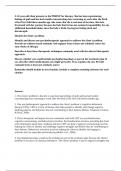
A 32-year-old client presents to the PMHNP for therapy. She has been experiencing
feelings of guilt and has had trouble concentrating since returning to work after the birth
of her first child three months ago. She states that she is sad most of the time. She feels
frustrated with her partner because she feels that he has not assumed responsibility for any
additional household duties since the baby's birth, leaving her feeling tired and
discouraged.
Identify the client's problem.
Identify and discuss one psychotherapeutic approach to address the client's problem.
Provide an evidence-based rationale with support from at least one scholarly source for
your choice of therapy.
Describe at least three therapeutic techniques commonly used with the selected therapeutic
approach.
Discuss whether you would include psychopharmacology as part of the treatment plan. If
yes, describe which medication(s) you might prescribe. If no, explain why not. Provide
rationale from at least one scholarly source.
Rationales should include in-text citations. Include a complete matching reference for each
citation
Answer:
1. The client's problem is that she is experiencing feelings of guilt and has had trouble
concentrating since returning to work after the birth of her first child three months ago.
2. One psychotherapeutic approach to address the client's problem is cognitive-behavioral
therapy (CBT). CBT is a form of therapy that helps people to identify and change negative
thinking patterns and behaviors that are contributing to their distress (Butler, Chapman, Forman,
& Beck, 2006).
3. Three therapeutic techniques that are commonly used with CBT are psychoeducation,
cognitive restructuring, and behavioral activation. Psychoeducation involves providing the client
with information about their condition and how CBT can help. Cognitive restructuring involves
helping the client to identify and challenge negative thoughts and beliefs that are contributing to
their distress. Behavioral activation involves helping the client to identify and engage in
activities that are enjoyable and satisfying (Butler et al., 2006).
4. Psychopharmacology would not be included as part of the treatment plan because the client's
problem is not due to a chemical imbalance. The client's problem is due to negative thoughts and
feelings of guilt and has had trouble concentrating since returning to work after the birth
of her first child three months ago. She states that she is sad most of the time. She feels
frustrated with her partner because she feels that he has not assumed responsibility for any
additional household duties since the baby's birth, leaving her feeling tired and
discouraged.
Identify the client's problem.
Identify and discuss one psychotherapeutic approach to address the client's problem.
Provide an evidence-based rationale with support from at least one scholarly source for
your choice of therapy.
Describe at least three therapeutic techniques commonly used with the selected therapeutic
approach.
Discuss whether you would include psychopharmacology as part of the treatment plan. If
yes, describe which medication(s) you might prescribe. If no, explain why not. Provide
rationale from at least one scholarly source.
Rationales should include in-text citations. Include a complete matching reference for each
citation
Answer:
1. The client's problem is that she is experiencing feelings of guilt and has had trouble
concentrating since returning to work after the birth of her first child three months ago.
2. One psychotherapeutic approach to address the client's problem is cognitive-behavioral
therapy (CBT). CBT is a form of therapy that helps people to identify and change negative
thinking patterns and behaviors that are contributing to their distress (Butler, Chapman, Forman,
& Beck, 2006).
3. Three therapeutic techniques that are commonly used with CBT are psychoeducation,
cognitive restructuring, and behavioral activation. Psychoeducation involves providing the client
with information about their condition and how CBT can help. Cognitive restructuring involves
helping the client to identify and challenge negative thoughts and beliefs that are contributing to
their distress. Behavioral activation involves helping the client to identify and engage in
activities that are enjoyable and satisfying (Butler et al., 2006).
4. Psychopharmacology would not be included as part of the treatment plan because the client's
problem is not due to a chemical imbalance. The client's problem is due to negative thoughts and


