Table - 1
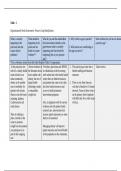
Organizational Needs Assessment: Practice Gap Identification
What is currently What should be What do you and the stakeholders 1. Why is there a gap in practice? What evidence do you have to demon
happening in the happening in the (decision-makers) identify as the a practice gap ?
practicum site that practicum site gap between what is currently 2. What factors are contributing to
causes clinical based on current happening and what should be the gap in practice?
problems? evidence*? happening (this is your practice
gap)?
*Use a reference citation from the Johns Hopkins Table 2 if appropriate.
At the practicum site Recent evidence in Providers, physicians and APRNS, 1. The practice gap exists due to Chart reviews
which is a family health the literature shows in collaboration with the nursing limited staffing and financial
center (clinic) in an that in adults with staff realize that in the family health resources.
urban community, obesity, the use of center there are limited resources,
obesity is the number digital health and patients that come to the clinic 2. There is very finite time per
one co-morbidity for technology results also have limited resources and visit that is limited to 15-minute
patients with chronic in measurable access to health promotion intervals. Focus of these visits is
illness across the board weight loss interventions/programs. on the primary chief complaint
including, diabetes, with little time for a wider scope
Cardiovascular and Also, in alignment with the current of focus.
renal disease. evidence and with patient-family
centered care, interventions that
There is nothing in increase patient autonomy are more
place currently at the likely to be sustained.
center to promote
weight loss that patients Managing obesity will improve
can participate in as patient outcomes and overall health
part of their ongoing of the population in the community.
care.
, Table - 2
Johns Hopkins Individual Evidence Summary Tool–4th Edition Modified for DNP program (Example entry in Blue. Be sure to delete the example before complet
EBP Project Practice Question:
In adult pts aged 18-65, with a BMI >30 (P), does the use of a behavioral intervention enhanced with digital-based technology (I) compared to pra
usual (C) impact weight loss in an outpatient ambulatory clinic (O) in an 8-week period (T)?
Reviewe Author, Date, and Findings that help E
Article Type of Population, size,
r Title Intervention answer the EBP Measures used Limitations
Number Evidence and setting
Name(s) question
P. Mezzina Number: Authors: Evidence: Participants: All the studies used Results: Primary observable different E
DOI:10.100 Patel, Michele L; Quantitative adults with BMI at least one digital Higher weight loss in measure was operationalizat le
2/oby.2308 Wakayama, Lindsay research >25 health modality. the intervention groups overall weight loss ions of
8 N; Bennett, Gary G. studies: compared to control at 6 months or engagement Q
Exclusion Digital health was 50 out of 68 (74%) longer were used, G
Type: criteria: modalities used occasions. precluding
Permalink: Article Title: Meta- pregnant/postpart include web-based direct
https://cha Self-Monitoring via analysis um, cancer pts or (66%), apps (33%) Engagement by comparison of
mberlain.pr Digital Health in pts with and wearables measuring weight, diet engagement
imo.exlibris Weight Loss AIM: To psychiatric (16%), and e-scales and activity yielded across all
group.com/ Interventions: A evaluate if diagnoses (12%). highest results. studies.
permalink/0 Systematic Review digital self-
1CUCON_I Among Adults with monitoring i Self-monitoring was There was
NST/f6kb8f Overweight or s associated There were 39 in one or more Wearables and e- potential for
/cdi_proque Obesity. Obesity. with studies that domain, including scales had the best selection bias
st_miscella reduction in (RCTs) met weight, diet and/or participation. – participants
neous_2493 Date: 2021 BMI all criteria to activity. got to choose
005789 03;29(3):478-99. be included digital health tools for which tools
Objectives: elf-monitoring increase they wanted to
An Sample size: weight loss. use
additional 8,232 adults
Organizational Needs Assessment: Practice Gap Identification
What is currently What should be What do you and the stakeholders 1. Why is there a gap in practice? What evidence do you have to demon
happening in the happening in the (decision-makers) identify as the a practice gap ?
practicum site that practicum site gap between what is currently 2. What factors are contributing to
causes clinical based on current happening and what should be the gap in practice?
problems? evidence*? happening (this is your practice
gap)?
*Use a reference citation from the Johns Hopkins Table 2 if appropriate.
At the practicum site Recent evidence in Providers, physicians and APRNS, 1. The practice gap exists due to Chart reviews
which is a family health the literature shows in collaboration with the nursing limited staffing and financial
center (clinic) in an that in adults with staff realize that in the family health resources.
urban community, obesity, the use of center there are limited resources,
obesity is the number digital health and patients that come to the clinic 2. There is very finite time per
one co-morbidity for technology results also have limited resources and visit that is limited to 15-minute
patients with chronic in measurable access to health promotion intervals. Focus of these visits is
illness across the board weight loss interventions/programs. on the primary chief complaint
including, diabetes, with little time for a wider scope
Cardiovascular and Also, in alignment with the current of focus.
renal disease. evidence and with patient-family
centered care, interventions that
There is nothing in increase patient autonomy are more
place currently at the likely to be sustained.
center to promote
weight loss that patients Managing obesity will improve
can participate in as patient outcomes and overall health
part of their ongoing of the population in the community.
care.
, Table - 2
Johns Hopkins Individual Evidence Summary Tool–4th Edition Modified for DNP program (Example entry in Blue. Be sure to delete the example before complet
EBP Project Practice Question:
In adult pts aged 18-65, with a BMI >30 (P), does the use of a behavioral intervention enhanced with digital-based technology (I) compared to pra
usual (C) impact weight loss in an outpatient ambulatory clinic (O) in an 8-week period (T)?
Reviewe Author, Date, and Findings that help E
Article Type of Population, size,
r Title Intervention answer the EBP Measures used Limitations
Number Evidence and setting
Name(s) question
P. Mezzina Number: Authors: Evidence: Participants: All the studies used Results: Primary observable different E
DOI:10.100 Patel, Michele L; Quantitative adults with BMI at least one digital Higher weight loss in measure was operationalizat le
2/oby.2308 Wakayama, Lindsay research >25 health modality. the intervention groups overall weight loss ions of
8 N; Bennett, Gary G. studies: compared to control at 6 months or engagement Q
Exclusion Digital health was 50 out of 68 (74%) longer were used, G
Type: criteria: modalities used occasions. precluding
Permalink: Article Title: Meta- pregnant/postpart include web-based direct
https://cha Self-Monitoring via analysis um, cancer pts or (66%), apps (33%) Engagement by comparison of
mberlain.pr Digital Health in pts with and wearables measuring weight, diet engagement
imo.exlibris Weight Loss AIM: To psychiatric (16%), and e-scales and activity yielded across all
group.com/ Interventions: A evaluate if diagnoses (12%). highest results. studies.
permalink/0 Systematic Review digital self-
1CUCON_I Among Adults with monitoring i Self-monitoring was There was
NST/f6kb8f Overweight or s associated There were 39 in one or more Wearables and e- potential for
/cdi_proque Obesity. Obesity. with studies that domain, including scales had the best selection bias
st_miscella reduction in (RCTs) met weight, diet and/or participation. – participants
neous_2493 Date: 2021 BMI all criteria to activity. got to choose
005789 03;29(3):478-99. be included digital health tools for which tools
Objectives: elf-monitoring increase they wanted to
An Sample size: weight loss. use
additional 8,232 adults