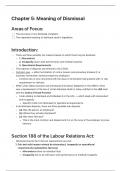
Chapter 5: Meaning of Dismissal
Areas of Focus:
The structure of any dismissal complaint.
The expanded meaning of dismissal used in legislation.
Introduction:
There are three possibly fair reasons based on which there may be dismissal
•
◦ 1. Misconduct
◦ 2. Incapacity (poor work performance and medical reasons)
◦ 3. Operational Requirements
• The majority of disputes are referred to the CCMA.
• Common Law -> either termination of notice (reason and procedure irrelevant) or
summary termination (serious breach by employee)
◦ Common law is only concerned with the issue of termination being lawful with no real
requirement for fairness.
• When unfair labour practice was introduced into labour legislation in the 1980's, there
was a development of the law of unfair dismissal which is today codified in the LRA read
with the Codes of Good Practice
◦ Code relating to dismissal and Schedule 8 or the LRA -> which deals with misconduct
and incapacity
▪ Specific Code form dismissal for operational requirements.
• In all dismissal disputes, there are three possible sub disputes
◦ (a) Was the person an employee?
◦ (b) Where they actually dismissed?
◦ (c) Was there fairness?
▪ This is the most common sub dispute and it is on the onus of the employer to prove
fairness.
Section 188 of the Labour Relations
Dismissal may be fair if the two requirements are met:
Act:
•
1. Fair and valid reason related to misconduct, incapacity or operational
requirements (substantive fairness)
▪ Misconduct refers to individual fault
▪ Incapacity has to do with poor work performance or medical incapacity
, ▪ Operational Requirements are concerned with external factors.
2. Fair Procedure
▪ For each of the three above reasons, there is a specific procedure that is
prescribed.
Rules:
1. Misconduct:
• Always requires fault
• Intent or negligence
• Is about individual blameworthy conduct
• Where the employer can identify an intentionally or negligently broken rule
• Code of Good Practice: Dismissal
2. Incapacity:
• No fault consequence
• Poor work performance and medical incapacity
• But the essence of this, is that there is not fault on the part of the employee
◦ Even medically, there is no fault but there is a problem -> there is an employee who
cannot do their job.
• Procedure in this regard is softly more towards the employer
• Code of Good Practice: Dismissal
3. Operational Requirements:
• Economic:
◦ The economy, such as a recession or a global pandemic
◦ The job disappears
◦ Fluctuation in the exchange rate
◦ Drop in demand for a product
• Technological:
◦ Employer brings in machines to do the jobs of people.
• Structural:
◦ Mergers and Acquisitions
◦ Unnecessary duplication of workers and or jobs
• Section A of the LRA and the Code of Good Practice.
Substantive and Procedural
Focus -> substantive fairness
Fairness
•
◦ Whether the employer had good reasons for dismissal.
• There are three remedies for unfair dismissal -> namely reinstatement, re-employment
and compensation
◦ In terms of Section 193, the preferred remedies are reinstatement and re-
employment but this preference falls away if:
2
Areas of Focus:
The structure of any dismissal complaint.
The expanded meaning of dismissal used in legislation.
Introduction:
There are three possibly fair reasons based on which there may be dismissal
•
◦ 1. Misconduct
◦ 2. Incapacity (poor work performance and medical reasons)
◦ 3. Operational Requirements
• The majority of disputes are referred to the CCMA.
• Common Law -> either termination of notice (reason and procedure irrelevant) or
summary termination (serious breach by employee)
◦ Common law is only concerned with the issue of termination being lawful with no real
requirement for fairness.
• When unfair labour practice was introduced into labour legislation in the 1980's, there
was a development of the law of unfair dismissal which is today codified in the LRA read
with the Codes of Good Practice
◦ Code relating to dismissal and Schedule 8 or the LRA -> which deals with misconduct
and incapacity
▪ Specific Code form dismissal for operational requirements.
• In all dismissal disputes, there are three possible sub disputes
◦ (a) Was the person an employee?
◦ (b) Where they actually dismissed?
◦ (c) Was there fairness?
▪ This is the most common sub dispute and it is on the onus of the employer to prove
fairness.
Section 188 of the Labour Relations
Dismissal may be fair if the two requirements are met:
Act:
•
1. Fair and valid reason related to misconduct, incapacity or operational
requirements (substantive fairness)
▪ Misconduct refers to individual fault
▪ Incapacity has to do with poor work performance or medical incapacity
, ▪ Operational Requirements are concerned with external factors.
2. Fair Procedure
▪ For each of the three above reasons, there is a specific procedure that is
prescribed.
Rules:
1. Misconduct:
• Always requires fault
• Intent or negligence
• Is about individual blameworthy conduct
• Where the employer can identify an intentionally or negligently broken rule
• Code of Good Practice: Dismissal
2. Incapacity:
• No fault consequence
• Poor work performance and medical incapacity
• But the essence of this, is that there is not fault on the part of the employee
◦ Even medically, there is no fault but there is a problem -> there is an employee who
cannot do their job.
• Procedure in this regard is softly more towards the employer
• Code of Good Practice: Dismissal
3. Operational Requirements:
• Economic:
◦ The economy, such as a recession or a global pandemic
◦ The job disappears
◦ Fluctuation in the exchange rate
◦ Drop in demand for a product
• Technological:
◦ Employer brings in machines to do the jobs of people.
• Structural:
◦ Mergers and Acquisitions
◦ Unnecessary duplication of workers and or jobs
• Section A of the LRA and the Code of Good Practice.
Substantive and Procedural
Focus -> substantive fairness
Fairness
•
◦ Whether the employer had good reasons for dismissal.
• There are three remedies for unfair dismissal -> namely reinstatement, re-employment
and compensation
◦ In terms of Section 193, the preferred remedies are reinstatement and re-
employment but this preference falls away if:
2