Chapter 2: Management Learning Past to Present
2.1 Classical Management Approaches
Three Major Classical Approaches:
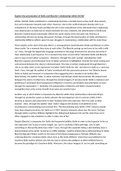
1. Scientific Management (Frederick Taylor): The goal is to improve workers’ productivity. Taylor
linked these job requirements to both worker training and support from supervisors in the form
of precise direction, work assistance and monetary incentives.
- Develop a “science” that includes rules of motion, standardized work implements and proper
working conditions for every job.
- Carefully select workers with the right abilities for the job.
- Carefully train workers to do their job and give them incentives to cooperate with the job
“science”.
- Support workers by carefully planning their tasks and by smoothing the way as they do their
work.
Recommendations from scientific management:
- Make result-based compensation a performance incentive.
- Carefully design jobs with efficient work methods.
- Carefully select workers with the abilities to do these jobs.
- Train workers to preform jobs to the best of their abilities.
- Train supervisors to support workers so they can perform to the best of their abilities.
Motion Study: The science of reducing a job or a task to its most basic physical components.
2. Administrative Principles (Henri Fayol): Fayol identifies five “rules/duties” of management that
coincide well with the four functions of management (planning, organizing, leading and
controlling). Fayol believed management could be taught and improve the quality of
management.
- Foresight: To complete a plan of action for the future.
- Organization: To provide and mobilize resources to implement the plan.
- Command: To lead, select and evaluate workers to het the best work toward the plan.
, - Coordination: To fit diverse efforts together and to ensure information is shared and problems
solved.
- Control: To make sire things happen according to plan and to take necessary corrective action.
Scalar Chain Principle: There should be a clear and unbroken line of communication from the top to the
bottom of the organization.
Unity of Command Principle: Each person should receive orders from only one boss.
Unity of Direction Principle: One person should be in charge of all activities that have the same
performance objective.
3. Bureaucratic Organization (Max Weber): Weber believed that people often held positions of
authority not because of their qualifications, but because of their privileged social status.
Organization structured as bureaucracies would use resources more efficiently and treat
employees more fairly than other systems.
Bureaucracy: A rational and efficient form of organization founded on logic, order and legitimate
authority.
Defining Characteristics of Weber’s bureaucratic organization are:
- Clear Division of Labour: Jobs are well defined and workers are highly skilled at performing
them.
- Clear Hierarchy of Authority: Authority and responsibility are well defined for each position and
each position reports to a higher level.
- Formal Rules and Procedures: Written guidelines direct behavior and decisions in jobs and
written files are kept for historical record.
- Impersonality: Rules and procedures are impartially and uniformly applied, with no one
receiving preferential treatment.
- Careers Based on Merit: Workers are selected and promoted on ability, competency and
performance and managers are career employees of the organizations.
2.1 Classical Management Approaches
Three Major Classical Approaches:
1. Scientific Management (Frederick Taylor): The goal is to improve workers’ productivity. Taylor
linked these job requirements to both worker training and support from supervisors in the form
of precise direction, work assistance and monetary incentives.
- Develop a “science” that includes rules of motion, standardized work implements and proper
working conditions for every job.
- Carefully select workers with the right abilities for the job.
- Carefully train workers to do their job and give them incentives to cooperate with the job
“science”.
- Support workers by carefully planning their tasks and by smoothing the way as they do their
work.
Recommendations from scientific management:
- Make result-based compensation a performance incentive.
- Carefully design jobs with efficient work methods.
- Carefully select workers with the abilities to do these jobs.
- Train workers to preform jobs to the best of their abilities.
- Train supervisors to support workers so they can perform to the best of their abilities.
Motion Study: The science of reducing a job or a task to its most basic physical components.
2. Administrative Principles (Henri Fayol): Fayol identifies five “rules/duties” of management that
coincide well with the four functions of management (planning, organizing, leading and
controlling). Fayol believed management could be taught and improve the quality of
management.
- Foresight: To complete a plan of action for the future.
- Organization: To provide and mobilize resources to implement the plan.
- Command: To lead, select and evaluate workers to het the best work toward the plan.
, - Coordination: To fit diverse efforts together and to ensure information is shared and problems
solved.
- Control: To make sire things happen according to plan and to take necessary corrective action.
Scalar Chain Principle: There should be a clear and unbroken line of communication from the top to the
bottom of the organization.
Unity of Command Principle: Each person should receive orders from only one boss.
Unity of Direction Principle: One person should be in charge of all activities that have the same
performance objective.
3. Bureaucratic Organization (Max Weber): Weber believed that people often held positions of
authority not because of their qualifications, but because of their privileged social status.
Organization structured as bureaucracies would use resources more efficiently and treat
employees more fairly than other systems.
Bureaucracy: A rational and efficient form of organization founded on logic, order and legitimate
authority.
Defining Characteristics of Weber’s bureaucratic organization are:
- Clear Division of Labour: Jobs are well defined and workers are highly skilled at performing
them.
- Clear Hierarchy of Authority: Authority and responsibility are well defined for each position and
each position reports to a higher level.
- Formal Rules and Procedures: Written guidelines direct behavior and decisions in jobs and
written files are kept for historical record.
- Impersonality: Rules and procedures are impartially and uniformly applied, with no one
receiving preferential treatment.
- Careers Based on Merit: Workers are selected and promoted on ability, competency and
performance and managers are career employees of the organizations.