

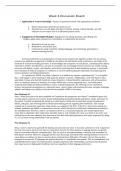
Week 4 Discussion Board:
1. Application of Course Knowledge: Answer all questions/criteria with explanations and detail:
a. Define what person-centered care means to you.
b. Describe how you will apply principles of holistic nursing, cultural humility, and self-
reflection in your future role as an advanced practice nurse.
2. Engagement in Meaningful Dialogue: Engage peers by asking questions, and offering new
insights, applications, perspectives, information, or implications for practice:
a. Respond to at least one peer.
b. Respond to a second peer post.
c. Communicate using respectful, collegial language and terminology appropriate to
advanced nursing practice.
Everyone holds their own interpretation of what person-centered care signifies to them. For me, person-
centered care embodies an approach to healthcare that places the individual's needs, preferences, and values at the
forefront of all decision-making processes. It acknowledges the uniqueness of each person, considering their distinct
experiences, beliefs, and objectives, and aims to customize care accordingly. Person-centered care entails treating
everyone with dignity, respect, and empathy, and actively involving them in their healthcare journey. It transcends
mere treatment of medical symptoms or conditions; it involves understanding the individual, encompassing their
social, emotional, and spiritual dimensions.
As a prospective APRN, my primary objective is to address my patients comprehensively. To accomplish
this, I will engage in active listening to fully grasp my patients' concerns. Additionally, I will refer them to other
specialists if issues arise that fall outside my scope of practice. Cultural humility commences with self-awareness
and is a continuous process of learning. As a future APRN and a current registered nurse, I am dedicated to
acquiring knowledge and skills pertaining to various cultural backgrounds. By reflecting on my experiences,
actions, and personal development as a registered nurse, I aim to make well-informed decisions, navigate challenges
adeptly, and enhance my abilities to become the best possible APRN in the future.
Peer Response #2
Dear, I found your post to be quite insightful and I appreciate the perspective you shared. I completely agree with
you that patient-centered care revolves around understanding and prioritizing the preferences, needs, and values of
the patient. It entails recognizing the patient as a whole person, taking into account their unique circumstances,
beliefs, and goals, and involving them in the decision-making process regarding their healthcare. This concept
reminds me of a particular experience I had when I was assigned to the PCU. In the ICU, most of my patients are
sedated, intubated, and unable to communicate with me, which allowed me to administer medications according to
the scheduled time. However, when I was floated to the PCU, I encountered patients who would request that I
return later to administer their medications and other tasks as well. Initially, this came as a shock to me, but I soon
realized that as the ones admitted, they deserved to have their individual preferences and values respected. By doing
so, we can foster strong relationships with our patients.
Peer Response #2
Dear, I want to express my gratitude for sharing your post and your story. It was truly a pleasure to read. I appreciate
the time you took to advocate not only for your patient, but also for future patients. Language barriers can greatly
limit or even hinder effective communication. This can result in misunderstandings, confusion, and frustration for
both parties involved. Moreover, language barriers may discourage individuals from seeking healthcare services or
cause delays in seeking care due to concerns about communication difficulties. Therefore, the fact that you have
managed to incorporate 30 languages into patient education is a remarkable achievement. This accomplishment will
undoubtedly lead to improved communication, stronger patient-provider relationships, and ensure that all patients
have equal access to high-quality healthcare services, regardless of their language proficiency.
1. Application of Course Knowledge: Answer all questions/criteria with explanations and detail:
a. Define what person-centered care means to you.
b. Describe how you will apply principles of holistic nursing, cultural humility, and self-
reflection in your future role as an advanced practice nurse.
2. Engagement in Meaningful Dialogue: Engage peers by asking questions, and offering new
insights, applications, perspectives, information, or implications for practice:
a. Respond to at least one peer.
b. Respond to a second peer post.
c. Communicate using respectful, collegial language and terminology appropriate to
advanced nursing practice.
Everyone holds their own interpretation of what person-centered care signifies to them. For me, person-
centered care embodies an approach to healthcare that places the individual's needs, preferences, and values at the
forefront of all decision-making processes. It acknowledges the uniqueness of each person, considering their distinct
experiences, beliefs, and objectives, and aims to customize care accordingly. Person-centered care entails treating
everyone with dignity, respect, and empathy, and actively involving them in their healthcare journey. It transcends
mere treatment of medical symptoms or conditions; it involves understanding the individual, encompassing their
social, emotional, and spiritual dimensions.
As a prospective APRN, my primary objective is to address my patients comprehensively. To accomplish
this, I will engage in active listening to fully grasp my patients' concerns. Additionally, I will refer them to other
specialists if issues arise that fall outside my scope of practice. Cultural humility commences with self-awareness
and is a continuous process of learning. As a future APRN and a current registered nurse, I am dedicated to
acquiring knowledge and skills pertaining to various cultural backgrounds. By reflecting on my experiences,
actions, and personal development as a registered nurse, I aim to make well-informed decisions, navigate challenges
adeptly, and enhance my abilities to become the best possible APRN in the future.
Peer Response #2
Dear, I found your post to be quite insightful and I appreciate the perspective you shared. I completely agree with
you that patient-centered care revolves around understanding and prioritizing the preferences, needs, and values of
the patient. It entails recognizing the patient as a whole person, taking into account their unique circumstances,
beliefs, and goals, and involving them in the decision-making process regarding their healthcare. This concept
reminds me of a particular experience I had when I was assigned to the PCU. In the ICU, most of my patients are
sedated, intubated, and unable to communicate with me, which allowed me to administer medications according to
the scheduled time. However, when I was floated to the PCU, I encountered patients who would request that I
return later to administer their medications and other tasks as well. Initially, this came as a shock to me, but I soon
realized that as the ones admitted, they deserved to have their individual preferences and values respected. By doing
so, we can foster strong relationships with our patients.
Peer Response #2
Dear, I want to express my gratitude for sharing your post and your story. It was truly a pleasure to read. I appreciate
the time you took to advocate not only for your patient, but also for future patients. Language barriers can greatly
limit or even hinder effective communication. This can result in misunderstandings, confusion, and frustration for
both parties involved. Moreover, language barriers may discourage individuals from seeking healthcare services or
cause delays in seeking care due to concerns about communication difficulties. Therefore, the fact that you have
managed to incorporate 30 languages into patient education is a remarkable achievement. This accomplishment will
undoubtedly lead to improved communication, stronger patient-provider relationships, and ensure that all patients
have equal access to high-quality healthcare services, regardless of their language proficiency.


