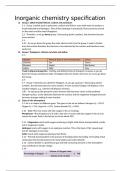
Inorganic chemistry specification
a) Group 1 (alkali metals)-lithium, sodium and potassium
2.1 - Group 1 metals such as potassium, sodium and lithium, react with water to produce a
metal hydroxide and hydrogen. They all fizz (hydrogen is produced), float and move around
on the water and the metal disappears.
2.2 - Therefore, as we go down group 1 (increasing atomic number), the elements become
more reactive.
2.3 -
2.4C - As you go down the group the outer electron lost from the group 1 metal is further
from the nucleus therefore the electron is less attracted by the nucleus and therefore more
easily lost.
b) Group 7 (halogens)- chlorine, bromine and iodine
2.5 –
Halogen Physical state at room temperature Colour
Chlorine Gas Green
Bromine Liquid Red brown
Iodine Solid Grey
Trend in physical properties - Melting and Boiling Points of Halogens increases as you go
down the Group and physical state of Halogens become harder and more set as you go down
the Group.
2.6 -
2.7 - Group 7 elements are called the Halogens. As you go up group 7 (decreasing atomic
number), the elements become more reactive. A more reactive halogen will displace a less
reactive halogen, e.g., chlorine will displace bromine.
2.8C – As you go up the group the outer electron shell becomes closer to the positively
charged nucleus, so the attraction between the nucleus and the negatively charged electrons
becomes stronger making it more reactive.
c) Gases in the atmosphere
2.9 -Air is a mixture of different gases. The gases in the air are follows: Nitrogen N 2 = 78.1%
Oxygen O2 = 21%, Argon Ar = 0.9%, Carbon dioxide CO 2 = 0.04%
2.10 – Iron =The iron reacts with the oxygen in the air (rusting).
Phosphorus =The phosphorus is lit with a hot wire. It reacts with the oxygen in the air and
causes the water level in the bell jar to rise by about 20%.
2.11 - Magnesium reacts with oxygen producing a bright white flame leaving behind a white
ash of magnesium oxide.
Hydrogen reacts with oxygen in an explosive reaction. This is the basis of the ‘squeak pop’
test for hydrogen in test tube.
Sulfur reacts with oxygen producing a blue flame.
2.12 - Thermal decomposition is the process of breaking down by heating. On heating metal
carbonates thermal decompose into metal oxides and carbon dioxide.
2.13 - carbon dioxide is a greenhouse gas and that increasing amounts in the atmosphere
may contribute to climate change
2.14 –
a) Group 1 (alkali metals)-lithium, sodium and potassium
2.1 - Group 1 metals such as potassium, sodium and lithium, react with water to produce a
metal hydroxide and hydrogen. They all fizz (hydrogen is produced), float and move around
on the water and the metal disappears.
2.2 - Therefore, as we go down group 1 (increasing atomic number), the elements become
more reactive.
2.3 -
2.4C - As you go down the group the outer electron lost from the group 1 metal is further
from the nucleus therefore the electron is less attracted by the nucleus and therefore more
easily lost.
b) Group 7 (halogens)- chlorine, bromine and iodine
2.5 –
Halogen Physical state at room temperature Colour
Chlorine Gas Green
Bromine Liquid Red brown
Iodine Solid Grey
Trend in physical properties - Melting and Boiling Points of Halogens increases as you go
down the Group and physical state of Halogens become harder and more set as you go down
the Group.
2.6 -
2.7 - Group 7 elements are called the Halogens. As you go up group 7 (decreasing atomic
number), the elements become more reactive. A more reactive halogen will displace a less
reactive halogen, e.g., chlorine will displace bromine.
2.8C – As you go up the group the outer electron shell becomes closer to the positively
charged nucleus, so the attraction between the nucleus and the negatively charged electrons
becomes stronger making it more reactive.
c) Gases in the atmosphere
2.9 -Air is a mixture of different gases. The gases in the air are follows: Nitrogen N 2 = 78.1%
Oxygen O2 = 21%, Argon Ar = 0.9%, Carbon dioxide CO 2 = 0.04%
2.10 – Iron =The iron reacts with the oxygen in the air (rusting).
Phosphorus =The phosphorus is lit with a hot wire. It reacts with the oxygen in the air and
causes the water level in the bell jar to rise by about 20%.
2.11 - Magnesium reacts with oxygen producing a bright white flame leaving behind a white
ash of magnesium oxide.
Hydrogen reacts with oxygen in an explosive reaction. This is the basis of the ‘squeak pop’
test for hydrogen in test tube.
Sulfur reacts with oxygen producing a blue flame.
2.12 - Thermal decomposition is the process of breaking down by heating. On heating metal
carbonates thermal decompose into metal oxides and carbon dioxide.
2.13 - carbon dioxide is a greenhouse gas and that increasing amounts in the atmosphere
may contribute to climate change
2.14 –