

Muscular System
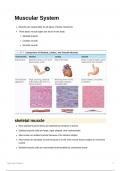
Muscles are responsible for all types of body movement
Three basic muscle types are found in the body
Skeletal muscle
Cardiac muscle
Smooth muscle
skeletal muscle
Most skeletal muscle fibers are attached by tendons to bones
Skeletal muscle cells are large, cigar-shaped, and multinucleate
Also known as striated muscle because of its obvious stripes
Also known as voluntary muscle because it is the only muscle tissue subject to conscious
control
Skeletal muscle cells are surrounded and bundled by connective tissue
Muscular System 1
, Endomysium — encloses a single
muscle fiber
Perimysium — wraps around a fascicle
(bundle) of muscle fibers
Epimysium — covers the entire skeletal
muscle
Fascia — on the outside of the
epimysium
The epimysium of skeletal muscle
blends into a connective tissue
attachment
Tendons
cordlike structures
Mostly collagen fibers
Often cross a joint because of
their toughness and small size
Aponeuroses
sheetlike structures
Muscular System 2
, Attach muscles indirectly to
bones, cartilages, or connective
tissue coverings
functions of the skeletal muscle
Whereas all muscle types produce movement, skeletal muscle has three other important
roles:
Maintain posture and body position
Stabilize joints
Generate heat
microscopic anatomy of the skeletal muscle
Sarcolemma
specialized plasma membrane
Myofibrils
long organelles inside muscle cell
Muscular System 3
Muscles are responsible for all types of body movement
Three basic muscle types are found in the body
Skeletal muscle
Cardiac muscle
Smooth muscle
skeletal muscle
Most skeletal muscle fibers are attached by tendons to bones
Skeletal muscle cells are large, cigar-shaped, and multinucleate
Also known as striated muscle because of its obvious stripes
Also known as voluntary muscle because it is the only muscle tissue subject to conscious
control
Skeletal muscle cells are surrounded and bundled by connective tissue
Muscular System 1
, Endomysium — encloses a single
muscle fiber
Perimysium — wraps around a fascicle
(bundle) of muscle fibers
Epimysium — covers the entire skeletal
muscle
Fascia — on the outside of the
epimysium
The epimysium of skeletal muscle
blends into a connective tissue
attachment
Tendons
cordlike structures
Mostly collagen fibers
Often cross a joint because of
their toughness and small size
Aponeuroses
sheetlike structures
Muscular System 2
, Attach muscles indirectly to
bones, cartilages, or connective
tissue coverings
functions of the skeletal muscle
Whereas all muscle types produce movement, skeletal muscle has three other important
roles:
Maintain posture and body position
Stabilize joints
Generate heat
microscopic anatomy of the skeletal muscle
Sarcolemma
specialized plasma membrane
Myofibrils
long organelles inside muscle cell
Muscular System 3


