Elizabethan Timeline 1558 - 1588
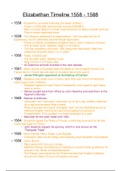
• 1558 - Elizabeth is crowned following the death of Mary I
- Crown in £300,000 debt (annual income £286,667)
- Mary of Guise (Mary’s mother) ruled Scotland on Mary’s behalf and had
French troops stationed there
• 1559 - The religious settlement is implemented - this includes the Act of
Supremacy, Act of Uniformity and the Royal Injunctions
- Treaty of Cateau-Cambrésis (England had to return Calais to France)
- The Scottish lords’ rebellion begins in Scotland
- The first visitations occurred - 400 clergymen dismissed. After this
visitations occurred every 3 or 4 years
• 1560 - Treaty of Edinburgh
- The Scottish lords’ rebellion ends
- King Francis II of France dies
- 42 Grammar schools founded in the next decade
• 1561 - Mary returns to Scotland after the death of her husband Francis II of
France (she is 18 and has not been in Scotland since she was 5)
- James Pilkington appointed as Archbishop of Durham
• 1562 - Religious war broke out in France, later that year French Protestants
made peace with Catholics
- Elizabeth agreed to help French Protestants, she hoped to get Calais
back in return
- Slaves bought back from Africa by John Hawkins and sold them to the
Spanish Colonists
• 1563 - Statute of Artificers
- Labourers’ act: Labourers could earn up to 3p a day, skilled craftsmen
4p a day and servants 8/9p a week
- Philip II banned the import of English cloth into the Netherlands as he
believed English merchants were encouraging the spread of
Protestantism. This resulted in a trade embargo for a year
- Bad year for the cloth trade until 1564
• 1564 - Elizabeth signed the Treaty of Troyes, confirming once and for all that
Calais belonged to France
- John Hawkins repeats his journey, which is now known as the
“Triangular Trade”
• 1565 - Mary marries Henry Stuart, Lord Darnley
- It became clear not all Clergy were wearing what Elizabeth had ordered
• 1566 - Dutch Revolt
- Mary gives birth to a son, James
- Matthew Parker, Archbishop of Canterbury issued further guidelines for
priests in his “Book of Advertisements”
- The Papacy was issued by the Pope and said that English Catholics
should not attend Church of England services
• 1558 - Elizabeth is crowned following the death of Mary I
- Crown in £300,000 debt (annual income £286,667)
- Mary of Guise (Mary’s mother) ruled Scotland on Mary’s behalf and had
French troops stationed there
• 1559 - The religious settlement is implemented - this includes the Act of
Supremacy, Act of Uniformity and the Royal Injunctions
- Treaty of Cateau-Cambrésis (England had to return Calais to France)
- The Scottish lords’ rebellion begins in Scotland
- The first visitations occurred - 400 clergymen dismissed. After this
visitations occurred every 3 or 4 years
• 1560 - Treaty of Edinburgh
- The Scottish lords’ rebellion ends
- King Francis II of France dies
- 42 Grammar schools founded in the next decade
• 1561 - Mary returns to Scotland after the death of her husband Francis II of
France (she is 18 and has not been in Scotland since she was 5)
- James Pilkington appointed as Archbishop of Durham
• 1562 - Religious war broke out in France, later that year French Protestants
made peace with Catholics
- Elizabeth agreed to help French Protestants, she hoped to get Calais
back in return
- Slaves bought back from Africa by John Hawkins and sold them to the
Spanish Colonists
• 1563 - Statute of Artificers
- Labourers’ act: Labourers could earn up to 3p a day, skilled craftsmen
4p a day and servants 8/9p a week
- Philip II banned the import of English cloth into the Netherlands as he
believed English merchants were encouraging the spread of
Protestantism. This resulted in a trade embargo for a year
- Bad year for the cloth trade until 1564
• 1564 - Elizabeth signed the Treaty of Troyes, confirming once and for all that
Calais belonged to France
- John Hawkins repeats his journey, which is now known as the
“Triangular Trade”
• 1565 - Mary marries Henry Stuart, Lord Darnley
- It became clear not all Clergy were wearing what Elizabeth had ordered
• 1566 - Dutch Revolt
- Mary gives birth to a son, James
- Matthew Parker, Archbishop of Canterbury issued further guidelines for
priests in his “Book of Advertisements”
- The Papacy was issued by the Pope and said that English Catholics
should not attend Church of England services