Weimar and Nazi Germany
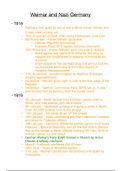
• 1918
- Germany torn apart by social and political unrest. Money and
troops were running out
- 75% of women worked, often doing traditionally male jobs
- 9th November - Kaiser Wilhelm abdicates
- German Republic announced
- Friedrich Ebert (SPD leader) became Chancellor
- 10th November - Kaiser Wilhelm went into exile in Holland
- Ebert agrees with General Groener for the army to
support the Government in keeping communists out
of power.
- Ebert suspends the old Reichstag and announced the
six moderate politicians to form the Council of
People’s Representatives.
- 11th November - Armistice signed by Matthias Erzberger
(Ebert’s representative)
- November - Women given right to vote in the first week of the
Republic
- December - German Communist Party (KPD) set up, it was
well funded from its backing from the Soviet Union
• 1919
- 4th January - Ebert sacked Emil Eichhorn, police chief in
Berlin, who was popular with the workers
- 6th January - Spartacist uprising and general strike in Berlin.
Over 100,000 workers took to the streets.
- 13th January - All rebels driven off the streets
- 16th January - Rosa Luxemburg and Karl Liebknecht arrested
and killed by Freikorps officers
- 19th January - Elections, Moderate parties gained most seats
- February - National Assembly met for the first time in Weimar
due to the danger in Berlin (Official opening 6th Feb). 90% of
women turned out and voted
- German Worker’s Party (DAP) formed in Munich by Anton
Drexler, a railway mechanic
- March - Freikorps numbered 250,00 men
- 28th June - Treaty of Versailles signed
- 31st July - Weimar Constitution established, with Ebert as
Chancellor
• 1918
- Germany torn apart by social and political unrest. Money and
troops were running out
- 75% of women worked, often doing traditionally male jobs
- 9th November - Kaiser Wilhelm abdicates
- German Republic announced
- Friedrich Ebert (SPD leader) became Chancellor
- 10th November - Kaiser Wilhelm went into exile in Holland
- Ebert agrees with General Groener for the army to
support the Government in keeping communists out
of power.
- Ebert suspends the old Reichstag and announced the
six moderate politicians to form the Council of
People’s Representatives.
- 11th November - Armistice signed by Matthias Erzberger
(Ebert’s representative)
- November - Women given right to vote in the first week of the
Republic
- December - German Communist Party (KPD) set up, it was
well funded from its backing from the Soviet Union
• 1919
- 4th January - Ebert sacked Emil Eichhorn, police chief in
Berlin, who was popular with the workers
- 6th January - Spartacist uprising and general strike in Berlin.
Over 100,000 workers took to the streets.
- 13th January - All rebels driven off the streets
- 16th January - Rosa Luxemburg and Karl Liebknecht arrested
and killed by Freikorps officers
- 19th January - Elections, Moderate parties gained most seats
- February - National Assembly met for the first time in Weimar
due to the danger in Berlin (Official opening 6th Feb). 90% of
women turned out and voted
- German Worker’s Party (DAP) formed in Munich by Anton
Drexler, a railway mechanic
- March - Freikorps numbered 250,00 men
- 28th June - Treaty of Versailles signed
- 31st July - Weimar Constitution established, with Ebert as
Chancellor