Surface Integrals of Vector Fields
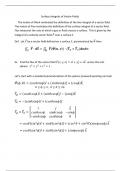
The notion of Work motivated the definition of the line integral of a vector field.
The notion of Flux motivates the definition of the surface integral of a vector field.
Flux measures the rate at which a gas or fluid crosses a surface. This is given by the
integral of a velocity vector field 𝐹⃗ over a surface 𝑆.
Def. Let 𝐹⃗ be a vector field defined on a surface 𝑆, parametrized by 𝛷
⃗⃗ then
⃗⃗ = ∬ ⃗𝑭⃗(𝜱
∬𝑺 ⃗𝑭⃗ ∙ 𝒅𝑺 ⃗⃗⃗⃗(𝒖, 𝒗)) ∙ (𝑻
⃗⃗𝒖 × 𝑻
⃗⃗𝒗 )𝒅𝒖𝒅𝒗.
𝑫
Ex. Find the flux of the vector field 𝐹⃗ (𝑥, 𝑦, 𝑧) = 𝑧𝑖⃗ + 𝑦𝑗⃗ + 𝑥𝑘⃗⃗ across the unit
sphere 𝑥 2 + 𝑦 2 + 𝑧 2 = 1 .
Let’s start with a standard parametrization of the sphere (outward pointing normal):
⃗⃗(𝜙, 𝜃) = (𝑐𝑜𝑠𝜃𝑠𝑖𝑛𝜙 )𝑖⃗ + (𝑠𝑖𝑛𝜃𝑠𝑖𝑛𝜙 )𝑗⃗ + (𝑐𝑜𝑠𝜙 )𝑘⃗⃗;
𝛷
0 ≤ 𝜙 ≤ 𝜋, 0 ≤ 𝜃 ≤ 2𝜋.
⃗⃗𝜙 = (𝑐𝑜𝑠𝜃𝑐𝑜𝑠𝜙)𝑖⃗ + (𝑠𝑖𝑛𝜃𝑐𝑜𝑠𝜙 )𝑗⃗ − (𝑠𝑖𝑛𝜙 )𝑘⃗⃗
𝑇
⃗⃗𝜃 = −(𝑠𝑖𝑛𝜃𝑠𝑖𝑛𝜙 )𝑖⃗ + (𝑐𝑜𝑠𝜃𝑠𝑖𝑛𝜙 )𝑗⃗
𝑇
𝑖⃗ 𝑗⃗ 𝑘⃗⃗
⃗⃗𝜙 × 𝑇
𝑇 ⃗⃗𝜃 = | 𝑐𝑜𝑠𝜃𝑐𝑜𝑠𝜙 𝑠𝑖𝑛𝜃𝑐𝑜𝑠𝜙 −𝑠𝑖𝑛𝜙 |
−𝑠𝑖𝑛𝜃𝑠𝑖𝑛𝜙 𝑐𝑜𝑠𝜃𝑠𝑖𝑛𝜙 0
= 𝑐𝑜𝑠𝜃(𝑠𝑖𝑛2 𝜙)𝑖⃗ + 𝑠𝑖𝑛𝜃 (𝑠𝑖𝑛2 𝜙)𝑗⃗ + (𝑐𝑜𝑠 2 𝜃 + 𝑠𝑖𝑛2 𝜃)(𝑠𝑖𝑛𝜙𝑐𝑜𝑠𝜙) 𝑘⃗⃗
= 𝑐𝑜𝑠𝜃(𝑠𝑖𝑛2 𝜙)𝑖⃗ + 𝑠𝑖𝑛𝜃 (𝑠𝑖𝑛2 𝜙)𝑗⃗ + (𝑠𝑖𝑛𝜙𝑐𝑜𝑠𝜙) 𝑘⃗⃗
, 2
𝐹⃗ (𝛷 ⃗⃗
⃗⃗(𝜙, 𝜃)) = (𝑐𝑜𝑠𝜙 )𝑖⃗ + (𝑠𝑖𝑛𝜃𝑠𝑖𝑛𝜙 )𝑗⃗ + (𝑐𝑜𝑠𝜃𝑠𝑖𝑛𝜙 )𝑘
𝐹⃗ ∙ (𝑇
⃗⃗𝜙 × 𝑇
⃗⃗𝜃 ) = 𝑐𝑜𝑠 𝜃 (sin2 𝜙)𝑐𝑜𝑠 𝜙 + sin2 𝜃 (sin3 𝜙) + 𝑐𝑜𝑠𝜃(sin2 𝜙)𝑐𝑜𝑠𝜙
= 2𝑐𝑜𝑠 𝜃 (sin2 𝜙)𝑐𝑜𝑠 𝜙 + sin2 𝜃 (sin3 𝜙)
∬𝑆 𝐹⃗ ∙ 𝑑𝑆⃗ = ∬𝐷 𝐹⃗ (𝛷
⃗⃗(𝜙, 𝜃)) ∙ (𝑇
⃗⃗𝜙 × 𝑇
⃗⃗𝜃 )𝑑𝜙𝑑𝜃
𝜃=2𝜋 𝜙=𝜋
= ∫𝜃=0 ∫𝜙=0 [2𝑐𝑜𝑠 𝜃 (sin2 𝜙)𝑐𝑜𝑠 𝜙 + sin2 𝜃 (sin3 𝜙)] 𝑑𝜙𝑑𝜃
𝜃=2𝜋 𝜙=𝜋
= 2 ∫𝜃=0 𝑐𝑜𝑠𝜃𝑑𝜃 ∫𝜙=0 sin2 𝜙 (𝑐𝑜𝑠𝜙 )𝑑𝜙
𝜃=2𝜋 𝜙=𝜋
+ ∫𝜃=0 sin2 𝜃𝑑𝜃 ∫𝜙=0 sin3 𝜙𝑑𝜙.
𝜃=2𝜋
∫𝜃=0 𝑐𝑜𝑠𝜃𝑑𝜃 = 0, so the first term is equal to 0.
𝜃=2𝜋 𝜃=2𝜋 1 1 1 1 2𝜋
∫𝜃=0 sin2 𝜃𝑑𝜃 = ∫𝜃=0 (2 − 2 𝑐𝑜𝑠2𝜃) 𝑑𝜃 = (2 𝜃 − 4 𝑠𝑖𝑛2𝜃)| =𝜋
0
𝜙=𝜋 𝜙=𝜋
∫𝜙=0 sin3 𝜙𝑑 𝜙 = ∫𝜙=0 𝑠𝑖𝑛𝜙 (1 − cos 2 𝜙)𝑑 𝜙 ; now let 𝑢 = 𝑐𝑜𝑠𝜙 to get
𝑢=−1 4
= − ∫𝑢=1 (1 − 𝑢2 )𝑑𝑢 = 3.
Putting these three integrals together we have:
4𝜋
𝐹𝑙𝑢𝑥 = ∬𝑆 𝐹⃗ ∙ 𝑑𝑆⃗ = 3 .
The notion of Work motivated the definition of the line integral of a vector field.
The notion of Flux motivates the definition of the surface integral of a vector field.
Flux measures the rate at which a gas or fluid crosses a surface. This is given by the
integral of a velocity vector field 𝐹⃗ over a surface 𝑆.
Def. Let 𝐹⃗ be a vector field defined on a surface 𝑆, parametrized by 𝛷
⃗⃗ then
⃗⃗ = ∬ ⃗𝑭⃗(𝜱
∬𝑺 ⃗𝑭⃗ ∙ 𝒅𝑺 ⃗⃗⃗⃗(𝒖, 𝒗)) ∙ (𝑻
⃗⃗𝒖 × 𝑻
⃗⃗𝒗 )𝒅𝒖𝒅𝒗.
𝑫
Ex. Find the flux of the vector field 𝐹⃗ (𝑥, 𝑦, 𝑧) = 𝑧𝑖⃗ + 𝑦𝑗⃗ + 𝑥𝑘⃗⃗ across the unit
sphere 𝑥 2 + 𝑦 2 + 𝑧 2 = 1 .
Let’s start with a standard parametrization of the sphere (outward pointing normal):
⃗⃗(𝜙, 𝜃) = (𝑐𝑜𝑠𝜃𝑠𝑖𝑛𝜙 )𝑖⃗ + (𝑠𝑖𝑛𝜃𝑠𝑖𝑛𝜙 )𝑗⃗ + (𝑐𝑜𝑠𝜙 )𝑘⃗⃗;
𝛷
0 ≤ 𝜙 ≤ 𝜋, 0 ≤ 𝜃 ≤ 2𝜋.
⃗⃗𝜙 = (𝑐𝑜𝑠𝜃𝑐𝑜𝑠𝜙)𝑖⃗ + (𝑠𝑖𝑛𝜃𝑐𝑜𝑠𝜙 )𝑗⃗ − (𝑠𝑖𝑛𝜙 )𝑘⃗⃗
𝑇
⃗⃗𝜃 = −(𝑠𝑖𝑛𝜃𝑠𝑖𝑛𝜙 )𝑖⃗ + (𝑐𝑜𝑠𝜃𝑠𝑖𝑛𝜙 )𝑗⃗
𝑇
𝑖⃗ 𝑗⃗ 𝑘⃗⃗
⃗⃗𝜙 × 𝑇
𝑇 ⃗⃗𝜃 = | 𝑐𝑜𝑠𝜃𝑐𝑜𝑠𝜙 𝑠𝑖𝑛𝜃𝑐𝑜𝑠𝜙 −𝑠𝑖𝑛𝜙 |
−𝑠𝑖𝑛𝜃𝑠𝑖𝑛𝜙 𝑐𝑜𝑠𝜃𝑠𝑖𝑛𝜙 0
= 𝑐𝑜𝑠𝜃(𝑠𝑖𝑛2 𝜙)𝑖⃗ + 𝑠𝑖𝑛𝜃 (𝑠𝑖𝑛2 𝜙)𝑗⃗ + (𝑐𝑜𝑠 2 𝜃 + 𝑠𝑖𝑛2 𝜃)(𝑠𝑖𝑛𝜙𝑐𝑜𝑠𝜙) 𝑘⃗⃗
= 𝑐𝑜𝑠𝜃(𝑠𝑖𝑛2 𝜙)𝑖⃗ + 𝑠𝑖𝑛𝜃 (𝑠𝑖𝑛2 𝜙)𝑗⃗ + (𝑠𝑖𝑛𝜙𝑐𝑜𝑠𝜙) 𝑘⃗⃗
, 2
𝐹⃗ (𝛷 ⃗⃗
⃗⃗(𝜙, 𝜃)) = (𝑐𝑜𝑠𝜙 )𝑖⃗ + (𝑠𝑖𝑛𝜃𝑠𝑖𝑛𝜙 )𝑗⃗ + (𝑐𝑜𝑠𝜃𝑠𝑖𝑛𝜙 )𝑘
𝐹⃗ ∙ (𝑇
⃗⃗𝜙 × 𝑇
⃗⃗𝜃 ) = 𝑐𝑜𝑠 𝜃 (sin2 𝜙)𝑐𝑜𝑠 𝜙 + sin2 𝜃 (sin3 𝜙) + 𝑐𝑜𝑠𝜃(sin2 𝜙)𝑐𝑜𝑠𝜙
= 2𝑐𝑜𝑠 𝜃 (sin2 𝜙)𝑐𝑜𝑠 𝜙 + sin2 𝜃 (sin3 𝜙)
∬𝑆 𝐹⃗ ∙ 𝑑𝑆⃗ = ∬𝐷 𝐹⃗ (𝛷
⃗⃗(𝜙, 𝜃)) ∙ (𝑇
⃗⃗𝜙 × 𝑇
⃗⃗𝜃 )𝑑𝜙𝑑𝜃
𝜃=2𝜋 𝜙=𝜋
= ∫𝜃=0 ∫𝜙=0 [2𝑐𝑜𝑠 𝜃 (sin2 𝜙)𝑐𝑜𝑠 𝜙 + sin2 𝜃 (sin3 𝜙)] 𝑑𝜙𝑑𝜃
𝜃=2𝜋 𝜙=𝜋
= 2 ∫𝜃=0 𝑐𝑜𝑠𝜃𝑑𝜃 ∫𝜙=0 sin2 𝜙 (𝑐𝑜𝑠𝜙 )𝑑𝜙
𝜃=2𝜋 𝜙=𝜋
+ ∫𝜃=0 sin2 𝜃𝑑𝜃 ∫𝜙=0 sin3 𝜙𝑑𝜙.
𝜃=2𝜋
∫𝜃=0 𝑐𝑜𝑠𝜃𝑑𝜃 = 0, so the first term is equal to 0.
𝜃=2𝜋 𝜃=2𝜋 1 1 1 1 2𝜋
∫𝜃=0 sin2 𝜃𝑑𝜃 = ∫𝜃=0 (2 − 2 𝑐𝑜𝑠2𝜃) 𝑑𝜃 = (2 𝜃 − 4 𝑠𝑖𝑛2𝜃)| =𝜋
0
𝜙=𝜋 𝜙=𝜋
∫𝜙=0 sin3 𝜙𝑑 𝜙 = ∫𝜙=0 𝑠𝑖𝑛𝜙 (1 − cos 2 𝜙)𝑑 𝜙 ; now let 𝑢 = 𝑐𝑜𝑠𝜙 to get
𝑢=−1 4
= − ∫𝑢=1 (1 − 𝑢2 )𝑑𝑢 = 3.
Putting these three integrals together we have:
4𝜋
𝐹𝑙𝑢𝑥 = ∬𝑆 𝐹⃗ ∙ 𝑑𝑆⃗ = 3 .