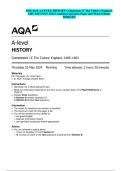
2024 AQA A-LEVEL HISTORY Component 1C The Tudors: England,
1485–1603 MAY 2024 Combined Question Paper and Mark Scheme
MERGED
A-level
HISTORY
Component 1C The Tudors: England, 1485–1603
Thursday 23 May 2024 Morning Time allowed: 2 hours 30 minutes
Materials
For this paper you must have:
an AQA 16-page answer book.
Instructions
Use black ink or black ball-point pen.
Write the information required on the front of your answer book. The Paper Reference is
7042/1C.
Answer three questions.
In Section A answer Question 01.
In Section B answer two questions.
Information
The marks for questions are shown in brackets.
The maximum mark for this paper is 80.
You will be marked on your ability to:
– use good English
– organise information clearly
– use specialist vocabulary where appropriate.
Advice
You are advised to spend about:
– 1 hour on Question 01 from Section A
– 45 minutes on each of the two questions answered from Section B.
,IB/M/Jun24/G4006/E5 7042/1C
, 2
Section A
Answer Question 01.
Extract A
The twenty years to 1547 were a time of high drama as Henry VIII faced new and
challenging issues which threatened the stability of the country. Henry’s most pressing
need was the resolution of his ‘Great Matter’. To achieve this, he relied on the tireless
support of the great administrative genius, Thomas Cromwell. Henry sought to challenge
the authority of the Papacy and achieve control over the Church. He appealed to the 5
widespread anxiety about the survival of the dynasty and the growing anti-clericalism of
parliament to carry through these aims. Following his triumph over the Church, Henry
attempted to sweep away further limitations on his power. Areas which had traditionally
not been under the control of the king, such as the Palatinate of Durham, were made
subject to royal authority. However, although the Church in England was brought under 10
political control, Henry did not plan to use the royal supremacy as a weapon to radically
change the doctrine of the Church itself.
Adapted from D Loades, Politics and The Nation, 1999
Extract B
It is easy to assume that Henry VIII was motivated by ambition and greed to take over the
power and wealth of the Church in the years between 1527 and his death. Yet this is only
part of the story. Henry clearly believed that he was following a path laid down by
Scripture and that it was his moral duty to impose his authority over the Church.
Henry never separated his religious role from his political responsibilities. He saw his 5 chief
political duty as removing superstition from the Kingdom. This was made clear in
his most important religious work, the King’s Book. Henry also wished to transform the
state.
However, the campaign to implement the Royal Supremacy resulted in division and
challenge at every level so that in the last ten years of his reign he had to adopt 10
increasingly defensive policies. It then seemed that his intention was to persecute both
religious offenders and political enemies alike.
Adapted from L Wooding, Tudor England: A History, 2022
IB/M/Jun24/7042/1C
1485–1603 MAY 2024 Combined Question Paper and Mark Scheme
MERGED
A-level
HISTORY
Component 1C The Tudors: England, 1485–1603
Thursday 23 May 2024 Morning Time allowed: 2 hours 30 minutes
Materials
For this paper you must have:
an AQA 16-page answer book.
Instructions
Use black ink or black ball-point pen.
Write the information required on the front of your answer book. The Paper Reference is
7042/1C.
Answer three questions.
In Section A answer Question 01.
In Section B answer two questions.
Information
The marks for questions are shown in brackets.
The maximum mark for this paper is 80.
You will be marked on your ability to:
– use good English
– organise information clearly
– use specialist vocabulary where appropriate.
Advice
You are advised to spend about:
– 1 hour on Question 01 from Section A
– 45 minutes on each of the two questions answered from Section B.
,IB/M/Jun24/G4006/E5 7042/1C
, 2
Section A
Answer Question 01.
Extract A
The twenty years to 1547 were a time of high drama as Henry VIII faced new and
challenging issues which threatened the stability of the country. Henry’s most pressing
need was the resolution of his ‘Great Matter’. To achieve this, he relied on the tireless
support of the great administrative genius, Thomas Cromwell. Henry sought to challenge
the authority of the Papacy and achieve control over the Church. He appealed to the 5
widespread anxiety about the survival of the dynasty and the growing anti-clericalism of
parliament to carry through these aims. Following his triumph over the Church, Henry
attempted to sweep away further limitations on his power. Areas which had traditionally
not been under the control of the king, such as the Palatinate of Durham, were made
subject to royal authority. However, although the Church in England was brought under 10
political control, Henry did not plan to use the royal supremacy as a weapon to radically
change the doctrine of the Church itself.
Adapted from D Loades, Politics and The Nation, 1999
Extract B
It is easy to assume that Henry VIII was motivated by ambition and greed to take over the
power and wealth of the Church in the years between 1527 and his death. Yet this is only
part of the story. Henry clearly believed that he was following a path laid down by
Scripture and that it was his moral duty to impose his authority over the Church.
Henry never separated his religious role from his political responsibilities. He saw his 5 chief
political duty as removing superstition from the Kingdom. This was made clear in
his most important religious work, the King’s Book. Henry also wished to transform the
state.
However, the campaign to implement the Royal Supremacy resulted in division and
challenge at every level so that in the last ten years of his reign he had to adopt 10
increasingly defensive policies. It then seemed that his intention was to persecute both
religious offenders and political enemies alike.
Adapted from L Wooding, Tudor England: A History, 2022
IB/M/Jun24/7042/1C