

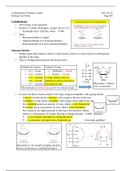
Carbohydrates, Proteins, Lipids 2017-02-25
Biology Test Notes Page M1
Carbohydrates
• Store energy in all organisms
• Found in a Carbon, Hydrogen, Oxygen ratio of 1:2:1
◦ Essentially that’s (CH2O)n, where N ∈ℕ
• Types
◦ Monosaccharides (1 sugar)
◦ Oligosaccharides (2-3 monosaccharides)
◦ Polysaccharides (4 or more monosaccharides)
Monosaccharides
• Simple sugars that contain a chain of carbon atoms with two or more hydroxyl (-OH) groups
attached to the chain
• They’re distinguished using the following criteria
Number of Carbons Carbonyl Group
• n=3 →triose • Aldehyde → aldose
• n=4 →tetrose • Ketone → ketose
• n=5 →pentose In rings, ketoses have an
• n=6 →hexose additional carbon attached to
• n=7 →heptose the anomeric one. Illustration 1: Ribose
is an aldopentose.
The formula is (carbonyl group)+(# of carbons)+(ose)
• In water, the above chains actually form rings, using nucleophillic (-OH group) attacks
◦ A tetrose in water forms a furanose, with oxygen at the top of the ring
◦ A pentose in water forms a pyranose, with oxygen on the right of the ring
◦ If an aldehyde group was present, it’s now called a cyclic hemiacetal
◦ If a ketone group was present, it’s now called a cyclic hemiketal
◦ The carbon on the right hand side of the ring is the anomeric carbon,
which is a stereoisomer. It’ll allow the ring to change between α and β anomeres
▪ In an α isomer, hydrogen up, hydroxide down
▪ In aβ isomer, hydrogen down, hydroxide up “downright uplefting”
Illustration 2: An example of alpha and beta
isomers (a furanose excluding hydrogen)
, Carbohydrates, Proteins, Lipids 2017-02-25
Biology Test Notes Page M2
Oligosaccharides
• Contain 2 or 3 simple sugars that are attached using covalent bonds involving oxygen called
glycosidic linkages (which are essentially condensation reactions)
◦ The special name for two connected sugars is a disaccharide, and the following examples of
oligosaccharides are all disaccharides
• Maltose: product of the digestion of starch→ contains 2 α glucoses :α 1,4 glycosidic linkages
+H2O
• Sucrose: table sugar → contains 1 α glucose and 1 α fructose :α 1,2 glycosidic linkages
• Lactose: component of milk → contains 1β glucose+1β galactose :β1, 4 glycosidic linkages
+H2O
Reducing vs Non-Reducing Sugars
• Reducing sugars have a free OH group on the anomeric carbon, which allows the sugar to act as
a reducing agent when the carbonyl group (which is now an OH) becomes an carboxyl group
◦ Examples: Glucose and lactose
• Non-reducing sugars do not have this luxury, as the OH group is attached or linked elsewhere
◦ Example: Sucrose
Biology Test Notes Page M1
Carbohydrates
• Store energy in all organisms
• Found in a Carbon, Hydrogen, Oxygen ratio of 1:2:1
◦ Essentially that’s (CH2O)n, where N ∈ℕ
• Types
◦ Monosaccharides (1 sugar)
◦ Oligosaccharides (2-3 monosaccharides)
◦ Polysaccharides (4 or more monosaccharides)
Monosaccharides
• Simple sugars that contain a chain of carbon atoms with two or more hydroxyl (-OH) groups
attached to the chain
• They’re distinguished using the following criteria
Number of Carbons Carbonyl Group
• n=3 →triose • Aldehyde → aldose
• n=4 →tetrose • Ketone → ketose
• n=5 →pentose In rings, ketoses have an
• n=6 →hexose additional carbon attached to
• n=7 →heptose the anomeric one. Illustration 1: Ribose
is an aldopentose.
The formula is (carbonyl group)+(# of carbons)+(ose)
• In water, the above chains actually form rings, using nucleophillic (-OH group) attacks
◦ A tetrose in water forms a furanose, with oxygen at the top of the ring
◦ A pentose in water forms a pyranose, with oxygen on the right of the ring
◦ If an aldehyde group was present, it’s now called a cyclic hemiacetal
◦ If a ketone group was present, it’s now called a cyclic hemiketal
◦ The carbon on the right hand side of the ring is the anomeric carbon,
which is a stereoisomer. It’ll allow the ring to change between α and β anomeres
▪ In an α isomer, hydrogen up, hydroxide down
▪ In aβ isomer, hydrogen down, hydroxide up “downright uplefting”
Illustration 2: An example of alpha and beta
isomers (a furanose excluding hydrogen)
, Carbohydrates, Proteins, Lipids 2017-02-25
Biology Test Notes Page M2
Oligosaccharides
• Contain 2 or 3 simple sugars that are attached using covalent bonds involving oxygen called
glycosidic linkages (which are essentially condensation reactions)
◦ The special name for two connected sugars is a disaccharide, and the following examples of
oligosaccharides are all disaccharides
• Maltose: product of the digestion of starch→ contains 2 α glucoses :α 1,4 glycosidic linkages
+H2O
• Sucrose: table sugar → contains 1 α glucose and 1 α fructose :α 1,2 glycosidic linkages
• Lactose: component of milk → contains 1β glucose+1β galactose :β1, 4 glycosidic linkages
+H2O
Reducing vs Non-Reducing Sugars
• Reducing sugars have a free OH group on the anomeric carbon, which allows the sugar to act as
a reducing agent when the carbonyl group (which is now an OH) becomes an carboxyl group
◦ Examples: Glucose and lactose
• Non-reducing sugars do not have this luxury, as the OH group is attached or linked elsewhere
◦ Example: Sucrose


