

Energy and Enzymes Test Notes 2017-03-03
Hassan Alibhai Page EE1
Thermodynamics
• Metabolism is the collective name for all chemical reacting that occurs inside the cell.
• Energy is the ability to do work
◦ Kinetic: the energy of motion → thermal, mechanical, electrical
◦ Potential: stored energy → gravitational, chemical
Laws of Thermodynamics
• First Law → The Law of Conservation of Energy: energy can never be created or destroyed, but
simply transferred from one form to another.
• Second Law → Energy cannot be transferred from one form to another with a loss of useful
energy.
◦ Energy transfer increases the entropy (the measure of the tendency for a system to become
unorganized) of the universe.
Applying the Laws
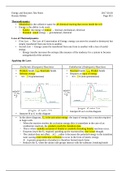
Exothermic (Exergonic) Reactions Endothermic (Endergonic) Reactions
• Products bonds >stable Reactants bonds • Reactant bonds >stable Product bonds
• Releases energy • Requires an input of energy
• Δ G < 0 (spontaneous) • Δ G > 0 (non-spontaneous)
• Interpret H as G in this diagram
• Interpret H as G in this diagram
• In the above diagrams, EA is the activation energy: the input of energy that a reaction requires
to begin with.
◦ When the reaction reaches the activation energy (this is immediate in the case of an
exothermic reaction), the products reach the transition state.
◦ This is where anabolic (creation of bonds) or catabolic (breaking bonds) reactions occur.
◦ Enzymes lower the EA required, speeding up the reaction (they don’t react though)
◦ The catalyst does not affect Δ G , rather it decreases the potential energy in the transition
state causing more molecular collisions to occur in the form of kinetic energy.
▪ A greater proportion of products is therefore formed much faster
◦ Reduces the EA when the amino side groups interact with the substrate, breaking bonds
Hassan Alibhai Page EE1
Thermodynamics
• Metabolism is the collective name for all chemical reacting that occurs inside the cell.
• Energy is the ability to do work
◦ Kinetic: the energy of motion → thermal, mechanical, electrical
◦ Potential: stored energy → gravitational, chemical
Laws of Thermodynamics
• First Law → The Law of Conservation of Energy: energy can never be created or destroyed, but
simply transferred from one form to another.
• Second Law → Energy cannot be transferred from one form to another with a loss of useful
energy.
◦ Energy transfer increases the entropy (the measure of the tendency for a system to become
unorganized) of the universe.
Applying the Laws
Exothermic (Exergonic) Reactions Endothermic (Endergonic) Reactions
• Products bonds >stable Reactants bonds • Reactant bonds >stable Product bonds
• Releases energy • Requires an input of energy
• Δ G < 0 (spontaneous) • Δ G > 0 (non-spontaneous)
• Interpret H as G in this diagram
• Interpret H as G in this diagram
• In the above diagrams, EA is the activation energy: the input of energy that a reaction requires
to begin with.
◦ When the reaction reaches the activation energy (this is immediate in the case of an
exothermic reaction), the products reach the transition state.
◦ This is where anabolic (creation of bonds) or catabolic (breaking bonds) reactions occur.
◦ Enzymes lower the EA required, speeding up the reaction (they don’t react though)
◦ The catalyst does not affect Δ G , rather it decreases the potential energy in the transition
state causing more molecular collisions to occur in the form of kinetic energy.
▪ A greater proportion of products is therefore formed much faster
◦ Reduces the EA when the amino side groups interact with the substrate, breaking bonds


