

Cellular Respiration and Photosynthesis Notes 2017-04-29
Hassan Alibhai Page CR/P1
Cellular Respiration
• General Equation: C6H12O6 + 6 O2 →6 CO2 + 6 H2O
kJ
Δ G= −2870
mol
• Cellular Respiration is conducted in 4 general steps, listed in
the table below
Step Step Name Location
#
1 Glycolysis Cytosol
2 Pyruvate Oxidation Mitochondria
3 Citric (Krebs) Cycle Mitochondria
4 Electron Transport Mitochondria
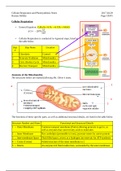
Anatomy of the Mitochondria
The structures below are named following Ms. Oliver’s notes.
1
4
Crista
(Cristae)
3
2 5
The functions of these specific parts, as well as additional structural details, are listed in the table below
Structure Number and Name Functional and Structural Details
1 → Outer Membrane Contains transport membrane (Porin) allowing pyruvate to get in, as
well as enzymes that convert fatty acids to molecules
2 → Inner Membrane Has cardiolipin (permeable to ions), pyruvate enters by carrier protein
3 → Inter-membrane Space Fluid filled space, serves as a hydrogen ion reservoir for ATP synthesis
4 → Crista (Cristae) Folded structure of the inner membrane in 2
5 → Matrix An enzyme rich fluid resides here, surrounded by the inner membrane
,Cellular Respiration and Photosynthesis Notes 2017-04-29
Hassan Alibhai Page CR/P2
Cellular Respiration: Introduction
• The conversion of chemical energy to ATP
◦ Glucose + Oxygen → Carbon Dioxide + Water +
Energy
• Adenosine Triphosphate (ATP)
◦ Chemical energy stored in bonds of food (such as
glucose) are converted to ATP
◦ Composed of a 5 carbon sugar (ribose), adenine, and
a triphosphate group, where the three phosphates are connected by high-energy covalent
bonds
▪ Breaking the above bonds releases about 30 kJ per mole, creating ADP via hydrolysis
▪ Energy is provided for mechanical, chemical, and transportation-related work
Cellular Respiration Step 1: Glycolysis
• This is the first step of cellular respiration, and it involves the conversion of the oxidation of the
6-carbon sugar glucose, producing two molecules of the 3-carbon compound pyruvate.
• The entire process is summarized below, with the inputs and outputs
◦ The beginning stages involve the investment of 2 molecules of adenosine triphophate, called
the energy investment phase, while the process ends with the production of 4 ATP and 2
NADH, called the energy payoff phase
◦ The 10-step detailed process within which this takes place need not be known, but a very
basic summary (the text below) is appropriate
▪ glycolysis 1: Glucose → Fructose 1,6 Biphosphate
▪ glycolysis 2: Fructose 1,6 Biphosphate → 2 G3P or PGAL molecules → 2 Pyruvate
• At the end of the day, a net output of 2 ATP, 2 NADH, and 2H2O are formed
• Equation: Glucose + 2 ADP + 2 Pi + 2 NAD+ → 2 pyruvate + 2 ATP + 2 NADH + 2H+
Input
2 H2O
Output
• NAD+ (nicotinamide adenine dinucleotide) is the carrier of electrons in oxidation of molecules
◦ Energy is released as NADH is oxidized back to NAD+ (reduced to oxidized form)
, Cellular Respiration and Photosynthesis Notes 2017-04-29
Hassan Alibhai Page CR/P3
Cellular Respiration Step 2: Pyruvate Oxidation (or “Transition” step)
• Pyruvates that are produced in glycolysis must pass through both the outer and inner
mitochondrial membranes.
◦ Large pores in the outer membrane allow pyruvate to
diffuse through.
• For pyruvate to cross the inner membrane, however, a
pyruvate-specific membrane carrier is required.
◦ Once pyruvate enters the matrix, it is converted into an
acetyl group, which is then temporarily bonded to a sulfur
atom on the end of a large molecule called coenzyme A, or
CoA.
◦ The result is an acetyl-CoA complex. This multi-step process is referred to as pyruvate
oxidation (or pyruvic acid oxidation).
• Bear in mind that because glycolysis itself produces 2 molecules of pyruvate, its oxidation and
the creation of acetyl-CoA and the product ratios that follow in the citric acid cycle must be
doubled.
LEGEND
(1) decarboxylation
(2) a dehydrogenation
(3) a reaction with coenzyme A
(CoA) that produces acetyl-CoA.
In reality, both pyruvates are
converted into acetyl-CoA
Illustration 1: Pyruvate Oxidation is explained in this diagram.
Cellular Respiration Step 3: The Krebs (Citric Acid) Cycle
• Combined, these reactions result in the oxidization of acetyl
groups to CO2, accompanied by the synthesis of ATP,
NADH, and another nucleotide-based molecule, flavin
adenine dinucleotide (FAD; the reduced form is FADH2)
• In a complete turn of the cycle, one 2-carbon acetyl unit is
consumed and two CO2 molecules are released, thereby
completing the conversion of all the carbon atoms that were
originally in glucose into CO2.
• The CoA molecule that carried the acetyl group to the cycle is released and again participates in
pyruvate oxidation to pick up another acetyl group.
Hassan Alibhai Page CR/P1
Cellular Respiration
• General Equation: C6H12O6 + 6 O2 →6 CO2 + 6 H2O
kJ
Δ G= −2870
mol
• Cellular Respiration is conducted in 4 general steps, listed in
the table below
Step Step Name Location
#
1 Glycolysis Cytosol
2 Pyruvate Oxidation Mitochondria
3 Citric (Krebs) Cycle Mitochondria
4 Electron Transport Mitochondria
Anatomy of the Mitochondria
The structures below are named following Ms. Oliver’s notes.
1
4
Crista
(Cristae)
3
2 5
The functions of these specific parts, as well as additional structural details, are listed in the table below
Structure Number and Name Functional and Structural Details
1 → Outer Membrane Contains transport membrane (Porin) allowing pyruvate to get in, as
well as enzymes that convert fatty acids to molecules
2 → Inner Membrane Has cardiolipin (permeable to ions), pyruvate enters by carrier protein
3 → Inter-membrane Space Fluid filled space, serves as a hydrogen ion reservoir for ATP synthesis
4 → Crista (Cristae) Folded structure of the inner membrane in 2
5 → Matrix An enzyme rich fluid resides here, surrounded by the inner membrane
,Cellular Respiration and Photosynthesis Notes 2017-04-29
Hassan Alibhai Page CR/P2
Cellular Respiration: Introduction
• The conversion of chemical energy to ATP
◦ Glucose + Oxygen → Carbon Dioxide + Water +
Energy
• Adenosine Triphosphate (ATP)
◦ Chemical energy stored in bonds of food (such as
glucose) are converted to ATP
◦ Composed of a 5 carbon sugar (ribose), adenine, and
a triphosphate group, where the three phosphates are connected by high-energy covalent
bonds
▪ Breaking the above bonds releases about 30 kJ per mole, creating ADP via hydrolysis
▪ Energy is provided for mechanical, chemical, and transportation-related work
Cellular Respiration Step 1: Glycolysis
• This is the first step of cellular respiration, and it involves the conversion of the oxidation of the
6-carbon sugar glucose, producing two molecules of the 3-carbon compound pyruvate.
• The entire process is summarized below, with the inputs and outputs
◦ The beginning stages involve the investment of 2 molecules of adenosine triphophate, called
the energy investment phase, while the process ends with the production of 4 ATP and 2
NADH, called the energy payoff phase
◦ The 10-step detailed process within which this takes place need not be known, but a very
basic summary (the text below) is appropriate
▪ glycolysis 1: Glucose → Fructose 1,6 Biphosphate
▪ glycolysis 2: Fructose 1,6 Biphosphate → 2 G3P or PGAL molecules → 2 Pyruvate
• At the end of the day, a net output of 2 ATP, 2 NADH, and 2H2O are formed
• Equation: Glucose + 2 ADP + 2 Pi + 2 NAD+ → 2 pyruvate + 2 ATP + 2 NADH + 2H+
Input
2 H2O
Output
• NAD+ (nicotinamide adenine dinucleotide) is the carrier of electrons in oxidation of molecules
◦ Energy is released as NADH is oxidized back to NAD+ (reduced to oxidized form)
, Cellular Respiration and Photosynthesis Notes 2017-04-29
Hassan Alibhai Page CR/P3
Cellular Respiration Step 2: Pyruvate Oxidation (or “Transition” step)
• Pyruvates that are produced in glycolysis must pass through both the outer and inner
mitochondrial membranes.
◦ Large pores in the outer membrane allow pyruvate to
diffuse through.
• For pyruvate to cross the inner membrane, however, a
pyruvate-specific membrane carrier is required.
◦ Once pyruvate enters the matrix, it is converted into an
acetyl group, which is then temporarily bonded to a sulfur
atom on the end of a large molecule called coenzyme A, or
CoA.
◦ The result is an acetyl-CoA complex. This multi-step process is referred to as pyruvate
oxidation (or pyruvic acid oxidation).
• Bear in mind that because glycolysis itself produces 2 molecules of pyruvate, its oxidation and
the creation of acetyl-CoA and the product ratios that follow in the citric acid cycle must be
doubled.
LEGEND
(1) decarboxylation
(2) a dehydrogenation
(3) a reaction with coenzyme A
(CoA) that produces acetyl-CoA.
In reality, both pyruvates are
converted into acetyl-CoA
Illustration 1: Pyruvate Oxidation is explained in this diagram.
Cellular Respiration Step 3: The Krebs (Citric Acid) Cycle
• Combined, these reactions result in the oxidization of acetyl
groups to CO2, accompanied by the synthesis of ATP,
NADH, and another nucleotide-based molecule, flavin
adenine dinucleotide (FAD; the reduced form is FADH2)
• In a complete turn of the cycle, one 2-carbon acetyl unit is
consumed and two CO2 molecules are released, thereby
completing the conversion of all the carbon atoms that were
originally in glucose into CO2.
• The CoA molecule that carried the acetyl group to the cycle is released and again participates in
pyruvate oxidation to pick up another acetyl group.


