

Nervous System Test Notes 2017-05-31
Hassan Alibhai Page N1
Introduction
• The role of the nervous system is to allow organisms to make sense of their environment. The
five senses, bodily interactions, and changes to stress all root in the core of the nervous system.
• The nervous system also allows the body to control its internal environment
• In essence, the nervous system is the functional unit of homeostasis
• There are two main components of the nervous system
◦ Central Nervous System (CNS) → the brain and spinal cord, the coordinating center the
body uses to regulate mechanical and chemical actions
◦ Peripheral Nervous System (PNS) → the rest of the nervous system, that branches out
from the CNS, which relays information from it to the rest of the body and reacts to changes
in external conditions as needed.
Neural Signalling
• Neuron → a specialized nerve cell, the functional unit of the nervous system
◦ Afferent or Sensory → carries the impulses from the sensory receptor to the central
nervous system
◦ Interneuron → relays information between the afferent and efferent nerves (99% of all)
◦ Efferent “Exit” or Motor → carries the impulse from the CNS to the skeletal muscles
◦ Neurons are all connected to each other, resulting in information being able to reach the
entire body in mere milliseconds. This is because each neuron has an axon, an extension
that carries the nerve impulse to the required part of the body.
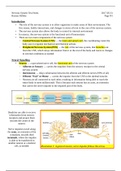
Dendrites are able to receive
information from sensory
receptors and project them
towards the center of the
neuron.
Nerve impulses travel along
the axon, an extension of the
cytoplasm, towards their (soma)
terminals, where the impulse
is able to be transferred to
another neuron or a skeletal
cell, as needed. Illustration 1: A general neuron, nerve impulse follows the arrow.
, Nervous System Test Notes 2017-05-31
Hassan Alibhai Page N2
Neuron Support System
• Glial cells provide nutrition and support to neurons
◦ Schwann cells, a type of glial cell forms tightly wrapped layers of the plasma membrane,
called the myelin sheath, around axons. The gaps between these cells are the nodes of
Ranvier, and they expose the axon membrane directly to the rest of the environment.
◦ The nerve impulse can travel faster in this arrangement.
Structure of the Nervous System
• We have already discussed the two prime divisors, the
Central and Peripheral Nervous Systems, but the PNS
in particular is divided into more sub-regions.
◦ The PNS controls both input and output to and
from the CNS, hence containing the follows
Hassan Alibhai Page N1
Introduction
• The role of the nervous system is to allow organisms to make sense of their environment. The
five senses, bodily interactions, and changes to stress all root in the core of the nervous system.
• The nervous system also allows the body to control its internal environment
• In essence, the nervous system is the functional unit of homeostasis
• There are two main components of the nervous system
◦ Central Nervous System (CNS) → the brain and spinal cord, the coordinating center the
body uses to regulate mechanical and chemical actions
◦ Peripheral Nervous System (PNS) → the rest of the nervous system, that branches out
from the CNS, which relays information from it to the rest of the body and reacts to changes
in external conditions as needed.
Neural Signalling
• Neuron → a specialized nerve cell, the functional unit of the nervous system
◦ Afferent or Sensory → carries the impulses from the sensory receptor to the central
nervous system
◦ Interneuron → relays information between the afferent and efferent nerves (99% of all)
◦ Efferent “Exit” or Motor → carries the impulse from the CNS to the skeletal muscles
◦ Neurons are all connected to each other, resulting in information being able to reach the
entire body in mere milliseconds. This is because each neuron has an axon, an extension
that carries the nerve impulse to the required part of the body.
Dendrites are able to receive
information from sensory
receptors and project them
towards the center of the
neuron.
Nerve impulses travel along
the axon, an extension of the
cytoplasm, towards their (soma)
terminals, where the impulse
is able to be transferred to
another neuron or a skeletal
cell, as needed. Illustration 1: A general neuron, nerve impulse follows the arrow.
, Nervous System Test Notes 2017-05-31
Hassan Alibhai Page N2
Neuron Support System
• Glial cells provide nutrition and support to neurons
◦ Schwann cells, a type of glial cell forms tightly wrapped layers of the plasma membrane,
called the myelin sheath, around axons. The gaps between these cells are the nodes of
Ranvier, and they expose the axon membrane directly to the rest of the environment.
◦ The nerve impulse can travel faster in this arrangement.
Structure of the Nervous System
• We have already discussed the two prime divisors, the
Central and Peripheral Nervous Systems, but the PNS
in particular is divided into more sub-regions.
◦ The PNS controls both input and output to and
from the CNS, hence containing the follows


