,UNIVERSITY EXAMINATIONS
Oct/Nov 2024
HED2601
History of Education in Foundation Phase
100 marks
Duration: 3 hours
QR Code:
EXAMINERS:
FIRST EXAMINER: DR MZ MNCANCA
SECOND EXAMINER: DR TF SAMBO
, [TURN OVER]
QR ACCESS CODE: 4879f06e 2 HED2601
QUESTION 1: (24)
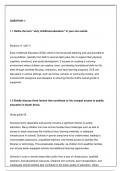
1.1 Define the term “early childhood education” in your own words. (1)
1.2 Briefly discuss three factors that contribute to the unequal access to
quality education in South Africa. (9)
1.3 After 1994, the South African government took a multidisciplinary approach that focused on
holistic child development. Discuss the meaning
of developing a child holistically. (6)
1.4 Evaluate the importance of infusing African Indigenous knowledge in the
school curriculum. (2X2) (4)
1.5 Name two prominent individuals (theorists) who shaped our understanding
of the learning needs of young children.
1.1 Define "early childhood education" in your own words. (1)
Answer: Early childhood education is the foundational education provided to young children,
typically from birth to about eight years old, focusing on their overall development—cognitive,
emotional, social, and physical—to prepare them for future learning.
1.2 Briefly discuss three factors that contribute to the unequal access to quality education
in South Africa. (9)
Answer:
, 1. Socioeconomic Disparities: Many families in South Africa live in poverty, making it
challenging to afford quality education. Schools in poorer areas may lack resources,
qualified teachers, and infrastructure.
2. Geographic Inequality: Rural areas often have fewer educational facilities and qualified
teachers, limiting access to quality education for children who live outside urban centers.
3. Historical Inequities: The legacy of apartheid has left lasting disparities in education,
with underfunded schools still present in historically marginalized communities, impacting
the quality and access to education for children in these areas.
1.3 Discuss the meaning of developing a child holistically. (6)
Answer:
Developing a child holistically means focusing on nurturing all aspects of a child's growth—
intellectual, physical, emotional, and social—rather than just academic achievement. This
approach recognizes that children are complex beings who need a balanced development that
includes life skills, emotional well-being, social skills, and physical health. By supporting every
area, children are better prepared for the demands of life and future learning.
1.4 Evaluate the importance of infusing African Indigenous knowledge in the school
curriculum. (4)
Answer:
1. Cultural Relevance: Including African Indigenous knowledge helps children connect their
learning to their heritage, identity, and environment, fostering pride and cultural
understanding.
Oct/Nov 2024
HED2601
History of Education in Foundation Phase
100 marks
Duration: 3 hours
QR Code:
EXAMINERS:
FIRST EXAMINER: DR MZ MNCANCA
SECOND EXAMINER: DR TF SAMBO
, [TURN OVER]
QR ACCESS CODE: 4879f06e 2 HED2601
QUESTION 1: (24)
1.1 Define the term “early childhood education” in your own words. (1)
1.2 Briefly discuss three factors that contribute to the unequal access to
quality education in South Africa. (9)
1.3 After 1994, the South African government took a multidisciplinary approach that focused on
holistic child development. Discuss the meaning
of developing a child holistically. (6)
1.4 Evaluate the importance of infusing African Indigenous knowledge in the
school curriculum. (2X2) (4)
1.5 Name two prominent individuals (theorists) who shaped our understanding
of the learning needs of young children.
1.1 Define "early childhood education" in your own words. (1)
Answer: Early childhood education is the foundational education provided to young children,
typically from birth to about eight years old, focusing on their overall development—cognitive,
emotional, social, and physical—to prepare them for future learning.
1.2 Briefly discuss three factors that contribute to the unequal access to quality education
in South Africa. (9)
Answer:
, 1. Socioeconomic Disparities: Many families in South Africa live in poverty, making it
challenging to afford quality education. Schools in poorer areas may lack resources,
qualified teachers, and infrastructure.
2. Geographic Inequality: Rural areas often have fewer educational facilities and qualified
teachers, limiting access to quality education for children who live outside urban centers.
3. Historical Inequities: The legacy of apartheid has left lasting disparities in education,
with underfunded schools still present in historically marginalized communities, impacting
the quality and access to education for children in these areas.
1.3 Discuss the meaning of developing a child holistically. (6)
Answer:
Developing a child holistically means focusing on nurturing all aspects of a child's growth—
intellectual, physical, emotional, and social—rather than just academic achievement. This
approach recognizes that children are complex beings who need a balanced development that
includes life skills, emotional well-being, social skills, and physical health. By supporting every
area, children are better prepared for the demands of life and future learning.
1.4 Evaluate the importance of infusing African Indigenous knowledge in the school
curriculum. (4)
Answer:
1. Cultural Relevance: Including African Indigenous knowledge helps children connect their
learning to their heritage, identity, and environment, fostering pride and cultural
understanding.