

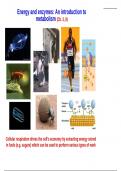
Energy and enzymes: An introduction to
metabolism (Ch. 2, 8)
Cellular respiration drives the cell’s economy by extracting energy stored
in fuels (e.g. sugars) which can be used to perform various types of work
, Metabolism: key concepts
• An organism’s metabolism transforms matter and energy, subject to
the laws of thermodynamics via metabolic pathways
• Free energy change (ΔG) between reactants and products tells us
which reactions occur spontaneously and which require input of
energy?
• ATP powers cellular work by coupling energy-producing (exergonic
or “spontaneous”) and energy-requiring (endergonic, “not
spontaneous”) reactions
• Exergonic reactions are not necessarily fast; enzymes speed up
(catalyze) metabolic reactions by lowering energy barriers
• Enzyme function is affected by local conditions (e.g. temp., pH) and
other chemical regulators (activators, inhibitors)
, Metabolism = sum of an organism’s chemical reactions
Individual reactions are linked in complex, intersecting
metabolic pathways
Enzyme 1 Enzyme 2 Enzyme 3
A B C D
Reaction 1 Reaction 2 Reaction 3
Reactant Product
- starting Intermediate
molecule(s)
Catabolic pathways release energy by breaking down complex
molecules to simpler molecules, e.g. oxidation of glucose during cell
respiration
Anabolic pathways use energy to build complicated molecules from
simpler ones, e.g. synthesis of sugars during photosynthesis, or polymers
from monomers
metabolism (Ch. 2, 8)
Cellular respiration drives the cell’s economy by extracting energy stored
in fuels (e.g. sugars) which can be used to perform various types of work
, Metabolism: key concepts
• An organism’s metabolism transforms matter and energy, subject to
the laws of thermodynamics via metabolic pathways
• Free energy change (ΔG) between reactants and products tells us
which reactions occur spontaneously and which require input of
energy?
• ATP powers cellular work by coupling energy-producing (exergonic
or “spontaneous”) and energy-requiring (endergonic, “not
spontaneous”) reactions
• Exergonic reactions are not necessarily fast; enzymes speed up
(catalyze) metabolic reactions by lowering energy barriers
• Enzyme function is affected by local conditions (e.g. temp., pH) and
other chemical regulators (activators, inhibitors)
, Metabolism = sum of an organism’s chemical reactions
Individual reactions are linked in complex, intersecting
metabolic pathways
Enzyme 1 Enzyme 2 Enzyme 3
A B C D
Reaction 1 Reaction 2 Reaction 3
Reactant Product
- starting Intermediate
molecule(s)
Catabolic pathways release energy by breaking down complex
molecules to simpler molecules, e.g. oxidation of glucose during cell
respiration
Anabolic pathways use energy to build complicated molecules from
simpler ones, e.g. synthesis of sugars during photosynthesis, or polymers
from monomers


