
EESA07 Hassan Alibhai
Final Exam Notes Page 1
Administration
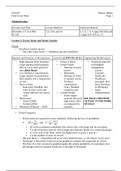
Location and Time Lecture Material Textbook Material
th
December 15 (2-4 PM) 5,6,7,8,9, and 10 4, 5, 6, 7, 8, 9, (pgs 200-202) and
IC 220 11 (pgs 223-229) 12, 13
Lecture 5: Excess Water and Water Scarcity
Floods
• Post-flood analysis factors
◦ One other major factor => sediment type and availability
Intensity and Duration of Precipitation Land Use (CONT PG 10-11) Engineering Modifications
• High Intensity Short Duration: • Urban vs Rural • Structural approach
Large amount of precipitation • Urban Floods to floodplain
falls in a very short period of ◦ Network of storm management
time (flash flood) sewers ◦ Leeves
• Low Intensity Long Duration: ◦ Basements ◦ Concrete
Large amount of precipitation ◦ Backups of storm floodwalls
falls steadily over a long period or sanitary sewers ◦ Floodways
of time ◦ No direct (example: Red
• Rain vs Snow connection to River floodway
◦ Rain-snow flooding: rain rivers, flooding in Winnipeg)
falls on snow cover and caused by rain ◦ Dams
cannot infiltrate into frozen • Coastal Floods ◦ Channelization
soils ◦ Storm surges-
• Hurricanes? seawater driven by SEE PAGE 3 BOTTOM
◦ Hazel (1994) high winds, often OF PAGE 10 FOR MORE
◦ Katrina (2005) accompanied by DETAILS
• Monsoons (Pakistan – 2010) tsunamis.
• Flood Frequency
◦ Flood events are assumed to occur randomly, following the laws of probability
m 1 n+1
▪ EP= and T = =
n+1 P m
• EP is the exceedence probability (the chance that a discharge will be exceeded)
• T is the recurrence interval (the average time between floods of a certain discharge)
• m is the rank of the flood, where the highest flow is given a rank of 1
• n is the number of years on record.
◦ 100 year flood => a flood that will occur every hundred years, or 1% chance “every year”
◦ Discharge vs Recurrence Interval can be graphed to estimate the magnitude of a flood
◦ The flow of a river can also be graphed against the annual probability of exceedance (as a
percentage) and less common floods are to the right of this graph.
,EESA07 Hassan Alibhai
Final Exam Notes Page 2
• Two key weaknesses to predicting flood intensity by using past frequency
1. Available hydrologic data often shorter than required to make accurate predictions. For
example, to predict a hundred year flood, flood data needs to be calculated consistently for
a minimum of fifty years, which usually doesn’t happen
2. The past is a good guide to the future – which is generally untrue, especially because of
how much our world has changed since the industrial revolution. The 100- year flood is a
moving target, which means we have no good way to calculate it.
• Alternative => probable maximum flood (the maximum flood that is likely to occur in a given
area under the most extreme conditions)
Flooding Impacts and Trends
• Loss of life and property damage => disease,
water supply contamination, mud damage
• Munich Re. And Dartmouth Flood
Observarory => Increasing trend in annual
numbers of high magnitude floods
• Reasons
◦ Climate change
◦ More people and property on flood-prone
areas (mostly floodplains)
Minimizing Flood Hazards
• Non-structural approach
◦ No people and structures in the floodplain => no economic damage
◦ Outcome Risk = (likelihood of a flood)(consequences)
• Structural approach
◦ Levees, concrete floodwalls, floodways, dams, channelization
, EESA07 Hassan Alibhai
Final Exam Notes Page 3
Structural flood hazard minimization Non-structural flood hazard minimization
• Levees • Control of floodplain development via
◦ New Orleans is protected by levees so land use decisions
that the Mississippi River now stands 4 ◦ Government dictates that floodplains
metres above the downtown area must be established where
development is not permitted
(regardless of residential or
commercial)
◦ Water ends up flowing faster and
deeper beyond a levee, causing
flooding both upstream and
downstream
• Floodway
◦ Red river has flooded so many times
that there’s now a floodway to protect ◦ Government also subsidizes flood
it from downtown Winnipeg insurance for older buildings
• Certain areas will be periodically flooded
• Streams can be channelized (flow straight)
Final Exam Notes Page 1
Administration
Location and Time Lecture Material Textbook Material
th
December 15 (2-4 PM) 5,6,7,8,9, and 10 4, 5, 6, 7, 8, 9, (pgs 200-202) and
IC 220 11 (pgs 223-229) 12, 13
Lecture 5: Excess Water and Water Scarcity
Floods
• Post-flood analysis factors
◦ One other major factor => sediment type and availability
Intensity and Duration of Precipitation Land Use (CONT PG 10-11) Engineering Modifications
• High Intensity Short Duration: • Urban vs Rural • Structural approach
Large amount of precipitation • Urban Floods to floodplain
falls in a very short period of ◦ Network of storm management
time (flash flood) sewers ◦ Leeves
• Low Intensity Long Duration: ◦ Basements ◦ Concrete
Large amount of precipitation ◦ Backups of storm floodwalls
falls steadily over a long period or sanitary sewers ◦ Floodways
of time ◦ No direct (example: Red
• Rain vs Snow connection to River floodway
◦ Rain-snow flooding: rain rivers, flooding in Winnipeg)
falls on snow cover and caused by rain ◦ Dams
cannot infiltrate into frozen • Coastal Floods ◦ Channelization
soils ◦ Storm surges-
• Hurricanes? seawater driven by SEE PAGE 3 BOTTOM
◦ Hazel (1994) high winds, often OF PAGE 10 FOR MORE
◦ Katrina (2005) accompanied by DETAILS
• Monsoons (Pakistan – 2010) tsunamis.
• Flood Frequency
◦ Flood events are assumed to occur randomly, following the laws of probability
m 1 n+1
▪ EP= and T = =
n+1 P m
• EP is the exceedence probability (the chance that a discharge will be exceeded)
• T is the recurrence interval (the average time between floods of a certain discharge)
• m is the rank of the flood, where the highest flow is given a rank of 1
• n is the number of years on record.
◦ 100 year flood => a flood that will occur every hundred years, or 1% chance “every year”
◦ Discharge vs Recurrence Interval can be graphed to estimate the magnitude of a flood
◦ The flow of a river can also be graphed against the annual probability of exceedance (as a
percentage) and less common floods are to the right of this graph.
,EESA07 Hassan Alibhai
Final Exam Notes Page 2
• Two key weaknesses to predicting flood intensity by using past frequency
1. Available hydrologic data often shorter than required to make accurate predictions. For
example, to predict a hundred year flood, flood data needs to be calculated consistently for
a minimum of fifty years, which usually doesn’t happen
2. The past is a good guide to the future – which is generally untrue, especially because of
how much our world has changed since the industrial revolution. The 100- year flood is a
moving target, which means we have no good way to calculate it.
• Alternative => probable maximum flood (the maximum flood that is likely to occur in a given
area under the most extreme conditions)
Flooding Impacts and Trends
• Loss of life and property damage => disease,
water supply contamination, mud damage
• Munich Re. And Dartmouth Flood
Observarory => Increasing trend in annual
numbers of high magnitude floods
• Reasons
◦ Climate change
◦ More people and property on flood-prone
areas (mostly floodplains)
Minimizing Flood Hazards
• Non-structural approach
◦ No people and structures in the floodplain => no economic damage
◦ Outcome Risk = (likelihood of a flood)(consequences)
• Structural approach
◦ Levees, concrete floodwalls, floodways, dams, channelization
, EESA07 Hassan Alibhai
Final Exam Notes Page 3
Structural flood hazard minimization Non-structural flood hazard minimization
• Levees • Control of floodplain development via
◦ New Orleans is protected by levees so land use decisions
that the Mississippi River now stands 4 ◦ Government dictates that floodplains
metres above the downtown area must be established where
development is not permitted
(regardless of residential or
commercial)
◦ Water ends up flowing faster and
deeper beyond a levee, causing
flooding both upstream and
downstream
• Floodway
◦ Red river has flooded so many times
that there’s now a floodway to protect ◦ Government also subsidizes flood
it from downtown Winnipeg insurance for older buildings
• Certain areas will be periodically flooded
• Streams can be channelized (flow straight)


