

General Chemistry 202-NYA-05
ASSIGNMENT 2
GUIDELINES:
Due time: Friday Oct. 7th, beginning of the lecture
Format:
- Answer questions directly on the booklet and hand it back to the teacher before the due date.
- You may also complete this assignment electronically, but it is your responsibility to print it in time
for the due date.
- Unless major circumstances prevent it (quarantine for example), only paper versions will be
accepted. Only students who have let the teacher know in advance about these circumstances will
be allowed to submit their work online. Assignments submitted online without prior
communication will NOT be graded.
- No make-up assignment. This is the only one you will get.
- Missed deadline will lead to a 10% daily penalty until day 5, after which you will get a 0 grade.
Extensions may be given if you explain the reasons you cannot submit it on time more than 24h
before the due time.
- The teacher will answer questions about this assignment by MIO, at the end of lectures (time
permitting), and during office hours.
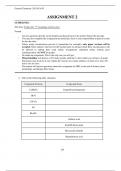
1) Fill out the following table. (8 points)
Compound Formula Compound Name
CuMnO4 Copper(I) permanganate
HCN
CuC2O4
KI
Rb2SO3
Sulfuric acid
Iron(III) thiocyanate
Mercury(I) chloride
Hypochlorous acid
1/9
, General Chemistry 202-NYA-05
2) Complete the following table. (8 points)
Compound formula Molecular weight Mass% of C
(g.mol-1)
C2H4 28.06 85.60%
K2C2O4
C5H5N
C12H23O14P
Questions 3-5: indicate which statements are correct. There might be more than one!
3) About moles: (5 points)
a. The mole can only be used to quantify tiny objects.
b. One mole corresponds to the number of atoms contained in exactly 12 g of 12C.
c. One mole contains roughly 6.022 x 10¹² atoms.
d. One mole of softballs typically fit in a shopping cart.
e. The mole is a convenient way to group tiny objects so they can be easily quantified.
4) To balance a chemical equation, one needs to: (5 points)
a. Change compounds formulae so that all atoms on the left are also present on the right.
b. Keep physical states the same.
c. Make sure that the number of molecules is conserved.
d. Adjust molar ratios of compounds so that all atoms are accounted for on both sides.
e. Display all stoichiometric coefficients as integers.
5) About molar mass: (5 points)
a. The molar mass of an element is determined by measuring the percent composition of its
natural isotopes.
b. The molar mass is the mass of one mole of a substance.
c. The mass number of an element is also its molar mass.
d. The molar mass is the mass of an atom.
e. The molar mass of a compound is equal to the sum of the molar masses of its individual
elements.
2/9
ASSIGNMENT 2
GUIDELINES:
Due time: Friday Oct. 7th, beginning of the lecture
Format:
- Answer questions directly on the booklet and hand it back to the teacher before the due date.
- You may also complete this assignment electronically, but it is your responsibility to print it in time
for the due date.
- Unless major circumstances prevent it (quarantine for example), only paper versions will be
accepted. Only students who have let the teacher know in advance about these circumstances will
be allowed to submit their work online. Assignments submitted online without prior
communication will NOT be graded.
- No make-up assignment. This is the only one you will get.
- Missed deadline will lead to a 10% daily penalty until day 5, after which you will get a 0 grade.
Extensions may be given if you explain the reasons you cannot submit it on time more than 24h
before the due time.
- The teacher will answer questions about this assignment by MIO, at the end of lectures (time
permitting), and during office hours.
1) Fill out the following table. (8 points)
Compound Formula Compound Name
CuMnO4 Copper(I) permanganate
HCN
CuC2O4
KI
Rb2SO3
Sulfuric acid
Iron(III) thiocyanate
Mercury(I) chloride
Hypochlorous acid
1/9
, General Chemistry 202-NYA-05
2) Complete the following table. (8 points)
Compound formula Molecular weight Mass% of C
(g.mol-1)
C2H4 28.06 85.60%
K2C2O4
C5H5N
C12H23O14P
Questions 3-5: indicate which statements are correct. There might be more than one!
3) About moles: (5 points)
a. The mole can only be used to quantify tiny objects.
b. One mole corresponds to the number of atoms contained in exactly 12 g of 12C.
c. One mole contains roughly 6.022 x 10¹² atoms.
d. One mole of softballs typically fit in a shopping cart.
e. The mole is a convenient way to group tiny objects so they can be easily quantified.
4) To balance a chemical equation, one needs to: (5 points)
a. Change compounds formulae so that all atoms on the left are also present on the right.
b. Keep physical states the same.
c. Make sure that the number of molecules is conserved.
d. Adjust molar ratios of compounds so that all atoms are accounted for on both sides.
e. Display all stoichiometric coefficients as integers.
5) About molar mass: (5 points)
a. The molar mass of an element is determined by measuring the percent composition of its
natural isotopes.
b. The molar mass is the mass of one mole of a substance.
c. The mass number of an element is also its molar mass.
d. The molar mass is the mass of an atom.
e. The molar mass of a compound is equal to the sum of the molar masses of its individual
elements.
2/9


