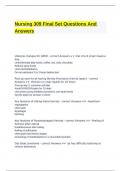
Nursing 309 Final Set Questions And
Answers
Lifestyle changes for GERD - correct Answers ✔✔ -Eat 4 to 6 small meals a
day.
Limit/eliminate fatty foods, coffee, tea, cola, chocolate.
Reduce spicy foods
Limit alcohol/tobacco
Do not eat/snack 2 to 3 hours before bed
Post op care for pt having Stretta Procedure (hernia repair) - correct
Answers ✔✔ -Remain on clear liquids for 24 hours
Post op day 2: consume soft diet
Avoid NSAIDS/Aspirin for 10 days
Use proton pump inhibitors (protonix), use liquid meds
No NG tubes for at least 1 month
Key features of sliding hiatal hernias - correct Answers ✔✔ -heartburn
regurgitation
chest pain
dysphagia
belching
Key features of Paraesophageal hernias - correct Answers ✔✔ -Feeling of
fullness after eating
breathlessness after eating
feeling of suffocation
chest pain that mimics angina
worsening of manifestations in a recumbent position
Gas bloat syndrome - correct Answers ✔✔ -pt has difficulty belching to
relieve distention
,Lifestyle changes for gastritis - correct Answers ✔✔ -eat a well balanced
diet
avoid drinking excess alcohol, coffee
Do not take large amounts of NSAIDS, Corticosteroids
Avoid food borne illnesses
smoking cessation
Acute gastritis - correct Answers ✔✔ -rapid onset of epigastric pain
nausea/vomiting
vomiting blood (hematemesis)
gastric hemorrhage
heartburn (dyspepsia)
anorexia
Chronic gastritis - correct Answers ✔✔ -vague report of epigastric pain
relieved by food
anorexia
nausea/vomiting
intolerance of fatty/spicy foods
pernicious anemia
Herbs for gastritis/peptic ulcer disease - correct Answers ✔✔ -cranberry,
ginger, licorice, probiotics, slippery elm, vitamin C
upper GI bleeding - correct Answers ✔✔ -bright red/coffee ground vomitus
melena (tarry stools)
increased heart rate/decreased blood pressure
weak peripheral pulses
Drugs for peptic ulcer disease - correct Answers ✔✔ -antacids, H2
antagonists, mucosal barrier fortifiers, proton pump inhibitors,
prostaglandin analogs, antimicrobrials
Antacids - correct Answers ✔✔ -magnesium hydroxide, aluminum
hydroxide
H2 antagonists - correct Answers ✔✔ -ranitidine (zantac)
famotidine (Pepcid)
nizatidine (Axid)
Mucosal barrier fortifiers - correct Answers ✔✔ -bismuth subsalicylate
(peptobismol)
sucralfate (sulcrate)
,gastric ulcers are more likely to have _____ than duodenal ulcers - correct
Answers ✔✔ -hematemesis
duodenal ulcers are more likely to have ___ than gastric ulcers - correct
Answers ✔✔ -melena
Antimicrobials for H. pylori - correct Answers ✔✔ -Biaxin, Amoxicillin,
Tetracycline, Metroniadazole
Peptic ulcer disease pt should go to the ED if: - correct Answers ✔✔ -
sharp, sudden, severe abdominal pain
bloody/black stools
bloody vomit
vomit that looks like coffee grounds
After esophageal surgery, make sure that the pt - correct Answers ✔✔ -
has a gag reflex before giving anything orally
direct inguinal hernia - correct Answers ✔✔ -passes through a weak point
in the abdominal wall
femoral hernia - correct Answers ✔✔ -protrude through the femoral ring
ventral hernia (incisional) - correct Answers ✔✔ -occur at a site of previous
hernia
indirect inguinal hernia - correct Answers ✔✔ -sac formed from the
peritoneum that contains a portion of the intestine
irreducible hernia - correct Answers ✔✔ -a hernia that cannot be place
back into the abdominal cavity
post op hernia repair care - correct Answers ✔✔ -monitor vital signs: focus
on blood pressure to detect bleeding
assess incisional pain
encourage deep breathing
encourage ambulation
apply ice packs to surgical area
do not life more than 10 pounds
A pt with multiple sclerosis (MS) is prescribed oral fingolimod (Gilenya).
, Which key point must the Rn teach the pt about this drug? - correct
Answers ✔✔ -"We need to teach you how to monitor your pulse rate
because this drug can cause a slow heart rate."
The pt is a woman in her early 30s who has recently been diagnosed with MS.
The RN has taught the pt's husband about the course of the illness and what
problems might occur in the future.
Which statement made by her husband indicates the need for additional
teaching? - correct Answers ✔✔ -"Later on she could have intermittent
short term memory loss."
The Rn is teaching a pt with MS and her family about her exercise program.
Which points must the Rn include? - correct Answers ✔✔ -Range of motion
exercises are an important component.
Increased body temperature can lead to increased fatigue.
Stretching and strengthening exercises will be part of your program.
The pt with MS has dysarthria (slurred speech).
For which complication must the RN monitor in this pt? - correct Answers
✔✔ -Dysphagia
Ataxia
The pt with MS states she is bothered by diplopia (double vision).
Which intervention does the Rn expect to implement? - correct Answers
✔✔ -Application of an eye patch alternating from eye to eye every few
hours.
The pt and family are referred to the RN for education about amyotrophic lateral
sclerosis (ALS).
What information does the RN included in the educational session? -
correct Answers ✔✔ -It is a progressive disease involving the motor
system.
The cause of ALS is unknown.
Answers
Lifestyle changes for GERD - correct Answers ✔✔ -Eat 4 to 6 small meals a
day.
Limit/eliminate fatty foods, coffee, tea, cola, chocolate.
Reduce spicy foods
Limit alcohol/tobacco
Do not eat/snack 2 to 3 hours before bed
Post op care for pt having Stretta Procedure (hernia repair) - correct
Answers ✔✔ -Remain on clear liquids for 24 hours
Post op day 2: consume soft diet
Avoid NSAIDS/Aspirin for 10 days
Use proton pump inhibitors (protonix), use liquid meds
No NG tubes for at least 1 month
Key features of sliding hiatal hernias - correct Answers ✔✔ -heartburn
regurgitation
chest pain
dysphagia
belching
Key features of Paraesophageal hernias - correct Answers ✔✔ -Feeling of
fullness after eating
breathlessness after eating
feeling of suffocation
chest pain that mimics angina
worsening of manifestations in a recumbent position
Gas bloat syndrome - correct Answers ✔✔ -pt has difficulty belching to
relieve distention
,Lifestyle changes for gastritis - correct Answers ✔✔ -eat a well balanced
diet
avoid drinking excess alcohol, coffee
Do not take large amounts of NSAIDS, Corticosteroids
Avoid food borne illnesses
smoking cessation
Acute gastritis - correct Answers ✔✔ -rapid onset of epigastric pain
nausea/vomiting
vomiting blood (hematemesis)
gastric hemorrhage
heartburn (dyspepsia)
anorexia
Chronic gastritis - correct Answers ✔✔ -vague report of epigastric pain
relieved by food
anorexia
nausea/vomiting
intolerance of fatty/spicy foods
pernicious anemia
Herbs for gastritis/peptic ulcer disease - correct Answers ✔✔ -cranberry,
ginger, licorice, probiotics, slippery elm, vitamin C
upper GI bleeding - correct Answers ✔✔ -bright red/coffee ground vomitus
melena (tarry stools)
increased heart rate/decreased blood pressure
weak peripheral pulses
Drugs for peptic ulcer disease - correct Answers ✔✔ -antacids, H2
antagonists, mucosal barrier fortifiers, proton pump inhibitors,
prostaglandin analogs, antimicrobrials
Antacids - correct Answers ✔✔ -magnesium hydroxide, aluminum
hydroxide
H2 antagonists - correct Answers ✔✔ -ranitidine (zantac)
famotidine (Pepcid)
nizatidine (Axid)
Mucosal barrier fortifiers - correct Answers ✔✔ -bismuth subsalicylate
(peptobismol)
sucralfate (sulcrate)
,gastric ulcers are more likely to have _____ than duodenal ulcers - correct
Answers ✔✔ -hematemesis
duodenal ulcers are more likely to have ___ than gastric ulcers - correct
Answers ✔✔ -melena
Antimicrobials for H. pylori - correct Answers ✔✔ -Biaxin, Amoxicillin,
Tetracycline, Metroniadazole
Peptic ulcer disease pt should go to the ED if: - correct Answers ✔✔ -
sharp, sudden, severe abdominal pain
bloody/black stools
bloody vomit
vomit that looks like coffee grounds
After esophageal surgery, make sure that the pt - correct Answers ✔✔ -
has a gag reflex before giving anything orally
direct inguinal hernia - correct Answers ✔✔ -passes through a weak point
in the abdominal wall
femoral hernia - correct Answers ✔✔ -protrude through the femoral ring
ventral hernia (incisional) - correct Answers ✔✔ -occur at a site of previous
hernia
indirect inguinal hernia - correct Answers ✔✔ -sac formed from the
peritoneum that contains a portion of the intestine
irreducible hernia - correct Answers ✔✔ -a hernia that cannot be place
back into the abdominal cavity
post op hernia repair care - correct Answers ✔✔ -monitor vital signs: focus
on blood pressure to detect bleeding
assess incisional pain
encourage deep breathing
encourage ambulation
apply ice packs to surgical area
do not life more than 10 pounds
A pt with multiple sclerosis (MS) is prescribed oral fingolimod (Gilenya).
, Which key point must the Rn teach the pt about this drug? - correct
Answers ✔✔ -"We need to teach you how to monitor your pulse rate
because this drug can cause a slow heart rate."
The pt is a woman in her early 30s who has recently been diagnosed with MS.
The RN has taught the pt's husband about the course of the illness and what
problems might occur in the future.
Which statement made by her husband indicates the need for additional
teaching? - correct Answers ✔✔ -"Later on she could have intermittent
short term memory loss."
The Rn is teaching a pt with MS and her family about her exercise program.
Which points must the Rn include? - correct Answers ✔✔ -Range of motion
exercises are an important component.
Increased body temperature can lead to increased fatigue.
Stretching and strengthening exercises will be part of your program.
The pt with MS has dysarthria (slurred speech).
For which complication must the RN monitor in this pt? - correct Answers
✔✔ -Dysphagia
Ataxia
The pt with MS states she is bothered by diplopia (double vision).
Which intervention does the Rn expect to implement? - correct Answers
✔✔ -Application of an eye patch alternating from eye to eye every few
hours.
The pt and family are referred to the RN for education about amyotrophic lateral
sclerosis (ALS).
What information does the RN included in the educational session? -
correct Answers ✔✔ -It is a progressive disease involving the motor
system.
The cause of ALS is unknown.