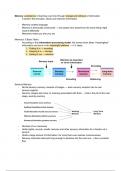
Memory: persistence of learning over time through storage and retrieval of information
- A system that encodes, stores and retrieves information
- Memory creates language
- Memory is personally constructed → two people who experience the same thing might
recall it differently
- Memories make you who you are
Memory’s 3 Basic Tasks
- According to the information-processing model, the human brain takes “meaningless”
information and turns it into meaningful patterns → in 3 steps:
1. Putting it in → encoding
2. Keeping it in → storage
3. Getting it out → retrieval
Sensory Memory
- Not all sensory memory consists of images → each sensory receptor has its own
sensory register
- Sensory images also have no meaning associated with them → that is the job of the next
stage, working memory
- Shortest of our memories
- Holds sights, sounds, smells, textures and other sensory information for a fraction of a
second
- Holds a large amount of information, far more than ever reaches consciousness
- Sensory memories lasts just long enough to dissolve into the next one → like a constant
flow
, - Unless you pay attention to it and bring it to short term memory, you’re not going
to remember every single sensation
- Esp visual stimuli since they last less than a sec VS auditory lasts 1-4 sec
- Sperling’s experiment → George Sperling → put letters in rows and tone to indicate
which row to recall
- Showed people three rows of three letters → each for 1/20th of a sec
- After nine letters disappeared from screen, people could only recall about half of
them
- It was not because of insufficient time → Sperling demonstrated that even at
faster than lightning-flash speed, people CAN see and recall ALL letters → only
momentarily
- Rather than asking to recall all 9 letters at once → he would sound a high,
medium, or low tone immediately after showing the letters
- This cue told participants to only recall letters of top, middle, or bottom row
respectively according to the tones
- With this cue that signaled them to recall a particular row immediately after →
they rarely missed a letter
- Proved that all nine letters were momentarily available for recall
- Revealed we have a fleeting photographic memory → iconic memory
- We also have perfect (but fleeting)
memory for auditory sensory → echoic memory
- Ie. someone is talking to you → last few words spoken lingers for 3-4
seconds if you partially paid attention
- You will recover last few words from your mind’s echo chamber
- Echoic memory is better than iconic memory
Encoding
- Encoding: modification of information to fit the preferred format for the memory system
- Most encoding is automatic and happens without our awareness
- Other encoding, like taking notes, require extra effortful encoding called
elaboration to make the memory useful
- Elaboration is more effortful memory making process
- The more time we spend learning new information, the more we remember
, - When we are exposed to stimuli and encode info → we do it in 3 ways:
1. Semantic encoding
- Encoding of meaning
- Including meaning of words
- Understanding of what words means and how they work
2. Acoustic encoding
- Encoding of sound
- Esp sound of words
- Ie. when you teach a toddler words, you say “table” and point to a
table → the toddler associates sound to that object
3. Visual encoding
- Encoding of picture / images
- Levels of processing
- Processing a word by its meaning (semantic encoding) produces better
recognition of it at a later time
- A system that encodes, stores and retrieves information
- Memory creates language
- Memory is personally constructed → two people who experience the same thing might
recall it differently
- Memories make you who you are
Memory’s 3 Basic Tasks
- According to the information-processing model, the human brain takes “meaningless”
information and turns it into meaningful patterns → in 3 steps:
1. Putting it in → encoding
2. Keeping it in → storage
3. Getting it out → retrieval
Sensory Memory
- Not all sensory memory consists of images → each sensory receptor has its own
sensory register
- Sensory images also have no meaning associated with them → that is the job of the next
stage, working memory
- Shortest of our memories
- Holds sights, sounds, smells, textures and other sensory information for a fraction of a
second
- Holds a large amount of information, far more than ever reaches consciousness
- Sensory memories lasts just long enough to dissolve into the next one → like a constant
flow
, - Unless you pay attention to it and bring it to short term memory, you’re not going
to remember every single sensation
- Esp visual stimuli since they last less than a sec VS auditory lasts 1-4 sec
- Sperling’s experiment → George Sperling → put letters in rows and tone to indicate
which row to recall
- Showed people three rows of three letters → each for 1/20th of a sec
- After nine letters disappeared from screen, people could only recall about half of
them
- It was not because of insufficient time → Sperling demonstrated that even at
faster than lightning-flash speed, people CAN see and recall ALL letters → only
momentarily
- Rather than asking to recall all 9 letters at once → he would sound a high,
medium, or low tone immediately after showing the letters
- This cue told participants to only recall letters of top, middle, or bottom row
respectively according to the tones
- With this cue that signaled them to recall a particular row immediately after →
they rarely missed a letter
- Proved that all nine letters were momentarily available for recall
- Revealed we have a fleeting photographic memory → iconic memory
- We also have perfect (but fleeting)
memory for auditory sensory → echoic memory
- Ie. someone is talking to you → last few words spoken lingers for 3-4
seconds if you partially paid attention
- You will recover last few words from your mind’s echo chamber
- Echoic memory is better than iconic memory
Encoding
- Encoding: modification of information to fit the preferred format for the memory system
- Most encoding is automatic and happens without our awareness
- Other encoding, like taking notes, require extra effortful encoding called
elaboration to make the memory useful
- Elaboration is more effortful memory making process
- The more time we spend learning new information, the more we remember
, - When we are exposed to stimuli and encode info → we do it in 3 ways:
1. Semantic encoding
- Encoding of meaning
- Including meaning of words
- Understanding of what words means and how they work
2. Acoustic encoding
- Encoding of sound
- Esp sound of words
- Ie. when you teach a toddler words, you say “table” and point to a
table → the toddler associates sound to that object
3. Visual encoding
- Encoding of picture / images
- Levels of processing
- Processing a word by its meaning (semantic encoding) produces better
recognition of it at a later time