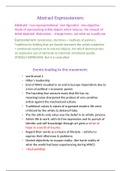
Abstract Expressionism:
Abstract: ‘non-representational’ ‘non-figurative’ ‘non-objective.’
Mode of representing visible objects which reduces, the amount of
detail depicted. Abstraction – change forms, not what we usually see
Expressionism: tendencies, doctrines + methods of painters.
Traditions by holding that art should represent the artists subjective
+ emotional reaction on to natural objects. Art which demonstrates
an expressive use of elements & materials. Emotional quality.
STONGLY EXPRESSIVE. But it is controlled
Events leading to this movement:
- world word 2
- Hitler’s leadership.
- End of WW2 resulted in an end to Europe imperialism due to
a loss of political + economic power.
- The haunting fear amount many that life has no
meaning/value sharpened the protest of very sensitive
artists against the mechanized culture.
- Traditional values & values of organized modern life were
criticized by the artists & declared false.
- The the artists only value was the belief in to artistic process.
- Artists life & work, with its free expression and its pursuit of
identity and self-knowledge through art gives a sense of
hope in a world of trauma.
- Regard their works as a means of lifestyle – activity to
express their dilemmas & problems.
- Denied objectivity to escape reality. (the harsh reality of
what the world had been experiencing during WW2)
- ‘ritual painting’
, - Art reflects society. Art that was done in the past may still
have been relevant at the time, but changes in the world +
the needs of man changing.
- AE provided new solutions to new situations.
Influences of European art on American art:
- A rational formalistic abstract trend which originated in
Cubism.
- The AE learned from the cubism how to extract the essence
from familiar shapes & forms.
- Cubism also inspired the different approach to the integrity
of the surface of the picture.
- AE acknowledged the 2D & shape of their canvases & made
no attempt to create the illusion of space.
- The anti-rational, emotional, expressive trend – promoted
through Surrealistics.
- Kandinsky’s works inspired the AE through his use of
automatic & spontaneous non-objectivity and his mystical
interpretation of colour + line.
- Experimented with chances
- Depict their emotions (their nuclear fear) symbolic +
expressive.
- Depict their emotions but not through traditional aspects.
Diff way to express how they are feeling
- Throw out subject matter. No subject matter.
- Work still w art elements + principles but not in a
representational way.
- Nothing recognizable.
Abstract: ‘non-representational’ ‘non-figurative’ ‘non-objective.’
Mode of representing visible objects which reduces, the amount of
detail depicted. Abstraction – change forms, not what we usually see
Expressionism: tendencies, doctrines + methods of painters.
Traditions by holding that art should represent the artists subjective
+ emotional reaction on to natural objects. Art which demonstrates
an expressive use of elements & materials. Emotional quality.
STONGLY EXPRESSIVE. But it is controlled
Events leading to this movement:
- world word 2
- Hitler’s leadership.
- End of WW2 resulted in an end to Europe imperialism due to
a loss of political + economic power.
- The haunting fear amount many that life has no
meaning/value sharpened the protest of very sensitive
artists against the mechanized culture.
- Traditional values & values of organized modern life were
criticized by the artists & declared false.
- The the artists only value was the belief in to artistic process.
- Artists life & work, with its free expression and its pursuit of
identity and self-knowledge through art gives a sense of
hope in a world of trauma.
- Regard their works as a means of lifestyle – activity to
express their dilemmas & problems.
- Denied objectivity to escape reality. (the harsh reality of
what the world had been experiencing during WW2)
- ‘ritual painting’
, - Art reflects society. Art that was done in the past may still
have been relevant at the time, but changes in the world +
the needs of man changing.
- AE provided new solutions to new situations.
Influences of European art on American art:
- A rational formalistic abstract trend which originated in
Cubism.
- The AE learned from the cubism how to extract the essence
from familiar shapes & forms.
- Cubism also inspired the different approach to the integrity
of the surface of the picture.
- AE acknowledged the 2D & shape of their canvases & made
no attempt to create the illusion of space.
- The anti-rational, emotional, expressive trend – promoted
through Surrealistics.
- Kandinsky’s works inspired the AE through his use of
automatic & spontaneous non-objectivity and his mystical
interpretation of colour + line.
- Experimented with chances
- Depict their emotions (their nuclear fear) symbolic +
expressive.
- Depict their emotions but not through traditional aspects.
Diff way to express how they are feeling
- Throw out subject matter. No subject matter.
- Work still w art elements + principles but not in a
representational way.
- Nothing recognizable.