

Chapter 2: Structure and Function of the Nervous System
Cells of the Nervous System
- All tissues in the body are composed of cells
- Understanding how cells become specialized is important for basic science and clinical
research
- Embryonic stem cells become neurons and glial cells provide support for neurons
- Histological methods involve preparing tissue for microscopic study
- New technologies provide investigators with tools to identify minute di erences in the
structural features of neurons.
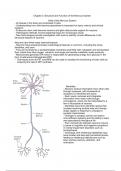
Neurons have three major external features
- Neurons have several principal morphological features in common, including the soma,
dendrites, and axon.
- They are enclosed by a semipermeable membrane and lled with cytoplasm and extracellular
uid, where they take oxygen, nutrients, and drugs and secrete metabolic waste products.
- Mitochondria generate ATP, which is responsible for generating energy from glucose in the
form of adenosine triphosphate (ATP).
- Techniques such as PET and fMRI can be used to visualize the functioning of brain cells by
analyzing the rate of ATP synthesis.
Dendrites
- Neurons receive information from other cells
through synapses, with thousands of
receptors on dendrites and soma
- Each neuron receives and integrates
information from many cells through
convergence, which can be transmitted to a
few or thousands of neurons
- Dendrites have short dendritic spines that
increase receiving surface area and change
shape rapidly in response to changes in
synaptic transmission
- Changes in synaptic activity can lead to
more e cient signaling and the ability to learn
new associations throughout life
- Poor connectivity between neurons may be
a cause of cognitive and negative symptoms
in mental impairment disorders such as
schizophrenia
- Individuals with intellectual disabilities may
have smaller and less well-connected spines,
leading to intellectual de ciencies such as
poor working memory, attention, and
motivation.
fl ffi fi fi ff
, Axons and Terminal Buttons
- Axons are tubular structures that transmit electrical signals from the axon hillock to the
terminals
- There is usually only one axon for a given neuron, but axons can split into branches called
axon collaterals to in uence many more cells
- Terminal buttons at the ends of axons contain neurotransmitters that transmit information to
adjacent cells or organs
- Most axons are wrapped with a fatty insulating coating called myelin, which increases the
speed of conduction and reduces energy required to restore neurons
- Multiple sclerosis (MS) is an autoimmune disease that damages the myelin sheath in neurons,
leading to symptoms such as fatigue, numbness, and cognitive dysfunction
- Myelin can be repaired by oliogodendroglia, but the repair is slow and not very e ective in MS
- Researchers are hopeful for new drugs that reverse nerve damage by facilitating
remyelination to improve symptoms in MS.
Soma
- The cell body synthesizes proteins for growth and maintenance of neurons, including
enzymes, receptors, and components of the cell membrane.
- Each cell type manufactures only those proteins needed for its speci c function, and which
speci c genes are activated by day-to-day experience is determined in part by stress and
chronic drug use
- Transcription occurs in the nucleus, where messenger RNA makes a complementary copy of
the active gene, and translation links the appropriate amino acids together to form the protein
- The basic steps in protein synthesis are shown in FIGURE 2.5.
Epigenetics
- Environmental events can alter gene expression through induction of transcription factors
- Epigenetic modi cations can determine which genes will be turned on or o and how much
gene expression occurs
- Changes in the germ cell line can persist through the lifetime of the organism and be passed
on to future generations
- Chromatin remodeling can loosen the chromatin structure, allowing transcription factors to
bind to the DNA and activate expression of the gene
- Pre- or postnatal epigenetic modi cation can occur in response to environmental factors
such as starvation or overabundance of food, stress, poor prenatal nutrition, childhood abuse
and neglect, exposure to environmental toxins, etc.
Axoplasmic Transport
- Axoplasmic transport is the process of moving proteins from the soma to the axon terminals
in neurons.
- The cytoskeleton is a matrix composed of tubular structures that includes microtubules and
neuro laments that form a mesh-like mass that provides shape for the cell and provide a
stationary track for motor proteins to carry newly synthesized proteins.
- Neuro brillary tangles are one of several pathological features of the brain in people with
Alzheimer's disease, caused by abnormal cytoskeletal structures and the hyperphosphorylation
of tau proteins in the neuro lament proteins.
The number of tangles related to cognitive impairment is directly related to the extent of
cognitive impairment, highlighting the importance of cytoskeleton function in brain function.
Characteristics of the cell membrane are critical for neuron function
- The cell membrane is a crucial component of neurons that prevents most materials from
passing freely.
fifi fi fi fl fi fi fi ff ff
Cells of the Nervous System
- All tissues in the body are composed of cells
- Understanding how cells become specialized is important for basic science and clinical
research
- Embryonic stem cells become neurons and glial cells provide support for neurons
- Histological methods involve preparing tissue for microscopic study
- New technologies provide investigators with tools to identify minute di erences in the
structural features of neurons.
Neurons have three major external features
- Neurons have several principal morphological features in common, including the soma,
dendrites, and axon.
- They are enclosed by a semipermeable membrane and lled with cytoplasm and extracellular
uid, where they take oxygen, nutrients, and drugs and secrete metabolic waste products.
- Mitochondria generate ATP, which is responsible for generating energy from glucose in the
form of adenosine triphosphate (ATP).
- Techniques such as PET and fMRI can be used to visualize the functioning of brain cells by
analyzing the rate of ATP synthesis.
Dendrites
- Neurons receive information from other cells
through synapses, with thousands of
receptors on dendrites and soma
- Each neuron receives and integrates
information from many cells through
convergence, which can be transmitted to a
few or thousands of neurons
- Dendrites have short dendritic spines that
increase receiving surface area and change
shape rapidly in response to changes in
synaptic transmission
- Changes in synaptic activity can lead to
more e cient signaling and the ability to learn
new associations throughout life
- Poor connectivity between neurons may be
a cause of cognitive and negative symptoms
in mental impairment disorders such as
schizophrenia
- Individuals with intellectual disabilities may
have smaller and less well-connected spines,
leading to intellectual de ciencies such as
poor working memory, attention, and
motivation.
fl ffi fi fi ff
, Axons and Terminal Buttons
- Axons are tubular structures that transmit electrical signals from the axon hillock to the
terminals
- There is usually only one axon for a given neuron, but axons can split into branches called
axon collaterals to in uence many more cells
- Terminal buttons at the ends of axons contain neurotransmitters that transmit information to
adjacent cells or organs
- Most axons are wrapped with a fatty insulating coating called myelin, which increases the
speed of conduction and reduces energy required to restore neurons
- Multiple sclerosis (MS) is an autoimmune disease that damages the myelin sheath in neurons,
leading to symptoms such as fatigue, numbness, and cognitive dysfunction
- Myelin can be repaired by oliogodendroglia, but the repair is slow and not very e ective in MS
- Researchers are hopeful for new drugs that reverse nerve damage by facilitating
remyelination to improve symptoms in MS.
Soma
- The cell body synthesizes proteins for growth and maintenance of neurons, including
enzymes, receptors, and components of the cell membrane.
- Each cell type manufactures only those proteins needed for its speci c function, and which
speci c genes are activated by day-to-day experience is determined in part by stress and
chronic drug use
- Transcription occurs in the nucleus, where messenger RNA makes a complementary copy of
the active gene, and translation links the appropriate amino acids together to form the protein
- The basic steps in protein synthesis are shown in FIGURE 2.5.
Epigenetics
- Environmental events can alter gene expression through induction of transcription factors
- Epigenetic modi cations can determine which genes will be turned on or o and how much
gene expression occurs
- Changes in the germ cell line can persist through the lifetime of the organism and be passed
on to future generations
- Chromatin remodeling can loosen the chromatin structure, allowing transcription factors to
bind to the DNA and activate expression of the gene
- Pre- or postnatal epigenetic modi cation can occur in response to environmental factors
such as starvation or overabundance of food, stress, poor prenatal nutrition, childhood abuse
and neglect, exposure to environmental toxins, etc.
Axoplasmic Transport
- Axoplasmic transport is the process of moving proteins from the soma to the axon terminals
in neurons.
- The cytoskeleton is a matrix composed of tubular structures that includes microtubules and
neuro laments that form a mesh-like mass that provides shape for the cell and provide a
stationary track for motor proteins to carry newly synthesized proteins.
- Neuro brillary tangles are one of several pathological features of the brain in people with
Alzheimer's disease, caused by abnormal cytoskeletal structures and the hyperphosphorylation
of tau proteins in the neuro lament proteins.
The number of tangles related to cognitive impairment is directly related to the extent of
cognitive impairment, highlighting the importance of cytoskeleton function in brain function.
Characteristics of the cell membrane are critical for neuron function
- The cell membrane is a crucial component of neurons that prevents most materials from
passing freely.
fifi fi fi fl fi fi fi ff ff


