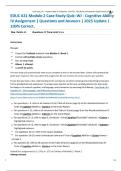
Question1
1.1 b
1.2 a
1.3 b
1.4 c
1.5 b
1.6 b
1.7 b
1.8 c
1.9 c
1.10 b
1.2.1 FALSE. According to the guidelines for applying Africanisation of assessment,
embracing only Afrocentric knowledge systems is not the sole focus when planning and
implementing assessments.
1.2.2 TRUE. Fairness of assessment indeed suggests that learners should be treated
equally, taking into account the dynamic nature of the classroom.
1.2.3 TRUE. Learning intentions do indicate the scope of content to be taught and assessed
during the teaching and learning process.
1.2.4 FALSE. Teachers should monitor learners’ progress throughout the assessment
process, not just focus on the final results.
1.2.5 TRUE. In inclusive education, using applications on mobile phones and laptops that
transcribe spoken words can help learners overcome barriers to learning.
, 1.3.1 – B. National Curriculum Assessment Policy Statement
1.3.2 – D. National protocol pertaining to the programme and promotion requirements
1.3.3 – F. Education White Paper 6
1.3.4 – C. Section 4 of the CAPS
1.3.5 – A. National Assessment Policy
Question 2
2.1 The two national curricula statements replaced by The National Curriculum Statement
Grades R – 12 (January 2012) are the Revised National Curriculum Statement Grades R-9
and the National Curriculum Statement Grades 10-12.
2.2The National Curriculum Statement Grade R – 12 aims to produce learners who can
think critically, solve problems, work effectively as part of a team, and communicate
effectively.
2.3 In the CAPS, the steps involved in assessment include planning assessment,
conducting assessment, recording assessment, and interpreting and using assessment
information.
2.4.1Applying the principle of active and critical learning in assessing learners means
designing assessments that require students to think deeply about the material, analyze
information, and apply their knowledge creatively. It involves moving beyond memorization
to evaluating students’ ability to think critically, solve problems, and demonstrate a deeper
understanding of the subject matter in various contexts. This approach aims to assess not
just what students know but how well they can apply their knowledge and think
independently.
2.4.2To apply the principle of active and critical learning in assessing learners, you can
design assessments that go beyond simple recall of facts. Encourage students to analyze
information, think critically, and apply their knowledge in real-world scenarios. This can be
done through open-ended questions, case studies, projects, and group discussions that
require students to demonstrate their understanding by applying their knowledge
creatively. By incorporating these elements into assessments, you can evaluate not just
1.1 b
1.2 a
1.3 b
1.4 c
1.5 b
1.6 b
1.7 b
1.8 c
1.9 c
1.10 b
1.2.1 FALSE. According to the guidelines for applying Africanisation of assessment,
embracing only Afrocentric knowledge systems is not the sole focus when planning and
implementing assessments.
1.2.2 TRUE. Fairness of assessment indeed suggests that learners should be treated
equally, taking into account the dynamic nature of the classroom.
1.2.3 TRUE. Learning intentions do indicate the scope of content to be taught and assessed
during the teaching and learning process.
1.2.4 FALSE. Teachers should monitor learners’ progress throughout the assessment
process, not just focus on the final results.
1.2.5 TRUE. In inclusive education, using applications on mobile phones and laptops that
transcribe spoken words can help learners overcome barriers to learning.
, 1.3.1 – B. National Curriculum Assessment Policy Statement
1.3.2 – D. National protocol pertaining to the programme and promotion requirements
1.3.3 – F. Education White Paper 6
1.3.4 – C. Section 4 of the CAPS
1.3.5 – A. National Assessment Policy
Question 2
2.1 The two national curricula statements replaced by The National Curriculum Statement
Grades R – 12 (January 2012) are the Revised National Curriculum Statement Grades R-9
and the National Curriculum Statement Grades 10-12.
2.2The National Curriculum Statement Grade R – 12 aims to produce learners who can
think critically, solve problems, work effectively as part of a team, and communicate
effectively.
2.3 In the CAPS, the steps involved in assessment include planning assessment,
conducting assessment, recording assessment, and interpreting and using assessment
information.
2.4.1Applying the principle of active and critical learning in assessing learners means
designing assessments that require students to think deeply about the material, analyze
information, and apply their knowledge creatively. It involves moving beyond memorization
to evaluating students’ ability to think critically, solve problems, and demonstrate a deeper
understanding of the subject matter in various contexts. This approach aims to assess not
just what students know but how well they can apply their knowledge and think
independently.
2.4.2To apply the principle of active and critical learning in assessing learners, you can
design assessments that go beyond simple recall of facts. Encourage students to analyze
information, think critically, and apply their knowledge in real-world scenarios. This can be
done through open-ended questions, case studies, projects, and group discussions that
require students to demonstrate their understanding by applying their knowledge
creatively. By incorporating these elements into assessments, you can evaluate not just