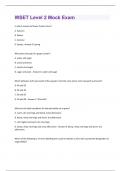
WSET Level 2 Mock Exam questions and answers graded A+
In which season do flower clusters form? A. Autumn B. Winter C. Summer D. Spring - Answer-D. Spring What does the pulp of a grape contain? A. water and sugar B. acid and tannins C. tannins and sugar D. sugar and yeast - Answer-A. water and sugar Which latitudes north and south of the equator mark the zone where most vineyards are found? A. 40 and 50 B. 20 and 40 C. 30 and 50 D. 30 and 40 - Answer-C. 30 and 50 What are the ideal conditions for botrytis/noble rot to grow? A. warm, dry mornings and damp, misty afternoons B. damp, misty mornings and warm, dry afternoons C. cool nights and warm, dry mornings D. damp, misty mornings and rainy afternoons - Answer-B. damp, misty mornings and warm, dry afternoons Which of the following is a French labelling term used to indicate a wine with a protected designation of origin (PDO)?A. Qualitätswein B. Vin de pays C. Indication géographique protégée D. Appellation d'origine contrôlée - Answer-D. Appellation d'origine contrôlée Which of the following techniques are used to produce sweet wines? 1. Juice is extracted from grapes with high levels of concentrated sugar 2. Yeast is removed after fermentation has completed 3. A dry wine is blended with a sweet wine A. 1 & 2 only B. 2 & 3 only C. 1, 2 & 3 D. 1 & 3 only - Answer-D. 1 & 3 only What is the correct sequence of events for most red winemaking? A. pressing, alcoholic fermentation B. pressing, crushing, alcoholic fermentation C. crushing, pressing, alcoholic fermentation D. crushing, alcoholic fermentation, pressing - Answer-D. crushing, alcoholic fermentation, pressing Outstanding-quality red wines age well for several years because they have... A. high tannins, low alcohol and low acidity B. low tannins, high alcohol and low acidity C. low tannins, concentrated fruit and low acidity D. high tannins, concentrated fruit and high acidity - Answer-D. high tannins, concentrated fruit and high acidity Which of the following can be used to add complexity to dry white wines?1. Blending 2. Malolactic conversion 3. Lees-stirring 4. Barrel Fermentation A. 1 & 2 only B. 1, 2, 3 & 4 C. 1 & 4 only D. 2, 3 & 4 only - Answer-B. 1, 2, 3 & 4
Written for
- Institution
- WSET Level 2
- Course
- WSET Level 2
Document information
- Uploaded on
- May 12, 2024
- Number of pages
- 12
- Written in
- 2023/2024
- Type
- Exam (elaborations)
- Contains
- Questions & answers
Subjects
-
wset level 2

Also available in package deal