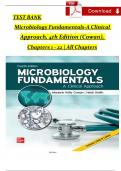
TEST BANK
Microbiology Fundamentals-A Clinical
Approach, 4th Edition (Cowan),
Chapters 1 - 22 | All Chapters
1
McGraw
, 2
McGraw
,Microbiology Fundamentals: A Clinical Approach, 4e
(Cowan)
Chapter 1 Introduction to Microbes and Their Building
Blocks
1) When humans manipulate the genes of microorganisms, the process is called .
A) bioremediation
B) genetic engineering
C) epidemiology
D) immunology
E) taxonomy
ANSWER: B
Section: 01.01
Topic: Microbial Roles; Basics of Genetic
EngineeringBloom's: 01. Remember
ASM Topic: Module 04 Information Flow
ASM Objective: 04.05 Cell genomes can be manipulated to alter cell function.
2) Which of the following is not considered a microorganism?
A) Mosquito
B) Protozoan
C) Bacterium
D) Virus
E) Fungus
ANSWER: A
Section: 01.01
Topic: Taxonomy of
MicroorganismsBloom's: 01.
Remember
ASM Topic: Module 01 Evolution
ASM Objective: 01.02 Mutations and horizontal gene transfer, along with the
immense variety ofmicroenvironments, have resulted in a vast diversity of
microorganisms.
3) All microorganisms are best defined as organisms that .
A) cause human disease
B) lack a cell nucleus
C) are infectious particles
D) are too small to be seen with the unaided eye
E) can only be found growing in laboratories
3
McGraw
,ANSWER: D
Section: 01.01
Topic: Microbial Roles
Bloom's: 01. Remember
ASM Topic: Module 01 Evolution
ASM Objective: 01.02 Mutations and horizontal gene transfer, along with the
immense variety ofmicroenvironments, have resulted in a vast diversity of
microorganisms.
4
McGraw
,4) Which activity is an example of biotechnology?
A) Bacteria in the soil secreting an antibiotic to kill competitors
B) A microbiologist using the microscope to study bacteria
C) Egyptians using moldy bread on wounds
D) Escherichia coli producing human insulin
E) Public health officials monitoring diseases in a community
ANSWER: D
Section: 01.01
Topic: Basics of Genetic
EngineeringBloom's: 02.
Understand
ASM Topic: Module 06 Impact of Microorganisms
ASM Objective: 06.03 Humans utilize and harness microorganisms and their
products.
5) Living things ordinarily too small to be seen with the unaided eye are termed .
A) bacteria
B) viruses
C) parasites
D) microorganisms
E) prokaryotes
ANSWER: D
Section: 01.01
Topic: Cellular
OrganizationBloom's:
01. Remember
ASM Topic: Module 01 Evolution
ASM Objective: 01.02 Mutations and horizontal gene transfer, along with the
immense variety ofmicroenvironments, have resulted in a vast diversity of
microorganisms.
6) The microorganisms that recycle nutrients by breaking down dead matter and
wastes are called
.
A) decomposers
B) prokaryotes
C) pathogens
D) eukaryotes
E) fermenters
ANSWER: A
Section: 01.01
Topic: Microbial Roles
Bloom's: 01. Remember
5
McGraw
,ASM Topic: Module 06 Impact of Microorganisms
ASM Objective: 06.01 Microbes are essential for life, as we know it, and the
processes thatsupport life (e.g. in biogeochemical cycles and plant/animal
microflora).
6
McGraw
,7) Cells, like bacteria and archaea, that do not have a nucleus in their cells have
traditionally beencalled .
A) decomposers
B) prokaryotes
C) pathogens
D) eukaryotes
E) fermenters
ANSWER: B
Section: 01.01
Topic: Cellular
OrganizationBloom's:
01. Remember
ASM Topic: Module 02 Structure and Function
ASM Objective: 01.01 Cells, organelles (e.g. mitochondria and chloroplasts) and all
majormetabolic pathways evolved from early prokaryotic cells.
8) The first cells appeared about billion years
ago.A) 5.2
B) 4.6
C) 3.8
D) 2.9
E) 1.5
ANSWER: C
Section: 01.01
Topic: History of Microbiology
Bloom's: 01. Remember
ASM Topic: Module 01 Evolution
ASM Objective: 01.01 Cells, organelles (e.g. mitochondria and chloroplasts) and all
majormetabolic pathways evolved from early prokaryotic cells.
9) Which of the following is not a human use of microorganisms?
A) Making bread
B) Treating water and sewage
C) Manufacturing copper wire
D) Mass producing antibiotics
E) Cleaning up oil spills
ANSWER: C
Section: 01.01
Topic: Microbial Roles
Bloom's: 01. Remember
ASM Topic: Module 06 Impact of Microorganisms
ASM Objective: 06.03 Humans utilize and harness microorganisms and their
products.
7
McGraw
,10) Using microbes to detoxify a site contaminated with heavy metals is an example
of .
A) biotechnology
B) bioremediation
C) decomposition
D) immunology
E) epidemiology
ANSWER: B
Section: 01.01
Topic: Microbial Roles
Bloom's: 01. Remember
ASM Topic: Module 06 Impact of Microorganisms
ASM Objective: 06.03 Humans utilize and harness microorganisms and their
products.
11) Disease-causing microorganisms are called .
A) decomposers
B) prokaryotes
C) pathogens
D) eukaryotes
E) fermenters
ANSWER: C
Section: 01.01
Topic: Microbial Roles
Bloom's: 01. Remember
ASM Topic: Module 06 Impact of Microorganisms
ASM Objective: 05.04 Microorganisms, cellular and viral, interact with both
human andnon-human hosts in beneficial, neutral or detrimental ways.
12) The most prevalent worldwide infectious diseases are .
A) AIDS-related diseases
B) diarrheal diseases
C) malaria diseases
D) measles
E) respiratory diseases
ANSWER: E
Section: 01.01
Topic: Microbial Roles
Bloom's: 01. Remember
ASM Topic: Module 06 Impact of Microorganisms
ASM Objective: 05.04 Microorganisms, cellular and viral, interact with both
human andnon-human hosts in beneficial, neutral or detrimental ways.
8
McGraw
, 13) Which of the following is a unique characteristic of viruses that distinguishes
them from theother major groups of microorganisms?
A) Cause human disease
B) Lack a nucleus
C) Cannot be seen without a microscope
D) Contain genetic material
E) Lack cell structure
ANSWER: E
Section: 01.01
Topic: General Viral Properties
Bloom's: 01. Remember
ASM Topic: Module 02 Structure and Function
ASM Objective: 01.02 Mutations and horizontal gene transfer, along with the
immense variety ofmicroenvironments, have resulted in a vast diversity of
microorganisms.
14) Helminths are .
A) bacteria
B) protozoa
C) molds
D) parasitic worms
E) infectious particles
ANSWER: D
Section: 01.01
Topic: Taxonomy of
MicroorganismsBloom's: 01.
Remember
ASM Topic: Module 02 Structure and Function
ASM Objective: 01.02 Mutations and horizontal gene transfer, along with the
immense variety ofmicroenvironments, have resulted in a vast diversity of
microorganisms.
15) Which group of microorganisms is composed only of hereditary material
wrapped in a proteincovering?
A) Viruses
B) Bacteria
C) Parasites
D) Fungi
E) Helminths
ANSWER: A
Section: 01.01
Topic: General Viral Properties
Bloom's: 01. Remember
9
McGraw
Microbiology Fundamentals-A Clinical
Approach, 4th Edition (Cowan),
Chapters 1 - 22 | All Chapters
1
McGraw
, 2
McGraw
,Microbiology Fundamentals: A Clinical Approach, 4e
(Cowan)
Chapter 1 Introduction to Microbes and Their Building
Blocks
1) When humans manipulate the genes of microorganisms, the process is called .
A) bioremediation
B) genetic engineering
C) epidemiology
D) immunology
E) taxonomy
ANSWER: B
Section: 01.01
Topic: Microbial Roles; Basics of Genetic
EngineeringBloom's: 01. Remember
ASM Topic: Module 04 Information Flow
ASM Objective: 04.05 Cell genomes can be manipulated to alter cell function.
2) Which of the following is not considered a microorganism?
A) Mosquito
B) Protozoan
C) Bacterium
D) Virus
E) Fungus
ANSWER: A
Section: 01.01
Topic: Taxonomy of
MicroorganismsBloom's: 01.
Remember
ASM Topic: Module 01 Evolution
ASM Objective: 01.02 Mutations and horizontal gene transfer, along with the
immense variety ofmicroenvironments, have resulted in a vast diversity of
microorganisms.
3) All microorganisms are best defined as organisms that .
A) cause human disease
B) lack a cell nucleus
C) are infectious particles
D) are too small to be seen with the unaided eye
E) can only be found growing in laboratories
3
McGraw
,ANSWER: D
Section: 01.01
Topic: Microbial Roles
Bloom's: 01. Remember
ASM Topic: Module 01 Evolution
ASM Objective: 01.02 Mutations and horizontal gene transfer, along with the
immense variety ofmicroenvironments, have resulted in a vast diversity of
microorganisms.
4
McGraw
,4) Which activity is an example of biotechnology?
A) Bacteria in the soil secreting an antibiotic to kill competitors
B) A microbiologist using the microscope to study bacteria
C) Egyptians using moldy bread on wounds
D) Escherichia coli producing human insulin
E) Public health officials monitoring diseases in a community
ANSWER: D
Section: 01.01
Topic: Basics of Genetic
EngineeringBloom's: 02.
Understand
ASM Topic: Module 06 Impact of Microorganisms
ASM Objective: 06.03 Humans utilize and harness microorganisms and their
products.
5) Living things ordinarily too small to be seen with the unaided eye are termed .
A) bacteria
B) viruses
C) parasites
D) microorganisms
E) prokaryotes
ANSWER: D
Section: 01.01
Topic: Cellular
OrganizationBloom's:
01. Remember
ASM Topic: Module 01 Evolution
ASM Objective: 01.02 Mutations and horizontal gene transfer, along with the
immense variety ofmicroenvironments, have resulted in a vast diversity of
microorganisms.
6) The microorganisms that recycle nutrients by breaking down dead matter and
wastes are called
.
A) decomposers
B) prokaryotes
C) pathogens
D) eukaryotes
E) fermenters
ANSWER: A
Section: 01.01
Topic: Microbial Roles
Bloom's: 01. Remember
5
McGraw
,ASM Topic: Module 06 Impact of Microorganisms
ASM Objective: 06.01 Microbes are essential for life, as we know it, and the
processes thatsupport life (e.g. in biogeochemical cycles and plant/animal
microflora).
6
McGraw
,7) Cells, like bacteria and archaea, that do not have a nucleus in their cells have
traditionally beencalled .
A) decomposers
B) prokaryotes
C) pathogens
D) eukaryotes
E) fermenters
ANSWER: B
Section: 01.01
Topic: Cellular
OrganizationBloom's:
01. Remember
ASM Topic: Module 02 Structure and Function
ASM Objective: 01.01 Cells, organelles (e.g. mitochondria and chloroplasts) and all
majormetabolic pathways evolved from early prokaryotic cells.
8) The first cells appeared about billion years
ago.A) 5.2
B) 4.6
C) 3.8
D) 2.9
E) 1.5
ANSWER: C
Section: 01.01
Topic: History of Microbiology
Bloom's: 01. Remember
ASM Topic: Module 01 Evolution
ASM Objective: 01.01 Cells, organelles (e.g. mitochondria and chloroplasts) and all
majormetabolic pathways evolved from early prokaryotic cells.
9) Which of the following is not a human use of microorganisms?
A) Making bread
B) Treating water and sewage
C) Manufacturing copper wire
D) Mass producing antibiotics
E) Cleaning up oil spills
ANSWER: C
Section: 01.01
Topic: Microbial Roles
Bloom's: 01. Remember
ASM Topic: Module 06 Impact of Microorganisms
ASM Objective: 06.03 Humans utilize and harness microorganisms and their
products.
7
McGraw
,10) Using microbes to detoxify a site contaminated with heavy metals is an example
of .
A) biotechnology
B) bioremediation
C) decomposition
D) immunology
E) epidemiology
ANSWER: B
Section: 01.01
Topic: Microbial Roles
Bloom's: 01. Remember
ASM Topic: Module 06 Impact of Microorganisms
ASM Objective: 06.03 Humans utilize and harness microorganisms and their
products.
11) Disease-causing microorganisms are called .
A) decomposers
B) prokaryotes
C) pathogens
D) eukaryotes
E) fermenters
ANSWER: C
Section: 01.01
Topic: Microbial Roles
Bloom's: 01. Remember
ASM Topic: Module 06 Impact of Microorganisms
ASM Objective: 05.04 Microorganisms, cellular and viral, interact with both
human andnon-human hosts in beneficial, neutral or detrimental ways.
12) The most prevalent worldwide infectious diseases are .
A) AIDS-related diseases
B) diarrheal diseases
C) malaria diseases
D) measles
E) respiratory diseases
ANSWER: E
Section: 01.01
Topic: Microbial Roles
Bloom's: 01. Remember
ASM Topic: Module 06 Impact of Microorganisms
ASM Objective: 05.04 Microorganisms, cellular and viral, interact with both
human andnon-human hosts in beneficial, neutral or detrimental ways.
8
McGraw
, 13) Which of the following is a unique characteristic of viruses that distinguishes
them from theother major groups of microorganisms?
A) Cause human disease
B) Lack a nucleus
C) Cannot be seen without a microscope
D) Contain genetic material
E) Lack cell structure
ANSWER: E
Section: 01.01
Topic: General Viral Properties
Bloom's: 01. Remember
ASM Topic: Module 02 Structure and Function
ASM Objective: 01.02 Mutations and horizontal gene transfer, along with the
immense variety ofmicroenvironments, have resulted in a vast diversity of
microorganisms.
14) Helminths are .
A) bacteria
B) protozoa
C) molds
D) parasitic worms
E) infectious particles
ANSWER: D
Section: 01.01
Topic: Taxonomy of
MicroorganismsBloom's: 01.
Remember
ASM Topic: Module 02 Structure and Function
ASM Objective: 01.02 Mutations and horizontal gene transfer, along with the
immense variety ofmicroenvironments, have resulted in a vast diversity of
microorganisms.
15) Which group of microorganisms is composed only of hereditary material
wrapped in a proteincovering?
A) Viruses
B) Bacteria
C) Parasites
D) Fungi
E) Helminths
ANSWER: A
Section: 01.01
Topic: General Viral Properties
Bloom's: 01. Remember
9
McGraw