1 Things in our ____________ can be considered in light of our goals, results in strategic
Q
or consciously mediated actions. Things in our _______________ can trigger habitual
behaviours and can also bias the way things appear in consciousness.
A. subconscious mind; conscious mind
B. conscious mind; unconscious mind
C. focused mind; conscious mind
D. unconscious mind; conscious mind
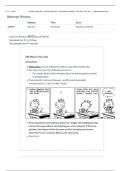
2 Thorndike put cats into a box that required a certain set of behaviors to open a door to
Q
see how long it took them to escape. At first, the cats tried various methods to get out of the
box—what Thorndike called trial-and-error learning, because it took so long to pay off and
seemed to occur at random. For instance, the cats might meow, scratch at the walls, paw at
the bars of the box, and push the door with their heads before finally emitting responses that
would release them from the box. In a puzzle box like the one below, cats turned a latch and
stepped on a pedal to release a pin holding the door. This allowed them to leave the box and
get fish. Thorndike found that after repeated trials, cats would produce the proper series of
behaviors required to release the door sooner. Because cats learned how to manipulate an
instrument such as a pedal, this type of learning is called ____________?
A. Systematic desensitization.
B. Instrumental.
C. Behaviorism.
D. Phobias.
3 Eleni and Ananya are friends and text every day. Ananya typically texts Eleni four times a
Q
day when Eleni responds (_________ in Figure 7.22). Then Eleni stopped responding to
Ananya's messages (___________ in Figure 7.22), and Ananya texted Eleni more times in a
day than she ever had before (___________ on days 7–13 in Figure 7.22). Eventually,
Ananya stopped texting Eleni (days 17–20 in Figure 7.22). Fill in the blanks with the
following words (refer to the graph below): extinction burst, reinforcement, extinction.
.
A ( 1) negative punishment, (2) positive punishment, (3) extinction.
B. (1) reinforcement, (2) extinction, (3) extinction burst.
C. (1) extinction, (2) reinforcement, (3) extinction burst..
D. (1) positive punishment, (2) negative punishment, (3) extinction.
4 In a study done by Merikle and Skanes (1992) on subliminal messages, participants
Q
were assigned to three groups. Which of the following best describes the results they found?
, A. A ll three groups lost weight and there was a difference between the three groups.
The results do not support the hypothesis that subliminal messages influence
behaviour.
B. All three groups lost weight and there was a difference between the three groups.
The results support the hypothesis that subliminal messages influence behaviour.
C. All three groups lost weight and there was no difference between the three groups.
The results do not support the hypothesis that subliminal messages influence
behaviour.
D. All three groups lost weight and there was no difference between the three groups.
The results support the hypothesis that subliminal messages influence behaviour.
5 Fill in the blanks. Behaviorism is ________ and was discovered by ______________
Q
using the _______ experiment.
A. (1) an approach to science that focuses on how we learn new behaviors and how
those behaviors change across different situations, (2) John B. Watson, (3) Little
Albert.
B. (1) an approach to science that focuses on how we learn new behaviors and how
those behaviors change across different situations, (2) Pavlov, (3) Little Albert.
C. (1) an approach to science that focuses on how we learn new behaviors and how
those behaviors change across different situations, (2) Pavlov, (3) Dog.
D. (1) an approach to science that focuses on how we learn new behaviors and how
those behaviors change across different situations, (2) Little Albert, (3) John B.
Watson.
6 You are completing a dichotic listening task. In the right ear, you hear a male repeating a
Q
speech made by former President Obama. In the left ear, you hear a female naming different
capitals of the world. You are told to pay attention to what is happening in your right ear,
what information might you be most likely to recall from your left ear?
A. The capital city of China.
B. The speed in which the speaker is talking in your left ear.
C. The gender of the speaker in your left ear.
D. The pitch of the speaker in your left ear.
7 Fill in the blanks. _______ (what you feel) are associated with the _________ system
Q
(emotional part of the brain) and are powerful enough to overcome _______ thought, which
is associated with the ______ lobes (rational part of the brain).
A. (1) rational, (2) limbic, (3) rational, (4) frontal.
B. (1) rational, (2) limbic, (3) emotions, (4) frontal.
C. (1) emotions, (2) limbic, (3) rational, (4) frontal.
D. (1) emotions, (2) rational, (3) limbic, (4) frontal.
8 Imagine the following scenario: you recently got a new EEG machine and you are
Q
excited to try it out. You decide to hook yourself to the machine to see how well it works.
While you are hooked to the machine, you try to do several difficult math problems. If you
EEG was working what might you expect when you look at the results?
A.
B. You would expect synchronized beta waves.
C. You would expect desynchronized and erratic beta waves.
Q
or consciously mediated actions. Things in our _______________ can trigger habitual
behaviours and can also bias the way things appear in consciousness.
A. subconscious mind; conscious mind
B. conscious mind; unconscious mind
C. focused mind; conscious mind
D. unconscious mind; conscious mind
2 Thorndike put cats into a box that required a certain set of behaviors to open a door to
Q
see how long it took them to escape. At first, the cats tried various methods to get out of the
box—what Thorndike called trial-and-error learning, because it took so long to pay off and
seemed to occur at random. For instance, the cats might meow, scratch at the walls, paw at
the bars of the box, and push the door with their heads before finally emitting responses that
would release them from the box. In a puzzle box like the one below, cats turned a latch and
stepped on a pedal to release a pin holding the door. This allowed them to leave the box and
get fish. Thorndike found that after repeated trials, cats would produce the proper series of
behaviors required to release the door sooner. Because cats learned how to manipulate an
instrument such as a pedal, this type of learning is called ____________?
A. Systematic desensitization.
B. Instrumental.
C. Behaviorism.
D. Phobias.
3 Eleni and Ananya are friends and text every day. Ananya typically texts Eleni four times a
Q
day when Eleni responds (_________ in Figure 7.22). Then Eleni stopped responding to
Ananya's messages (___________ in Figure 7.22), and Ananya texted Eleni more times in a
day than she ever had before (___________ on days 7–13 in Figure 7.22). Eventually,
Ananya stopped texting Eleni (days 17–20 in Figure 7.22). Fill in the blanks with the
following words (refer to the graph below): extinction burst, reinforcement, extinction.
.
A ( 1) negative punishment, (2) positive punishment, (3) extinction.
B. (1) reinforcement, (2) extinction, (3) extinction burst.
C. (1) extinction, (2) reinforcement, (3) extinction burst..
D. (1) positive punishment, (2) negative punishment, (3) extinction.
4 In a study done by Merikle and Skanes (1992) on subliminal messages, participants
Q
were assigned to three groups. Which of the following best describes the results they found?
, A. A ll three groups lost weight and there was a difference between the three groups.
The results do not support the hypothesis that subliminal messages influence
behaviour.
B. All three groups lost weight and there was a difference between the three groups.
The results support the hypothesis that subliminal messages influence behaviour.
C. All three groups lost weight and there was no difference between the three groups.
The results do not support the hypothesis that subliminal messages influence
behaviour.
D. All three groups lost weight and there was no difference between the three groups.
The results support the hypothesis that subliminal messages influence behaviour.
5 Fill in the blanks. Behaviorism is ________ and was discovered by ______________
Q
using the _______ experiment.
A. (1) an approach to science that focuses on how we learn new behaviors and how
those behaviors change across different situations, (2) John B. Watson, (3) Little
Albert.
B. (1) an approach to science that focuses on how we learn new behaviors and how
those behaviors change across different situations, (2) Pavlov, (3) Little Albert.
C. (1) an approach to science that focuses on how we learn new behaviors and how
those behaviors change across different situations, (2) Pavlov, (3) Dog.
D. (1) an approach to science that focuses on how we learn new behaviors and how
those behaviors change across different situations, (2) Little Albert, (3) John B.
Watson.
6 You are completing a dichotic listening task. In the right ear, you hear a male repeating a
Q
speech made by former President Obama. In the left ear, you hear a female naming different
capitals of the world. You are told to pay attention to what is happening in your right ear,
what information might you be most likely to recall from your left ear?
A. The capital city of China.
B. The speed in which the speaker is talking in your left ear.
C. The gender of the speaker in your left ear.
D. The pitch of the speaker in your left ear.
7 Fill in the blanks. _______ (what you feel) are associated with the _________ system
Q
(emotional part of the brain) and are powerful enough to overcome _______ thought, which
is associated with the ______ lobes (rational part of the brain).
A. (1) rational, (2) limbic, (3) rational, (4) frontal.
B. (1) rational, (2) limbic, (3) emotions, (4) frontal.
C. (1) emotions, (2) limbic, (3) rational, (4) frontal.
D. (1) emotions, (2) rational, (3) limbic, (4) frontal.
8 Imagine the following scenario: you recently got a new EEG machine and you are
Q
excited to try it out. You decide to hook yourself to the machine to see how well it works.
While you are hooked to the machine, you try to do several difficult math problems. If you
EEG was working what might you expect when you look at the results?
A.
B. You would expect synchronized beta waves.
C. You would expect desynchronized and erratic beta waves.