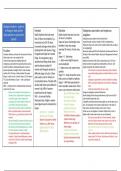
Biological rhythms – patterns
of change in body activity Infradian Ultradian Endogenous pacemakers and exogenous
that conform to cyclical time Bodily rhythms that take more Bodily rhythm that takes less than zeitgebers
periods. than 24 hours to complete. E.g., 24 hours to complete. Endogenous pacemakers (internal body-clock)
menstrual cycle (24-35 days). Stages of sleep. Psychologists have Superchiasmatic nucleus. Bundle of cells in hypothalamus.
identified 5 key sleep stages Maintains sleep cycle receives info on light enables body to adjust
Increased oestrogen levels led to to changing light.
development and release of egg. spanning 90 minutes. Found using
Circadian Decoursey destroyed SCN in 30 chipmunks and observed them for
Circadian rhythms are those that last around 24 hours. Progesterone helps form womb EEG. 80 days in their natural habitat. Sleep cycle disappeared and most
Sleep/wake cycle is an example of this. lining. If no pregnancy egg is Stage 1+2 – light sleep were killed.
Governed by exogenous zeitgeber light and absorbed and lining sheds. Stern 1 – alpha waves (high frequency, Ralph bred hamster with 20-hour sleep/wake cycle. SCN from
endogenous pacemaker the superchiasmatic nucleus. small amplitude) foetal hamsters transplanted and defaulted to 20 hours. SCN
Aschoff and Wever studied participants 4 weeks in and Mcclintock studied 29 signals production of melatonin when dark.
2 – alpha waves and random sleep
bunker deprived of sunlight. All but 1 had circadian women with irregular periods at - SCN research may obscure other body clocks. Damiola
spindles.
rhythms of 24-25 hours. Folkard studied 12 people different stages of cycle. Cotton researched feeding patterns and their influence on liver
living in a dark cave for 3 weeks. Slept at 11:45 woke at
Stage 3+4 – deep sleep/slow waves. cells.
pads under arms for 8 hours to Delta waves and higher amplitude.
7:45. Day shortened by 2 hours – only 1 participant - Endogenous pacemakers cannot be studied in isolation.
record pheromones. Treated with Stage 5 – REM body paralysed but Siffre used artificial light that could influence biological
adjusted.
Siffre – underground for extended periods and found alcohol and frozen and rubbed on brain resembles awake brain. Theta clock.
cycle to be 24+ hours. women’s lip. 68% of women waves, eye movement and dreams. - Mammals studied often die as a result.
- Allows us to understand consequences of experienced cycle changes. Exogenous zeitgebers (external influences)
- Age related sleep change.
disrupted cycle. Night workers experience Reset biological clock through entrainment. Light can reset SCN
SAD – circannual rhythm. Slow waves keep
circadian troughs at 6am. Night work and maintain sleep/wake cycle.
associated with worse health. Knuttson 3x Melatonin lack of light in winter – decreasing with age. Campbell and Murphy demonstrated light can also be taken up by
more likely to develop heart disease. pineal gland secrets melatonin for Growth hormone skin. 15 participants were woken by light shone on the back of
- Real-world concerning worker productivity. longer. production reduced. their knees. Deviation of sleep cycle of up to 3 hours.
Boivin correlation doesn’t equal causation. - Synchrony – evolution Reduced alertness. Social cues act as zeitgebers. Circadian rhythms don’t occur in
Other factors e.g., high divorce levels in shift - Variation between people – babies until 6 weeks when social cues are introduced.
shared care of babies. - Don’t have same effects in all environments. People
workers.
- Improved medical treatment. Bonton found a - Doesn’t account for other Tucker found large who live in places where some seasons have a lot/no
rise and fall in body processes throughout factors e.g., diet stress. differences in duration of light have the same sleep cycle all year round.
the day led to chronotherapeutic e.g., aspirin - Light therapy for SAD. sleep stages. - Age related insomnia due to changes in biological
for heart attacks best taken at night. 80% effective. - Control of extraneous rhythms.
- Can’t generalise due to small participant variables in sleep studies - Miles studied a blind man from birth who had abnormal
numbers. Czeisler found differences in sleep but lab environment leads sleep cycle of 24.9 hours. Social cues not effective. Case
cycle from 13-65 hours. Duffy found changes study lacks sample size.
to unusual sleep.
throughout life.
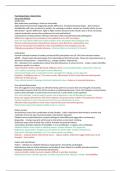
of change in body activity Infradian Ultradian Endogenous pacemakers and exogenous
that conform to cyclical time Bodily rhythms that take more Bodily rhythm that takes less than zeitgebers
periods. than 24 hours to complete. E.g., 24 hours to complete. Endogenous pacemakers (internal body-clock)
menstrual cycle (24-35 days). Stages of sleep. Psychologists have Superchiasmatic nucleus. Bundle of cells in hypothalamus.
identified 5 key sleep stages Maintains sleep cycle receives info on light enables body to adjust
Increased oestrogen levels led to to changing light.
development and release of egg. spanning 90 minutes. Found using
Circadian Decoursey destroyed SCN in 30 chipmunks and observed them for
Circadian rhythms are those that last around 24 hours. Progesterone helps form womb EEG. 80 days in their natural habitat. Sleep cycle disappeared and most
Sleep/wake cycle is an example of this. lining. If no pregnancy egg is Stage 1+2 – light sleep were killed.
Governed by exogenous zeitgeber light and absorbed and lining sheds. Stern 1 – alpha waves (high frequency, Ralph bred hamster with 20-hour sleep/wake cycle. SCN from
endogenous pacemaker the superchiasmatic nucleus. small amplitude) foetal hamsters transplanted and defaulted to 20 hours. SCN
Aschoff and Wever studied participants 4 weeks in and Mcclintock studied 29 signals production of melatonin when dark.
2 – alpha waves and random sleep
bunker deprived of sunlight. All but 1 had circadian women with irregular periods at - SCN research may obscure other body clocks. Damiola
spindles.
rhythms of 24-25 hours. Folkard studied 12 people different stages of cycle. Cotton researched feeding patterns and their influence on liver
living in a dark cave for 3 weeks. Slept at 11:45 woke at
Stage 3+4 – deep sleep/slow waves. cells.
pads under arms for 8 hours to Delta waves and higher amplitude.
7:45. Day shortened by 2 hours – only 1 participant - Endogenous pacemakers cannot be studied in isolation.
record pheromones. Treated with Stage 5 – REM body paralysed but Siffre used artificial light that could influence biological
adjusted.
Siffre – underground for extended periods and found alcohol and frozen and rubbed on brain resembles awake brain. Theta clock.
cycle to be 24+ hours. women’s lip. 68% of women waves, eye movement and dreams. - Mammals studied often die as a result.
- Allows us to understand consequences of experienced cycle changes. Exogenous zeitgebers (external influences)
- Age related sleep change.
disrupted cycle. Night workers experience Reset biological clock through entrainment. Light can reset SCN
SAD – circannual rhythm. Slow waves keep
circadian troughs at 6am. Night work and maintain sleep/wake cycle.
associated with worse health. Knuttson 3x Melatonin lack of light in winter – decreasing with age. Campbell and Murphy demonstrated light can also be taken up by
more likely to develop heart disease. pineal gland secrets melatonin for Growth hormone skin. 15 participants were woken by light shone on the back of
- Real-world concerning worker productivity. longer. production reduced. their knees. Deviation of sleep cycle of up to 3 hours.
Boivin correlation doesn’t equal causation. - Synchrony – evolution Reduced alertness. Social cues act as zeitgebers. Circadian rhythms don’t occur in
Other factors e.g., high divorce levels in shift - Variation between people – babies until 6 weeks when social cues are introduced.
shared care of babies. - Don’t have same effects in all environments. People
workers.
- Improved medical treatment. Bonton found a - Doesn’t account for other Tucker found large who live in places where some seasons have a lot/no
rise and fall in body processes throughout factors e.g., diet stress. differences in duration of light have the same sleep cycle all year round.
the day led to chronotherapeutic e.g., aspirin - Light therapy for SAD. sleep stages. - Age related insomnia due to changes in biological
for heart attacks best taken at night. 80% effective. - Control of extraneous rhythms.
- Can’t generalise due to small participant variables in sleep studies - Miles studied a blind man from birth who had abnormal
numbers. Czeisler found differences in sleep but lab environment leads sleep cycle of 24.9 hours. Social cues not effective. Case
cycle from 13-65 hours. Duffy found changes study lacks sample size.
to unusual sleep.
throughout life.