

Biotechnology and Bioinformatics
Restriction enzymes: Enzymes that cut DNA molecules at a number of specific
locations. They protect the cell by cutting out foreign DNA.
- Help recombinant DNA technology by allowing us to cut a segment of DNA
(specific gene) to be inserted into the plasmid
Sticky ends: As the restriction enzymes create staggered cuts, it leaves one
complementary single-stranded end called a sticky end from a double-stranded
restriction fragment.
- Allows two ends to pair up by hydrogen bonding but can be made permanent by
DNA ligase
- Connected through base pairing
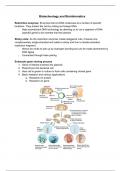
Eukaryote gene cloning process
1. Gene of interest inserted into plasmid
2. Plasmid put into bacterial cell
3. Host cell is grown in culture to form cells containing cloned gene
4. Basic research and various applications
a. Research on protein
b. Research on gene
, Recombinant DNA techniques
Gel Electrophoresis: Used to separate nucleic acids/proteins/electrical charge
1. Each sample is a mixture of DNA molecules and is separated by wells. Agarose
gel is immersed in aqueous buffer solution in a tray with electrodes at each end.
2. Electrical current causes negatively charged DNA molecules to move towards
positive electrode. Shorter molecules moving quicker than longer ones. Bands
shown in blue under UV light.
Polymerase chain reaction (PCR): Obtains many copies of the desired gene.
Cannot substitute gene cloning in cells when large amounts are required, due to
occasional errors.
Cycle #1 (Yields 2 molecules)
1. Denaturation: Heat briefly to separate DNA strands
2. Annealing: Cool to allow primers to form hydrogen bonds with the end of target
sequence
3. Extension: DNA polymerase adds nucleotides to the 3’ end of each primer
Cycle #2 (Yields 4 molecules)
Cycle #3 (Yields 8 molecules, 2 which match target sequence)
Sequencing technology
1. Dideoxy chain termination method (pg.434)
Complementary DNA strands created. Strands start with the same primer
and end with ddNTP. In the set of synthesized strands, each nucleotide
position is represented by strands ending at that point with complementary
ddNTP. Because of tagged fluorescent label, the entire original sequence
can be determined.
2. Next-generation sequencing (pg.435)
Starts with individual genomic DNA fragments, each immobilized on a
bead and amplified by PCR. Copies sequenced using DNA polymerase to
synthesize identical single strands in parallel. The technique uses a flash
of light when nucleotide base is added, determining the sequence base-
by-base.
Gene expression (pg.437)
1. RT-PCR Analysis of single gene
Uses enzyme reverse transcriptase (RT) in combination with PCR and gel
electrophoresis. Used to compare gene expression between samples. Ex.
different embryonic stages, tissues of the same cell in different conditions.
2. DNA Microarray assay
Restriction enzymes: Enzymes that cut DNA molecules at a number of specific
locations. They protect the cell by cutting out foreign DNA.
- Help recombinant DNA technology by allowing us to cut a segment of DNA
(specific gene) to be inserted into the plasmid
Sticky ends: As the restriction enzymes create staggered cuts, it leaves one
complementary single-stranded end called a sticky end from a double-stranded
restriction fragment.
- Allows two ends to pair up by hydrogen bonding but can be made permanent by
DNA ligase
- Connected through base pairing
Eukaryote gene cloning process
1. Gene of interest inserted into plasmid
2. Plasmid put into bacterial cell
3. Host cell is grown in culture to form cells containing cloned gene
4. Basic research and various applications
a. Research on protein
b. Research on gene
, Recombinant DNA techniques
Gel Electrophoresis: Used to separate nucleic acids/proteins/electrical charge
1. Each sample is a mixture of DNA molecules and is separated by wells. Agarose
gel is immersed in aqueous buffer solution in a tray with electrodes at each end.
2. Electrical current causes negatively charged DNA molecules to move towards
positive electrode. Shorter molecules moving quicker than longer ones. Bands
shown in blue under UV light.
Polymerase chain reaction (PCR): Obtains many copies of the desired gene.
Cannot substitute gene cloning in cells when large amounts are required, due to
occasional errors.
Cycle #1 (Yields 2 molecules)
1. Denaturation: Heat briefly to separate DNA strands
2. Annealing: Cool to allow primers to form hydrogen bonds with the end of target
sequence
3. Extension: DNA polymerase adds nucleotides to the 3’ end of each primer
Cycle #2 (Yields 4 molecules)
Cycle #3 (Yields 8 molecules, 2 which match target sequence)
Sequencing technology
1. Dideoxy chain termination method (pg.434)
Complementary DNA strands created. Strands start with the same primer
and end with ddNTP. In the set of synthesized strands, each nucleotide
position is represented by strands ending at that point with complementary
ddNTP. Because of tagged fluorescent label, the entire original sequence
can be determined.
2. Next-generation sequencing (pg.435)
Starts with individual genomic DNA fragments, each immobilized on a
bead and amplified by PCR. Copies sequenced using DNA polymerase to
synthesize identical single strands in parallel. The technique uses a flash
of light when nucleotide base is added, determining the sequence base-
by-base.
Gene expression (pg.437)
1. RT-PCR Analysis of single gene
Uses enzyme reverse transcriptase (RT) in combination with PCR and gel
electrophoresis. Used to compare gene expression between samples. Ex.
different embryonic stages, tissues of the same cell in different conditions.
2. DNA Microarray assay


