Unit 0
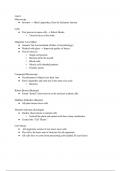
Microscope
● Inventor → Hans Lippershey, Hans & Zacharias Janssen
Cells
● First person to name cells → Robert Hooke
○ Viewed slices of tree bark
Magnifier Lens Maker
● Antonie Van Leeuwenhoek (Father of microbiology)
● Worked with glass → Improved quality of lenses
● First to observe;
○ Single cell protists
○ Bacteria from the mouth
○ Blood cells
○ Muscle cells (banded pattern)
○ Giardia, sperm
Compound Microscope
● Visualization of objects less than 1um
● Some organelles and cells are in the same size scale
○ Bacteria
Robert Brown (Botanist)
● Found “kernel” (later known as the nucleus) in plant cells
Matthias Schleiden (Botanis)
● All plant tissues have cells
Theodor Schwann (Zoologist)
● Similar observations in animal cells
○ Noticed the plant and animal cells have many similarities
● Created the “Cell Theory”
Cell Theory
● All organisms consist of one more more cells
● The cell is the basic unit of structure for all organisms
● All cells have to come from preexisting cells (added 20 years later)
, Fact (scientific):
● An attempt to state our best current understanding
○ Based on observations and experiments
● Then revised or replaced when there were better observations
Scientific Method
● Make observations
● Develop the hypothesis
● Make predictions based on the hypothesis (if, then, so)
● Interpret the result to see if it matches the hypothesis
Theory
● A hypothesis that has been tested critically
○ Under different conditions
○ By many investigators using different approaches
● Must be widely accepted to be called a theory
● “Solid ground” of science
○ Evolution theory, germ theory, cell theory
More than a theory (Law)
● If is tested and confirmed over many years by many investigators and there is not doubt
in its validity
● Gravity
● Laws of thermodynamics
● Laws that govern the behaviour of gasses
● Biologists don’t use the term law
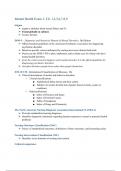
‘Strands’ of Cell Biology
● Cytology → what they look like
Microscope
● Inventor → Hans Lippershey, Hans & Zacharias Janssen
Cells
● First person to name cells → Robert Hooke
○ Viewed slices of tree bark
Magnifier Lens Maker
● Antonie Van Leeuwenhoek (Father of microbiology)
● Worked with glass → Improved quality of lenses
● First to observe;
○ Single cell protists
○ Bacteria from the mouth
○ Blood cells
○ Muscle cells (banded pattern)
○ Giardia, sperm
Compound Microscope
● Visualization of objects less than 1um
● Some organelles and cells are in the same size scale
○ Bacteria
Robert Brown (Botanist)
● Found “kernel” (later known as the nucleus) in plant cells
Matthias Schleiden (Botanis)
● All plant tissues have cells
Theodor Schwann (Zoologist)
● Similar observations in animal cells
○ Noticed the plant and animal cells have many similarities
● Created the “Cell Theory”
Cell Theory
● All organisms consist of one more more cells
● The cell is the basic unit of structure for all organisms
● All cells have to come from preexisting cells (added 20 years later)
, Fact (scientific):
● An attempt to state our best current understanding
○ Based on observations and experiments
● Then revised or replaced when there were better observations
Scientific Method
● Make observations
● Develop the hypothesis
● Make predictions based on the hypothesis (if, then, so)
● Interpret the result to see if it matches the hypothesis
Theory
● A hypothesis that has been tested critically
○ Under different conditions
○ By many investigators using different approaches
● Must be widely accepted to be called a theory
● “Solid ground” of science
○ Evolution theory, germ theory, cell theory
More than a theory (Law)
● If is tested and confirmed over many years by many investigators and there is not doubt
in its validity
● Gravity
● Laws of thermodynamics
● Laws that govern the behaviour of gasses
● Biologists don’t use the term law
‘Strands’ of Cell Biology
● Cytology → what they look like