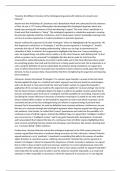
“Examine the Different Versions of the Ontological Argument with reference to Anselm and
Malcom”.
Anselm was the Archbishop of Canterbury and a Benedictine Monk who advocated for the existence
of God. He was a 11th Century Philosopher who developed the Ontological Argument which was
based upon proving the existence of God and deeming it Logical. The word ‘ontos’ specifically is a
Greek word that translates to “being”. The ontological argument is a deductive argument, meaning
the premises logically entail the conclusions, and it is based upon ‘apriori’ knowledge meaning it has
no form of previous experience or empirical evidence to promote argument.
Anselm outlined his argument in his book ‘Proslogian’ where he highlighted both his arguments. His
first Argument is referred to as ‘Proslogian 2’ and the second argument is ‘Proslogian 3’. Anselm
promotes this idea of ‘faith seeking understanding’ where you use logic to demonstrate the
rationality of faith. In Anselm’s first argument he highlights that there are 2 ways something can
exist. He argued things can either exist in reality or in the mind, however with defining God “as that
which no greater can be conceived” he highlights this idea that in order for God to be this
transcendent, existential being he must exist in both reality and in the mind otherwise there would
be something greater than God and this that force or being would not be God. this is important as al
cell is using the definition of God to substantiate his existence being omnipotent. he argues that
even an atheist who doesn't necessarily have to believe in God's existence would argue that if God
did exist, he has to possess these characteristics therefore strengthening his argument and imposing
God's existence.
Moreover, Anselm formulated ‘Proslogian 3’ to counter argue Gaunilo’s concept of the lost island.
Gaunilo applied this logic to a ‘mythical lost island’ arguing it was the best island he could imagine
and to be the best it must exist in both the mind and reality. instead, he argued that Gaunilo’s
application of his concept was invalid as the argument only applied to ‘necessary beings’ due to the
fact the island contains contingent objects the logic is unable to be applied. Anselm argued that all
humans and objects apart from God or contingent, had the possibility of not existing, instead is only
God being the creator that hasn't necessary of existence meaning he is unable to not exist and has
always existed within creation. he formulated his argument as God is that which no greater can be
conceived and due to the fact contingent being are inferior to supreme beings it presents how
because God is transcendent, he must by definition have necessary existence. furthermore, we see
this idea of a necessary through the teleological argument where Aquinas argued how things came
into existence. Like Anselm, he stated that it wasn’t spontaneous and ruled out the possibility of a
continuous sense of infinite regress. Instead, like William Paley, he argued that “intelligent creation”
was concurrent to a “intelligent creator” and it was gods characteristics (omnipotent, omniscient
and transcendent) that reduced the idea of a continuous chain of infinite regress highlighting there
must’ve been something that has existed and will always exist therefore, like Anselm, deeming God
as a “necessary Being” within existence.
Furthermore, Norman Malcolm revived the ontological argument in the 20th century where he
counter argued Rene Descartes of existence being an essence to God's character. Instead, Malcolm
argued existence is not a ‘predicate’. A predicate is something that adds to the essence of another
object therefore it cannot be used as a defining characteristic. Malcolm like and his argument to
Anselm’s Proslogian 3 where he imposed the importance of God's necessity in existence. he argued
that in order to have a God it must have necessary existence; he cannot spontaneously come into
existence if he didn't already exist but instead, he has to have always existed. he argued if God didn't
exist today then he would never be able to and his existence would be impossible, as a result God
existence is either impossible or necessary to which he imposed it is necessary as it is not logically
Malcom”.
Anselm was the Archbishop of Canterbury and a Benedictine Monk who advocated for the existence
of God. He was a 11th Century Philosopher who developed the Ontological Argument which was
based upon proving the existence of God and deeming it Logical. The word ‘ontos’ specifically is a
Greek word that translates to “being”. The ontological argument is a deductive argument, meaning
the premises logically entail the conclusions, and it is based upon ‘apriori’ knowledge meaning it has
no form of previous experience or empirical evidence to promote argument.
Anselm outlined his argument in his book ‘Proslogian’ where he highlighted both his arguments. His
first Argument is referred to as ‘Proslogian 2’ and the second argument is ‘Proslogian 3’. Anselm
promotes this idea of ‘faith seeking understanding’ where you use logic to demonstrate the
rationality of faith. In Anselm’s first argument he highlights that there are 2 ways something can
exist. He argued things can either exist in reality or in the mind, however with defining God “as that
which no greater can be conceived” he highlights this idea that in order for God to be this
transcendent, existential being he must exist in both reality and in the mind otherwise there would
be something greater than God and this that force or being would not be God. this is important as al
cell is using the definition of God to substantiate his existence being omnipotent. he argues that
even an atheist who doesn't necessarily have to believe in God's existence would argue that if God
did exist, he has to possess these characteristics therefore strengthening his argument and imposing
God's existence.
Moreover, Anselm formulated ‘Proslogian 3’ to counter argue Gaunilo’s concept of the lost island.
Gaunilo applied this logic to a ‘mythical lost island’ arguing it was the best island he could imagine
and to be the best it must exist in both the mind and reality. instead, he argued that Gaunilo’s
application of his concept was invalid as the argument only applied to ‘necessary beings’ due to the
fact the island contains contingent objects the logic is unable to be applied. Anselm argued that all
humans and objects apart from God or contingent, had the possibility of not existing, instead is only
God being the creator that hasn't necessary of existence meaning he is unable to not exist and has
always existed within creation. he formulated his argument as God is that which no greater can be
conceived and due to the fact contingent being are inferior to supreme beings it presents how
because God is transcendent, he must by definition have necessary existence. furthermore, we see
this idea of a necessary through the teleological argument where Aquinas argued how things came
into existence. Like Anselm, he stated that it wasn’t spontaneous and ruled out the possibility of a
continuous sense of infinite regress. Instead, like William Paley, he argued that “intelligent creation”
was concurrent to a “intelligent creator” and it was gods characteristics (omnipotent, omniscient
and transcendent) that reduced the idea of a continuous chain of infinite regress highlighting there
must’ve been something that has existed and will always exist therefore, like Anselm, deeming God
as a “necessary Being” within existence.
Furthermore, Norman Malcolm revived the ontological argument in the 20th century where he
counter argued Rene Descartes of existence being an essence to God's character. Instead, Malcolm
argued existence is not a ‘predicate’. A predicate is something that adds to the essence of another
object therefore it cannot be used as a defining characteristic. Malcolm like and his argument to
Anselm’s Proslogian 3 where he imposed the importance of God's necessity in existence. he argued
that in order to have a God it must have necessary existence; he cannot spontaneously come into
existence if he didn't already exist but instead, he has to have always existed. he argued if God didn't
exist today then he would never be able to and his existence would be impossible, as a result God
existence is either impossible or necessary to which he imposed it is necessary as it is not logically