EPPP Practice test 1 In-class activity
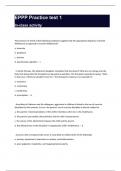
EPPP Practice test 1 In-class activity The presence of which of the following symptoms suggests that the appropriate diagnosis is Alcohol Withdrawal as opposed to Cocaine Withdrawal? a. insomnia b. dysphoria c. seizures d. psychomotor agitation - c. In family therapy, the adolescent daughter complains that she doesn't think she can change and she feels that doing what the therapist has requested is pointless. The therapist responds by saying, "Well, in that case, I think you shouldn't even try." The therapist's response is an example of: a. reactance. b. restraining. c. positioning. d. prescription. - b. According to Patterson and his colleagues, aggression in children is linked to the use of coercive discipline by their parents. In turn, the parent's use of coercive discipline is directly related to: a. the parents' misinterpretations of the child's intentions when he or she misbehaves. b. the parents' personality characteristics and the child's temperament. c. the nature of the attachment between the child and the parent. d. the effectiveness of the discipline in stopping the child's misbehavior. - b. A person with a temporal lobe tumor is most likely to exhibit which of the following? a. memory impairment, depression or anxiety, and hallucinations b. poor judgment, impulsivity, and inappropriate jocularity c. confabulation, irritability and suspiciousness, and prosopagnosia d. dysgraphia, depression and apathy, and denial of his or her problems - a. According to the path-goal theory of leadership, a primary task of a leader is to help subordinates find the best path for attaining goals. In terms of leadership style, this theory proposes that: a. the best style (directive, supportive, participative, or achievement-oriented) depends on certain characteristics of the task and the subordinates. b. the best style (directive, supportive, participative, or achievement-oriented) depends on the leader's experience, personality, and so on. c. the best style is a participative one that allows employees to help set their own goals. d. the best style is an achievement-oriented one that focuses on enhancing the skills and knowledge of subordinates so that they are better able to achieve their goals. - a. Research on mnemonic devices suggests that they are: a. superior to rote rehearsal in terms of both short-and long-term retention. b. superior to rote rehearsal and elaboration in terms of both short-and long-term retention. c. superior to rote rehearsal in terms of short-term but not long-term retention. d. superior to rote rehearsal and elaboration in terms of short-term but not long-term retention. - c. In the assessment of cognitive abilities with a standardized test, you would "test the limits": a. before administering the test. b. before administering each subtest. c. after administering the test. d. whenever it seems appropriate to do so. - c. A worker whose job consists primarily of handling customer complaints will be happier if he s/he blames the customer's problems on: a. external, stable, and global factors. b. internal, stable, and specific factors. c. external, unstable, and global factors. d. external, unstable, and specific factors. - d. You administer a test to a sample of young adults with PTSD and, from their scores, calculate a kappa coefficient of .95. This indicates that the test is: a. reliable. b. valid. c. reliable and valid. d. reliable but not valid. - a. You are hired by a small company to provide evaluation and counseling services to employees. The company owner tells you that employees routinely sign a waiver of confidentiality when they are hired. In this situation, you should: a. tell the employer that you can give her only very limited and relevant information about an employee even though the employee has signed a waiver. b. clarify the company policy with the employees that you see and determine if they want to continue in counseling. c. provide the employer with information only after you have confirmed that the employee has actually signed the waiver. d. refuse to give the employer any information about the employees that you see. - b. An adolescent is brought to therapy by her mother who says the girl has recently become "another person." She says her daughter used to be easy-going and easy to get along with and was well-liked at school by her peers and teachers. However, now her daughter is constantly irritable, is smoking and drinking, and has started having trouble at school. When the therapist interviews the girl, he learns that she is engaging in high-risk sexual behavior, but the girl feels that nothing bad can ever happen to her. Based on these symptoms, the best diagnosis is: a. ADHD. b. Conduct Disorder. c. Bipolar I Disorder. d. Bipolar II Disorder. - c. During the first few sessions of family therapy, a structural family therapist makes use of "tracking" and "mimesis" in order to: a. keep from becoming emotionally triangulated into the family system. b. join with the family system. c. make initial changes in the family structure. d. reduce stress in the family system. - b. When a program to reduce aggression in children is based on the work of Patterson and his colleagues, it will include which of the following? a. providing the child with opportunities for catharsis b. training parents in child management skills c. increasing the child's perspective-taking skills d. individual insight-oriented therapy for each parent - b. Which of the following is true about the retrograde amnesia that occurs as the result of a moderate to severe head injury? a. it is limited to recent long-term memories b. it is limited to remote long-term memories c. when it begins to resolve, the most recent memories return first d. when it begins to resolve, the most remote memories return first - d. Research comparing heterogeneous to homogeneous work groups has found that heterogeneous groups: a. are more creative and better at decision-making. b. are more creative but less productive overall. c. make better decisions but are less productive overall. d. are more creative but worse at decision-making. - a. You are conducting a study to investigate the phenomenon known as "blocking." Consequently, you will: a. first present the CS prior to the US; then, once the CR is established, present the US prior to the CS. b. first present the CS prior to the US; then, once the CR is established, present the CS prior to a sec and US. c. first present the CS prior to the US; then, once the CR is established, present the original CS simultaneously with a second CS prior to the US. d. first present the CS prior to the US; then, once the CR is established, present a second CS prior to the original CS. - c. When using the Halstead-Reitan, an examinee's performance on seven measures (e.g., the Category Test, the Seashore Rhythm Test, and the Finger Oscillation Test) is used to derive a or an: a. Impairment Index, which can be used to determine if an examinee has brain damage. b. Impairment Index, which can be used to determine if an examinee is suffering from a functional disorder. c. Pathology Profile, which allows the examiner to compare the examinee's score profile to those of people with and without brain damage. d. Pathology Profile, which helps the examiner determine the appropriate DSM-IV diagnosis. - a. After playing the role of a child abuser in a feature film, a well-known and formerly well-liked actor begins receiving a lot of "hate mail." The writers of these letters are exhibiting: a. psychological reactance. b. the fundamental attribution error. c. the availability bias. d. defensive attribution. - b. Dr. Dither is hired by the court to conduct an evaluation of a family as part of a child protection matter. Based on Dr. Dither's evaluation and other evidence, the court determines that the child can remain at home with his family who will be provided with supervision and counseling. Six months after the case is heard in court, Dr. Dither is contacted by the mother who says she would like to begin therapy with him for issues unrelated to the child protection matter. According to APA's Guidelines for Psychological Evaluations in Child Protection Matters, Dr. Dither should: a. agree to see the woman in therapy since the child protection matter has been resolved. b. agree to see the woman in therapy only if her problem is, in fact, unrelated to the child protection matter. c. agree to see the women in therapy since his familiarity with her situation will be an advantage. d. refer the woman to a colleague. - d. Conduct Disorder frequently co-occurs with ADHD. Which of the following is NOT true about children with both disorders? a. They have higher rates of social maladjustment than children with ADHD only. b. They have more extensive cognitive difficulties and poorer school achievement than children with ADHD only. c. They have poorer long-term outcomes and a higher risk of adult psychopathology than children with ADHD only. d. They often have a less favorable response to stimulant medication than children with ADHD only. - b. From the perspective of Rational Emotive Therapy: a. irrational beliefs are acquired primarily through social learning processes. b. irrational beliefs are acquired largely through the process of selective reinforcement. c. people are biologically prone to the acquisition of irrational beliefs. d. people adopt irrational beliefs as the result of early traumatic events that are still unresolved. - c. Work by Perry and Busey (1977) suggests that highly aggressive children: a. were exposed prenatally to high levels of androgens. b. are less sensitive to physical discomfort than less aggressive children. c. exhibited a disoriented/disengaged attachment pattern as young children. d. show little remorse after hurting another child. - d. Androgens and estrogens are secreted by the: a. gonads only. b. gonads and adrenal glands. c. gonads and pituitary gland. d. gonads and pineal gland. - b. Which of the following is most relevant to equity theory? a. Rosenthal effect b. social comparison theory c. drive theory d. buffering hypothesis - b. Subjects learn a task while under the influence of a CNS stimulant. Three days later, half of the subjects are tested while under the influence of the drug; the other half are tested while drug-free. Subjects who have been given the drug perform better on the task during testing. This result is predicted by which of the following? a. state dependent memory b. proactive facilitation c. drug-dependence effect d. priming - a. Unilateral ECT to the right hemisphere would most likely produce: a. predominantly anterograde amnesia involving nonverbal material. b. predominantly anterograde amnesia involving verbal material. c. predominantly retrograde amnesia involving nonverbal material. d. predominantly retrograde amnesia involving verbal material. - a. You are hired by a community mental health center as an outside consultant to help one of the clinicians develop a treatment plan for a difficult client. This type of consultation is referred to as: a. consultee-centered case consultation. b. client-centered case consultation. c. client-administrative case consultation. d. consultee-administrative case consultation. - b. An adolescent's adoption of a "ready-made" identity that was formulated by a parent or other authority figure is referred to as: a. foreclosure. b. moratorium. c. fusion. d. emersion. - a. A split-brain patient would be able to do which of the following? a. say the word "spoon" after it is projected to his left visual field b. repeat a series of letters that have been whispered in his left ear c. identify an odor that has been presented to his right nostril d. identify a spoon with his left hand after an image of a spoon is projected to his left visual field - d. With regard to the effects of age on global job satisfaction, the best conclusion is that these variables have: a. a U-shaped relationship. b. an inverted U-shaped relationship. c. an inverse relationship. d. a positive relationship. - d. When using the technique known as the Premack Principle, the reinforcer is: a. applied intermittently. b. a generalized conditioned reinforcer. c. a behavior that occurs frequently. d. a stimulus that naturally elicits the desired behavior. - c. The research suggests that which of the following would be least useful for the treatment of alcoholism? a. social-skills training b. stress management training c. antidepressant medication d. anxiolytic medication - d.
Written for
- Institution
- EPPP
- Course
- EPPP
Document information
- Uploaded on
- January 2, 2024
- Number of pages
- 51
- Written in
- 2023/2024
- Type
- Exam (elaborations)
- Contains
- Questions & answers
Subjects
-
eppp practice test 1 in class activity

Also available in package deal