

Written by students who passed Immediately available after payment Read online or as PDF Wrong document? Swap it for free 4.6 TrustPilot
logo-home
Exam (elaborations)

CBIC CIC Practice Exam

Rating
-
Sold
-
Pages
13
Grade
A+
Uploaded on
30-12-2023
Written in
2023/2024

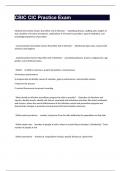
CBIC CIC Practice Exam Medical intervention factors that affect risk of infection - indwelling devices, staffing ratio, lengths of stay, duration of invasive procedures, medications, # of exams by providers, type of institution, and knowledge/experience of providers environmental intervention factors that affect risk of infection - disinfectant type used, contact with animals, hand hygiene anatomical/phys factors that affect risk of infection - preexisting diseases, trauma, malignancies, age, gender, and nutritional status DMAIC - D=define customers, project boundaries, and processes M=measure performance A=analyze data to identify causes of variation, gaps in performance, and prioritize actions I=improve the process C=control the process to prevent reverting What should an effective surveillance program be able to provide? - Detection of infections and injuries, identify trends, identify risk factors associated with infections and other AEs detect outbreaks and clusters, assess the overall effectiveness of the infection control and prevention program and demonstrate changes in proactive and processes that lead to better outcomes Define point prevalence - number of persons ill on the date divided by the population on that date. Define attack rate - Number of people at risk in whom a certain illness develops / (divided by) / Total number of people at risk Define prevalence - fraction of a population having a specific disease at a given time Define incidence - number of new cases of a disease divided by the number of persons at risk for the disease. Type of specimen for C. diff - liquid stool is required When to suspect C. diff infection? - when 3 or more unformed/watery stool in 24 hrs occurs Relative Risk (RR) - Used in cohort studies to determine how strongly a risk factor is associated with an outcome. 1 is the null= no significance of the association between exposure and adverse event P(X infection or exposed)/P(Y infection or unexposed) = RR Details of control chart - central line = the ave of data pts x axis = time y axis = rate/count may be upper control/lower control limit lines and +/- 3 SD lines Directly observed therapy (DOT) - requires that a health care provider directly observe the patient swallowing the pills, whether it is in the hospital, office, or home care setting the best method for TB regimen, intermittent therapy, MDRO, high risk for noncompliance (drug abusers/homeless) Hill's Criteria of Causality - 1) strength of association- relationship between casual factor and disease outcome 2) consistency of finding- associations are repeated 3) specificity of association- very specific cause 4) temporality- cause must be before the effect 5) biological gradient- dose and response relationship, more exposure causes higher risk 6) biologic or theoretical plausibility- has to make biological sense 7) coherence with the established knowledge- established knowledge should not conflict with findings True or False: The thoroughness of the cleaning is more important than the duration of the disinfection - true Steps of systemic review and meta-analyisis - 1. Research question 2. develop methodology 3. Literature search/selecting studies 4. Analysis of data/interpretation 4 stages of prevention - 1. preventing altogether ie vaccine 2. early identification/tx ie cessation or dx testing 3. providing optimal health to prevent further disease progression 4. preventing healthcare associated complications Volume limit for alcohol-based hand dispensers - 1.2 L in rooms, hallways/areas open to hallways 2L in suites What is the primary limitation of qualitative research? - lack of generalizability a positive is the patients' point of view chain of infection - infectious agent, reservoir, portal of exit, mode of transmission, portal of entry, susceptible host Passive/indirect transmission - occurs when an organism is present and does not replicate within the source such as hepA (hepA does not replicate in the food) Crude mortality rate - Number of deaths ÷ population total x 1,000 = _____ per 1,000 Reusing single-use devices - must have written policy and procedures and plan for reprocessing (often done by a third party) high-level disinfection - heat-automated pasteurization and liquid immersion time needed = 10-90 minutes destroys all microorganisms except for high levels of spores required for heat sensitive semi-critical items Division of Healthcare Quality Promotion (DHQP) - Division of the CDC responsible for monitoring HAIs and maintaining the NHSN Responsible for prevention of dialysis-associated disease and guidance for sterilization and disinfection social cognitive theory - views prejudice as an attitude acquired through direct instruction, modeling, and other social influences when a critical mass of persons act a certain way the environment changes and others are more likely to carry out similar behaviors The Agency for Healthcare Research and Quality (AHRQ) mission - to improve the quality of medical care through outcomes research and development of clinical guidelines Aims to make healthcare safer and more accessible and affordable HRSA (Health Resources and Services Administration) - the primary federal agency for improving access to health care services for people who are uninsured, isolated or medically vulnerable CMS (Centers for Medicare and Medicaid Services) - Federal agency in the Department of Health and Human Services that runs Medicare, Medicaid, clinical laboratories, and other government health programs; responsible for enforcing all HIPAA standards other than the privacy and security standards Surveillance criteria - should be considered exactly as defined without consideration of diagnosis Standardized Infection Ratio (SIR) - formula = observed/predicted the 3 most common causes of HAIs - contamination or defects on medical products/devices lapses in infection prevention practices colonization or infection of healthcare personnel case definition - A method of determining criteria for cases that should be included in a registry What is the method of surveillance that is likely to provide the most useful information? - combined whole house and targeted as targeted alone, although the NHSN system focuses on this, may miss small outbreaks or breaches in non-targeted areas IOM - Institute of Medicine: primary aim is patient-centered/safety dependent variable - The outcome factor: occurs in result of something else independent variable - the cause or the influence of the dependent variable ordinal scale - a scale of data measurement that involves ordered categorical responses (stages of cancer) nominal scale - measurement in which numbers are assigned to objects or classes of objects solely for the purpose of identification (male/female; gay/straight..) interval scale of measurement - Numerical distances between intervals ie temperature Most appropriate graphic display for continuous data - histogram, freq polygon, ogive (line chart)

Show more Read less
Institution
CBIC CIC
Course
CBIC CIC

Content preview

CBIC CIC Practice Exam
Medical intervention factors that affect risk of infection - indwelling devices, staffing ratio, lengths of stay, duration of invasive procedures, medications, # of exams by providers, type of institution, and knowledge/experience of providers environmental intervention factors that affect risk of infection - disinfectant type used, contact with animals, hand hygiene anatomical/phys factors that affect risk of infection - preexisting diseases, trauma, malignancies, age, gender, and nutritional status DMAIC - D=define customers, project boundaries, and processes
M=measure performance A=analyze data to identify causes of variation, gaps in performance, and prioritize actions
I=improve the process
C=control the process to prevent reverting What should an effective surveillance program be able to provide? - Detection of infections and injuries, identify trends, identify risk factors associated with infections and other AEs detect outbreaks and clusters, assess the overall effectiveness of the infection control and prevention program and demonstrate changes in proactive and processes that lead to better outcomes Define point prevalence - number of persons ill on the date divided by the population on that date. Define attack rate - Number of people at risk in whom a certain illness develops / (divided by) / Total number of people at risk Define prevalence - fraction of a population having a specific disease at a given time Define incidence - number of new cases of a disease divided by the number of persons at risk for the disease. Type of specimen for C. diff - liquid stool is required When to suspect C. diff infection? - when 3 or more unformed/watery stool in 24 hrs occurs Relative Risk (RR) - Used in cohort studies to determine how strongly a risk factor is associated with an
outcome. 1 is the null= no significance of the association between exposure and adverse event
P(X infection or exposed)/P(Y infection or unexposed) = RR Details of control chart - central line = the ave of data pts
x axis = time
y axis = rate/count
may be upper control/lower control limit lines and +/- 3 SD lines Directly observed therapy (DOT) - requires that a health care provider directly observe the patient swallowing the pills, whether it is in the hospital, office, or home care setting
the best method for TB regimen, intermittent therapy, MDRO, high risk for noncompliance (drug abusers/homeless) Hill's Criteria of Causality - 1) strength of association- relationship between casual factor and disease outcome 2) consistency of finding- associations are repeated 3) specificity of association- very specific cause
4) temporality- cause must be before the effect

Written for

Institution
CBIC CIC
Course
CBIC CIC

Document information

Uploaded on
December 30, 2023
Number of pages
13
Written in
2023/2024
Type
Exam (elaborations)
Contains
Questions & answers

Subjects

CA$16.07
Get access to the full document:

Wrong document? Swap it for free Within 14 days of purchase and before downloading, you can choose a different document. You can simply spend the amount again.
Written by students who passed
Immediately available after payment
Read online or as PDF

Get to know the seller
Seller avatar
otebamanyuru

Also available in package deal

Get to know the seller

Seller avatar
otebamanyuru Arizona State University - Downtown Campus
Follow You need to be logged in order to follow users or courses
Sold
7
Member since
2 year
Number of followers
5
Documents
499
Last sold
1 year ago
Gemini wrld

Welcome to gemini world, welcome to my world of infinite knowledge and possibilities.

0.0

0 reviews

5
0
4
0
3
0
2
0
1
0

Why students choose Stuvia

Created by fellow students, verified by reviews

Quality you can trust: written by students who passed their tests and reviewed by others who've used these notes.

Didn't get what you expected? Choose another document

No worries! You can instantly pick a different document that better fits what you're looking for.

Pay as you like, start learning right away

No subscription, no commitments. Pay the way you're used to via credit card and download your PDF document instantly.

Student with book image

“Bought, downloaded, and aced it. It really can be that simple.”

Alisha Student

Working on your references?

Create accurate citations in APA, MLA and Harvard with our free citation generator.

Working on your references?

Frequently asked questions

