NES Elementary Subtest 2 Comprehesive Exam
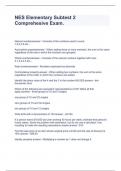
NES Elementary Subtest 2 Comprehesive ExamNatural numbersanswer - Consists of the numbers used to count. 1,2,3,4,5 etc... Associative propertyanswer - When adding three or more numbers, the sum is the same regardless of the way in which the numbers are grouped. Whole numbersanswer - Consists of the natural numbers together with zero. 0,1,2,3,4,5 etc... Real numbersanswer - Numbers expressed as decimals Commutative r - When adding two numbers, the sum is the same regardless of the order in which the numbers are added. Identify the place value of the 4 and the 2 in the number 643,r - ten-thousands; tens Which of the following are equivalent representations of 32? (Mark all that apply.)answer - three groups of 10 and 2 singles one group of 10 and 22 singles zero groups of 10 and 32 singles two groups of 10 and 12 singles Write 6/35 with a denominator of r - 24/140 If a person earns $19,650 per year working 40 hours per week, estimate that person's hourly salary. Solve the problem with estimation, but do not use a calculator. Use rounding to make the resulting calculations r - $10 Find the sale price of an item whose original price is $120 and the rate of discount is 18%.answer - $98.40 Identity r - Multiplying a number by 1 does not change it. 2 × 1 = 2 Distributive r - The product of a number with a sum equals the sum of the products of the number with each term of the sum. 2 × (3 + 5) = (2 × 3) + (2 × 5) Exponentiationanswer - Exponentiation is repeated multiplication. An exponent is often called a power. For example, the third power of 2 is: 2³ = 2 × 2 × 2 = 8 In this example, the number 2 is called the base and the number 3 is called the exponent. We define the zero power of any nonzero number to be 1. For example: (-3)0 = 1 The following laws of exponents are r - The first power of any number is itself. For example: 21 = 2 To multiply like bases with exponents, add the exponents. For example: 23 × 25 = 23+5 = 28 = 256 To exponentiate a power, multiply the exponents. For example: (23)5 = 23×5 = 215 = 32768 Converting a fraction to a r - Remember that the fraction bar is a division sign and that the fraction 3/8 is equivalent to 3 ÷ 8 by long division. Divide 8 into 3 to get 0.375 Converting a percentage to a r - Move the decimal point two places to the left and remove the percent sign. If needed, append zeroes to fill decimal places. For example: 5% = 0.05 Converting a decimal to a r - Move the decimal point two places to the right and add a percent (%) sign. If needed, append zeroes to fill decimal places. For example: 0.123 = 12.3% Converting a fraction to a r - Convert the fraction to a decimal and then convert the decimal to a percentage. For example: 2/5=0.4=40% Converting a percentage to a fraction. Convert the percentage to fraction with a denominator of 100. For example:answer - 65%=65/100=13/20 Adding and Subtracting Fractionsanswer - To add or subtract fractions, first find the common denominator, then convert the fraction to equivalent fractions and add or subtract the new numerators to find the numerator of the answer. For example, find 2/3+4/5 The common denominator = 3 × 5 = 15. The initial fractions can be converted to equivalent fractions with a common denominator of 15 as follows. Cr - All organisms are composed of cells. A cell is considered to be the basic unit of life because it is the smallest structural unit of an organism that is capable of independently carrying out life processes including maintenance, growth, and self-repair. Carbon-based r - Living organisms are characterized by a common carbon-based biochemistry. Without this chemical element, life as we know it would not be possible. Hr - All living organisms exhibit homeostasis, or the ability to maintain a state of internal balance. For example, if the environmental temperature increases, the human body begins to perspire, and the cooling effect of evaporation decreases the surface temperature of the skin. Likewise, a disruption in any system will set off a diverse set of control mechanisms that return the organism to a state of internal balance Response to stimulianswer - All living organisms respond to the environment. Their response can take many forms, from contractions of unicellular organisms when touched to complex reactions involving the senses of higher animals. Adaptationanswer - All living organisms adapt to their environment. Adaptation refers to a change in the structure or function of an organism that makes it better suited for its habitat.
Written for
- Institution
- Nes
- Course
- Nes
Document information
- Uploaded on
- December 24, 2023
- Number of pages
- 17
- Written in
- 2023/2024
- Type
- Exam (elaborations)
- Contains
- Questions & answers
Subjects
-
if a
-
nes elementary subtest 2 comprehesive exam
-
associative property when adding three or more num
-
identify the place value of the 4 and the 2 in the
-
which of the following are equivalent representati

Also available in package deal