ATLs POST TEST REVIEW
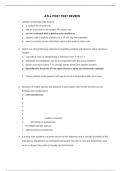
ATLs POST TEST REVIEW 1. Cardiac tamponade after trauma a. is seldom life-threatening b. can be excluded by an upright, AP chest x-ray c. can be confused with a tension pneumothorax d. causes a fall in systolic pressure of > 15 mm Hg with expiration e. most commonly occurs after blunt injury to the anterior chest wall 2. Which one of the following statements regarding patients with thoracic spine injuries is TRUE? a. Log-rolling may be destabilizing to fractures from T-12 to L-1. b. Adequate immobilization can be accomplished with the scoop stretcher. c. Spinal cord injury below T-10 usually spares bowel and bladder function. d. Hyperflexion fractures in the upper thoracic spine are inherently unstable. e. These patients rarely present with spinal shock in association with cord injury. 3. Absence of breath sounds and dullness to percussion over the left hemithorax are fmdings best explained by a. Left hemothorax. b. c. d. e. f. g. cardiac contusion h. left simple pneumothorax i. left diaphragmatic rupture j. right tension pneumothorax. 4. A young man sustains a gunshot wound to the abdomen and is brought promptly to the emergency department by prehospital personnel. His skin is cool and diaphoretic, and he is confused. His pulse is thready and his femoral pulse is only weakly palpable. The defmitive treatment in managing this patient is to a. administer 0-negative blood b. applyextemal warming devices. c. Control internal hemorrhage operatively d. apply the pneumatic antishock garment e. infuse large volumes of intravenous crystalloid solution. 5. To establish a diagnosis of shock, a. systolic blood pressure must be below 90 mm Hg. b. the presence of a closed head injury should be excluded c. acidosis should be present by arterial blood gas analysis d. the patient must fail to respond to intravenous fluid infusion. e. clinical evidence of inadequate organ perfusion must be present. 6. A 23-year-old man is brought immediately to the emergency department from the hospital' s parking lot where he was shot in the lower abdomen. Examination reveals a single bullet wound. He is breathing and has a thready pulse. However, he is unconscious and has no detectable blood pressure. Optimal immediate management is to a. perform diagnostic peritoneal lavage. b. initiate infusion of packed red blood cells. c. insert a nasogastric tube and urinary catheter. d. transfer the patient to the operating room, while initiating fluid therapy. e. initiate fluid therapy to return his blood pressure to normotensive 7. An electrician is electrocuted by a downed power line after a thunderstorm. He apparently made contact with the wire at the level of the right mid thigh. In the emergency department, his vital signs are normal and no dysrhythmia is noted on ECG. On examination, there is an exit wound on the bottom of the right foot. His urine is positive for blood by dip stick but no RBCs are seen microscopically. Initial management should include a. immediate angiography. b. aggressive fluid infusion. c. intravenouspyleography. d. debridement of necrotic muscle. e. admission to the intensive care unit for observation. 8. An 8-year-old girl is an unrestrained passenger in a vehicle struck from behind. In the emergency department, her blood pressure is 80/60 mm Hg, heart rate is 80 beats per minute, and respiratory rate is 16 breaths per minute. Her GCS score is 14. She complains that her legs feel "funny and won't move right;" however, her spine x-rays do not show a fracture or dislocation. A spinal cord injury in this child a. is most likely a central cord syndrome. b. must be diagnosed by magnetic resonance imaging. c. can be excluded by obtaining a CT of the entire spine. d. may exist in the absence of objective findings on x-ray studies. e. is unlikely because of the incomplete calcification of the vertebral bodies. 9. Immediate chest tube insertion is indicated for which of the following conditions? a. Pneumothorax b. Pneumomediastinum c. Massive hemothorax d. Diaphragmatic rupture e. Subcutaneous emphysema 10.A 32-year-old man is brought to the hospital unconscious with severe facial injuries and noisy respirations after an automobile collision. In the emergency department, he has no apparent injury to the anterior aspect of his neck. He suddenly becomes apneic, and attempted ventilation with a face mask is unsuccessful. Examination of his mouth reveals a large hematoma of the pharynx with loss of normal anatomic landmarks. Initial management of his airway should consist of a. inserting an oropharyngealairvvay. b. inserting a nasopharyngeal airway. c. performing a surgical cricothyroidotomy. d. performingfiberoptic-guided nasotracheal intubation. e. performingorotracheal intubation after obtaining a lateral c-spine x-ray. 11.The primary indication for transferring a patient to a higher level trauma center is a. unavailability of a surgeon or operating room staff. b. multiple system injuries, including severe head injury. c. resource limitations as determined by the transferring doctor. d. resource limitations as determined by the hospital administration. e. widened mediastinum on chest x-ray following blunt thoracic trauma. 12.A young man sustains a ritle wound to the mid-abdomen. He is brought promptly to the emergency department by prehospital personnel. His skin is cool and diaphoretic, and his systolic blood pressure is 58 rnm Hg. Warmed crystalloid fluids are initiated without improvement in his vital signs. The next, most appropriate step is to perform a. celiotomy. b. an abdominal CT scan. c. diagnostic laparoscopy. d. abdominal ultrasonography. e. a diagnostic peritoneal lavage. 13.A teen-aged bicycle rider is hit by a truck traveling at a high rate of speed. In the emergency department, she is actively bleeding from open fractures of her legs, and has abrasions on her chest and abdominal wall. Her blood pressure is 80/50 mm Hg, heart rate is 140 beats per minute, respiratory rate is 8 breaths per minute, and GCS score is 6. The first step in managing this patient is to a. obtain a lateral cervical spine x-ray. b. insert a central venous pressure line. c. administer 2 liters of crystalloid solution. d. perform endotracheal intubation and ventilation. e. apply the PASG and inflate the leg compartments. 14.An 8-year-old boy falls 4.5 meters (15 feet) from a tree and is brought to the emergency department by his family. His vital signs are normal, but he complains of left upper quadrant pain. An abdominal CT scan reveals a moderately severe laceration of the spleen. The receiving institution does not have 24-hour-a-day operating room capabilities. The most appropriate management of this patient would be to a. type and crossmatch for blood. b. request consultation of a pediatrician. c. transfer the patient to a trauma center. d. admit the patient to the intensive care unit. e. prepare the patient for surgery the next day. 15.A 17-year-old helmeted motorcyclist is struck broadside by an automobile at an intersection. He is unconscious at the scene with a blood pressure of 140/90 mm Hg, heart rate of 90 beats per minute, and respiratory rate of 22 breaths per minute. His respirations are sonorous and deep. His GCS score is 6. Immobilization of the entire patient may include the use of all the following EXCEPT a. air splints. b. bolstering devices. c. a long spine board. d. a scoop-style stretcher. e. A semirigid cervical collar. 16.Which of the following statements regarding injury to the central nervous system in children is TRUE? a. Children suffer spinal cord injury without x-ray abnormality more commonly than adults. b. An infant with a traumatic brain injury may become hypotensive from cerebral edema. c. Initial therapy for the child with traumatic brain injury includes the administration of methylprednisolone intravenously. d. Children have more focal mass lesions as a result of traumatic brain injury when compared to adults . e. Young children are less tolerant of expanding intracranial mass lesions than adults. 17.During an altercation, a 32-year-old man sustains a gunshot wound to the right upper hemithorax, above the nipple line with an exit wound posteriorly above the scapula on the right. He is transported by ambulance to a community hospital. He is endotracheally intubated, closed tube thoracostomy is performed, and 2 liters of Ringer's lactate solution are infused through 2 large-caliber IVs. His blood pressure now is 60/0 mm Hg, heart rate is 160 beats per minute, and respiratory rate is 14 breaths per minute (ventilated with 100% 02). The most appropriate next step in managing this patient is a. celiotomy. b. diagnostic peritoneal lavage. c. arterial blood gas determination. d. administer packed red blood cells. e. chest x-ray to confinn tube placement. 18.A 42-year-old man, injured in a motor vehicle crash, suffers a closed head injury, multiple palpable left rib fractures, and bilateral femur fractures. He is intubated orotracheally without difficulty. Initially, his ventilations are easily assisted with a bag¬valve device. It becomes more difficult to ventilate the patient over the next 5 minutes, and his hemoglobin oxygen saturation level decreases from 98% to89 % . The most appropriate next step is to a. obtain a chest x-ray. b. decrease the tidal volume. c. auscultate the patient's chest. d. increase the rate of assisted ventilations. e. perform needle decompression of the left chest. 19.A 24-year-old woman passenger in an automobile strikes the wind screen with her face during a head-on collision. In the emergency department, she is talking and has marked facial edema and crepitus. The highest priority should be given to a. lateral, c-spine x-ray. b. upper airway protection. c. carotid pulse assessment. d. management of blood loss. e. determination of associated Injuries.
Written for
- Institution
- ATLs
- Course
- ATLs
Document information
- Uploaded on
- December 1, 2023
- Number of pages
- 14
- Written in
- 2023/2024
- Type
- Exam (elaborations)
- Contains
- Questions & answers
Subjects
-
atls post test review
-
soal post test

Also available in package deal