CCRN Practice
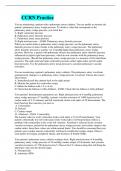
You are monitoring a patient with a pulmonary artery catheter. You are unable to measure the patient's pulmonary artery wedge pressure. To obtain a value that corresponds to the pulmonary artery wedge pressure, you check the: A. Right ventricular pressure B. Pulmonary artery diastolic pressure C. Pulmonary artery mean pressure D. Right atrial pressure - ANSB. Pulmonary artery diastolic pressure When you cannot obtain a pulmonary artery wedge pressure, use the pulmonary artery diastolic pressure to detect trends in the pulmonary artery wedge pressure. The pulmonary artery diastolic pressure is usually 1 to 4 mm/Hg higher than pulmonary artery wedge pressure. However, a patient with pulmonary disease has pulmonary artery diastolic pressure influenced by higher right heart pressures, which do not correlate with the pulmonary artery wedge pressure. (Recall that pulmonary artery wedge pressure is a measure of left-sided heart pressure). The right atrial and right ventricular pressures reflect right-sided, not left-sided, heart pressures. Use the pulmonary artery mean pressure to calculate pulmonary vascular resistance. You are monitoring a patient's pulmonary artery catheter. The pulmonary artery waveform spontaneously changes to a pulmonary artery wedge pressure waveform. Choose the correct intervention: A. Immediately pull the catheter back to the right atrium B. Monitor the patient for ventricular ectopy C. Inflate the balloon with 1.5 cc of air D. Check that the balloon is fully deflated - ANSD. Check that the balloon is fully deflated Your patient's hemodynamic parameters are: Right atrial pressure of 4 mm/Hg; pulmonary artery wedge pressure of 7 mm/Hg; systemic vascular resistance of 1,000 dynes/sec/cm-5; cardiac index of 3.5 L/minute; and left ventricular stroke work index of 20 beats/minute. The heart function that concerns you most is: A. Contractility B. Preload C. Cardiac output D. Afterload - ANSA. Contractility The normal value for a left ventricular stroke work index is 35 to 85 beats/minute. Your patient's abnormally low left ventricular stroke work index of 20 beats/minute reflects a problem with contractility in his or her left ventricle. Afterload is reflected in the systemic vascular resistance, preload in the pulmonary artery wedge pressure, and cardiac output in the cardiac index; these three values are within normal limits. You should be concerned that your patient's poor cardiac muscle contractility will lead to insufficient cardiac output. Observe your patient for fatigue, peripheral edema, and shortness of breath (SOB). Your patient's pulmonary artery catheter readings show: Right atrial pressure of 6 mm/Hg; pulmonary artery wedge pressure of 10 mm/Hg; cardiac output of 6 L/minute; and systemic vascular resistance of 1,700 dynes/sec/cm-5. Choose the I.V. infusion drug that will bring the abnormal value into the desired range: A. Nitroprusside B. Amrinone (INN)
Written for
- Institution
- CCRN
- Course
- CCRN
Document information
- Uploaded on
- November 27, 2023
- Number of pages
- 4
- Written in
- 2023/2024
- Type
- Exam (elaborations)
- Contains
- Questions & answers
Subjects
-
ccrn practice

Also available in package deal