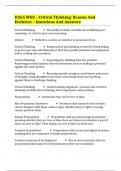
D265 WGU - Critical Thinking: Reason And
Evidence – Questions And Answers
Critical Thinking ✔️ The ability to think carefully about thinking and
reasoning--to criticize your own reasoning.
Critical ✔️ Reflective, careful, or attentive to potential errors.
Critical Thinking ✔️ Being curious and thinking creatively; Being billing
to go the next step and think about all of the possible positions and arguments
before settling into a position.
Critical Thinking ✔️ Separating the thinking from the position;
Removing personal opinion from the discussion and not making it personal
against the other person.
Critical Thinking ✔️ Knowing oneself enough to avoid biases and errors
of thought; being thoughtful and aware of personal biases and working
against them to challenge thinking.
Critical Thinking ✔️ Understanding arguments ,reasons, and evidence;
thinking carefully about thinking, about arguments, and positions.
Propositions ✔️ Statements that can be true or false.
Non-Proposition Sentences ✔️ Sentences that cannot be true or false;
cannot disagree with them; cannot argue whether they're right or wrong;
cannot question them.
Simple Propositions ✔️ Proposition with no internal logical structure,
meaning whether they are true or false does not depend on whether a part of
them are true or false. They simply are true or false on their own.
Complex Propositions ✔️ Propositions with an internal logical structure,
meaning they are composed of simple propositions.
Common Anatomy of an Argument ✔️ One or more premises that are
propositions that support or demonstrate at least one conclusion.
, Premise ✔️ Propositions/statements that support or demonstrate the
conclusion.
Conclusion ✔️ The point being made and offered for acceptance or
rejection as the basis of an argument.
Bad Inferential Structure ✔️ The argument's premises do not
demonstrate or support the conclusion. We can accept the premises as true
without being compelled to accept the conclusion.
False Premise ✔️ The premises in an argument are false.
Argument ✔️ A set of statements where the premises attempt to
provide a reason for thinking that the conclusion is true.
Conclusion Indicators ✔️ Therefore, Hence, We may conclude that, So,
Thus, Implies that, It follows that, Entails that, As a result
Premise Indicators ✔️ Because, In that, As indicated by, Given that,
Since, For, As
Inference ✔️ Argument
Argument ✔️ Any purportedly rational movement from evidence or
premises to a conclusion.
Deductive Inferences ✔️ Arguments where the premises guarantee or
necessitate the conclusion.
Inductive Inferences ✔️ Arguments where the premises make the
conclusion probable, at best.
Abductive Inference ✔️ Arguments where the best available explanation
is chosen as the correct explanation.
Truth ✔️ A property of propositions--not arguments.
Evidence – Questions And Answers
Critical Thinking ✔️ The ability to think carefully about thinking and
reasoning--to criticize your own reasoning.
Critical ✔️ Reflective, careful, or attentive to potential errors.
Critical Thinking ✔️ Being curious and thinking creatively; Being billing
to go the next step and think about all of the possible positions and arguments
before settling into a position.
Critical Thinking ✔️ Separating the thinking from the position;
Removing personal opinion from the discussion and not making it personal
against the other person.
Critical Thinking ✔️ Knowing oneself enough to avoid biases and errors
of thought; being thoughtful and aware of personal biases and working
against them to challenge thinking.
Critical Thinking ✔️ Understanding arguments ,reasons, and evidence;
thinking carefully about thinking, about arguments, and positions.
Propositions ✔️ Statements that can be true or false.
Non-Proposition Sentences ✔️ Sentences that cannot be true or false;
cannot disagree with them; cannot argue whether they're right or wrong;
cannot question them.
Simple Propositions ✔️ Proposition with no internal logical structure,
meaning whether they are true or false does not depend on whether a part of
them are true or false. They simply are true or false on their own.
Complex Propositions ✔️ Propositions with an internal logical structure,
meaning they are composed of simple propositions.
Common Anatomy of an Argument ✔️ One or more premises that are
propositions that support or demonstrate at least one conclusion.
, Premise ✔️ Propositions/statements that support or demonstrate the
conclusion.
Conclusion ✔️ The point being made and offered for acceptance or
rejection as the basis of an argument.
Bad Inferential Structure ✔️ The argument's premises do not
demonstrate or support the conclusion. We can accept the premises as true
without being compelled to accept the conclusion.
False Premise ✔️ The premises in an argument are false.
Argument ✔️ A set of statements where the premises attempt to
provide a reason for thinking that the conclusion is true.
Conclusion Indicators ✔️ Therefore, Hence, We may conclude that, So,
Thus, Implies that, It follows that, Entails that, As a result
Premise Indicators ✔️ Because, In that, As indicated by, Given that,
Since, For, As
Inference ✔️ Argument
Argument ✔️ Any purportedly rational movement from evidence or
premises to a conclusion.
Deductive Inferences ✔️ Arguments where the premises guarantee or
necessitate the conclusion.
Inductive Inferences ✔️ Arguments where the premises make the
conclusion probable, at best.
Abductive Inference ✔️ Arguments where the best available explanation
is chosen as the correct explanation.
Truth ✔️ A property of propositions--not arguments.