THEO 204
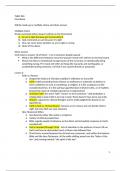
Final Exam
Will be made up or multiple choice and short answer.
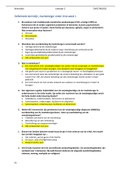
Multiple choice
Divine command ethics means? (will be on the final exam)
a) An act is right because god commanded it
b) God commands an act because it is right
c) One can never know whether an act is right or wrong
d) None of the above
Short answer:
(only have to answer 10 of them) - 2 to 4 sentences double spaced
What is the difference between moral evil and pre-moral evil? (will be on the final exam)
Moral evil refers to intentional transgressions of the moral law or intentionally doing
something wrong. Pre-moral evil refers to things like tsunamis and earthquakes, or
accidentally hurting someone, evil that is not caused directly or purposely.
Lesson 2:
- Faith vs. Reason
o Shaped the history of Christian tradition’s reflection on moral life
o Faith: belief proceeding from reliance on testimony or authority, to believe or
have confidence or trust in something. In religion, it is the acceptance of the
revealed doctrines. It is the spiritual apprehension of divine truths, or of realities
beyond the reach of sensible experience or logical proof.
o Christian Faith: the word “faith” meant “to trust someone,” and symbolizes a
relationship to God. Faith is to trust in God. There doesn’t have to be any truth.
o Reason: capacity for rational thought, and to make judgements based on our
experiences.
o Faith in God vs. Human Reason: humans act on reason and can decide what is
right, but only faith can save someone
- New Testament Ethics
o See diversity rather than unity in scriptures
o Variety of ethical perspectives
o Bible regards people’s behaviour as the direct and immediate response to God’s
revealed will
o God is revealed through Christ - lots of attention to the patterns of Jesus’ life on
Earth and how he demanded much of those who followed him
o Christ forms a bond between the old and new covenants, and unifies the Hebrew
Bible and the New Testament, all the while shifting away from the “letter of the
law” and moving towards “the spirit of the law”
1
, o Jesus (New Testament): “the kingdom of God is at hand” - refers to a person’s
acceptance of God and their adherence to living by the standards of this life.
Refers to his teachings on morality, content and motivation which attempted to
persuade people to understand his central message that was focused on
“repentance” and obedience to divine will (discipleship)
o New Testament Ethic characteristicss: Jesus condemns ritual law - human heart is
more important and there is no right or wrong completely set in stone. His
attempts are “follow me” as in imitate the selfless pattern of his life.
o Jesus uses parables or stories to teach ethical behaviour
Lesson 3:
- Natural Law
o Thomas Aquinas: drew on Aristotle, humans are intellectual beings or rational
animals - highest achievement is contemplation. Believed that humans are
responsible for their own actions. Human beings are actors in the world, and God
has given human beings the capacity to be reasonable and responsible agents.
o Aristotle’s Influence on Aquinas: Aquinas was influenced by Aristotle’s notion of
the good - teleological ethics. A good life under the control of right reason
consists of the best use of one’s rational powers (intellect and will), one’s lower
capacities (appetites and bodily activities)
o Teleology: meaning end or purpose. Teleological Ethics focuses on the end or
consequences of an act (i.e. Utilitarianism; asserts the criterion of right or wrong
actions and which one has the maximum benefits)
o Deontology: focus on the law, the rule, which takes priority over the results of an
action
o Ends - teleology, means - deontology
o There is a struggle between people who believe they should act on what they
perceive to be morally right but against the law, and those who believe to follow
all law even though it may not be moral
o Example: Greenpeace (often breaks the law to save animals)
o Natural law’s basic principle: good should be sought after and done, evil avoided.
(known through our own understanding of moral behaviour)
o Moral knowledge is available to not only believers but all those who reflect on
human experience
o Natural law assumes that human beings are naturally good and have a capacity
to choose what is right
o Aquinas links natural law both with practical reason and eternal law
- Reformation (Martin Luther, Faith working through Love)
o Nominalism: goes hand-in-hand with realism. Has to do with the way we
perceive and identify the meaning of things.
o Martin Luther: nominalism made the basis of natural law providing humans with
the innate capacity to discern good and evil, impossible. Led from the abuse of
2
Final Exam
Will be made up or multiple choice and short answer.
Multiple choice
Divine command ethics means? (will be on the final exam)
a) An act is right because god commanded it
b) God commands an act because it is right
c) One can never know whether an act is right or wrong
d) None of the above
Short answer:
(only have to answer 10 of them) - 2 to 4 sentences double spaced
What is the difference between moral evil and pre-moral evil? (will be on the final exam)
Moral evil refers to intentional transgressions of the moral law or intentionally doing
something wrong. Pre-moral evil refers to things like tsunamis and earthquakes, or
accidentally hurting someone, evil that is not caused directly or purposely.
Lesson 2:
- Faith vs. Reason
o Shaped the history of Christian tradition’s reflection on moral life
o Faith: belief proceeding from reliance on testimony or authority, to believe or
have confidence or trust in something. In religion, it is the acceptance of the
revealed doctrines. It is the spiritual apprehension of divine truths, or of realities
beyond the reach of sensible experience or logical proof.
o Christian Faith: the word “faith” meant “to trust someone,” and symbolizes a
relationship to God. Faith is to trust in God. There doesn’t have to be any truth.
o Reason: capacity for rational thought, and to make judgements based on our
experiences.
o Faith in God vs. Human Reason: humans act on reason and can decide what is
right, but only faith can save someone
- New Testament Ethics
o See diversity rather than unity in scriptures
o Variety of ethical perspectives
o Bible regards people’s behaviour as the direct and immediate response to God’s
revealed will
o God is revealed through Christ - lots of attention to the patterns of Jesus’ life on
Earth and how he demanded much of those who followed him
o Christ forms a bond between the old and new covenants, and unifies the Hebrew
Bible and the New Testament, all the while shifting away from the “letter of the
law” and moving towards “the spirit of the law”
1
, o Jesus (New Testament): “the kingdom of God is at hand” - refers to a person’s
acceptance of God and their adherence to living by the standards of this life.
Refers to his teachings on morality, content and motivation which attempted to
persuade people to understand his central message that was focused on
“repentance” and obedience to divine will (discipleship)
o New Testament Ethic characteristicss: Jesus condemns ritual law - human heart is
more important and there is no right or wrong completely set in stone. His
attempts are “follow me” as in imitate the selfless pattern of his life.
o Jesus uses parables or stories to teach ethical behaviour
Lesson 3:
- Natural Law
o Thomas Aquinas: drew on Aristotle, humans are intellectual beings or rational
animals - highest achievement is contemplation. Believed that humans are
responsible for their own actions. Human beings are actors in the world, and God
has given human beings the capacity to be reasonable and responsible agents.
o Aristotle’s Influence on Aquinas: Aquinas was influenced by Aristotle’s notion of
the good - teleological ethics. A good life under the control of right reason
consists of the best use of one’s rational powers (intellect and will), one’s lower
capacities (appetites and bodily activities)
o Teleology: meaning end or purpose. Teleological Ethics focuses on the end or
consequences of an act (i.e. Utilitarianism; asserts the criterion of right or wrong
actions and which one has the maximum benefits)
o Deontology: focus on the law, the rule, which takes priority over the results of an
action
o Ends - teleology, means - deontology
o There is a struggle between people who believe they should act on what they
perceive to be morally right but against the law, and those who believe to follow
all law even though it may not be moral
o Example: Greenpeace (often breaks the law to save animals)
o Natural law’s basic principle: good should be sought after and done, evil avoided.
(known through our own understanding of moral behaviour)
o Moral knowledge is available to not only believers but all those who reflect on
human experience
o Natural law assumes that human beings are naturally good and have a capacity
to choose what is right
o Aquinas links natural law both with practical reason and eternal law
- Reformation (Martin Luther, Faith working through Love)
o Nominalism: goes hand-in-hand with realism. Has to do with the way we
perceive and identify the meaning of things.
o Martin Luther: nominalism made the basis of natural law providing humans with
the innate capacity to discern good and evil, impossible. Led from the abuse of
2