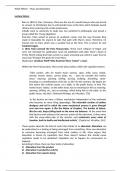
- Week 8- 13
- Chapter 7, 10, 12, 13 (only after Midterm)
- MCQ 45 ( 1 point each)
- 2 SA (5 points each)
- 25% of grade
WEEK 8A: Speech Perception
Sound Waves
● Frequency (Hz): the amount of time to complete a full cycle
○ Corresponds to pitch
● Amplitude (dB): the amount of energy in the sound wave
○ Corresponds to loudness
● Spectrogram:
○ Ends of darkness = the frequency is most prominent
○ Voice produces infinite = most important are the first view to give us an idea of
the vowels we are producing
Formants
● The most different above is the vowel ^
○ Strongest frequency pattern in the
,Features of Speech Perception
1. Categorical Perception:
● coping with variability of sounds
● What we perceive is not the same as what we are presented = illusions
● Visual perception is NOT the same as visual information provided by the retina
○ Perceive when we see the colour spectrum
○ Ability to discriminate the wavelengths would be easier for us because we have
the categorical
● Speech perception is NOt the same as sound waves received by the ear
○ Same person we hear different consonants and vowels
○ Exp: Gain vs. Cane
■ Sound involve back of the tongue, roof of mouth
■ One is voiced and Cane is unvoiced ; Cane shows there is a gap before
we can hear .
■ Gain = 0 onset time
● Force choice - identification task: hearing speech sounds in a continuous in
categorical
●
, ○ 0 onset time = some would say its \pa/
○ Categorical = say its ‘ba’
Speech Perception Test
● ABX Discrimination task: p hear two different sounds (eg. ra and la ) followed by a third
that is identical to one of the first two either ra or la
○ Pair 1 : ra ra ra
■ Used steps 1 and 3: different versions of r
■ Within- category discrimination = hard
○ Pair 2: ra la ra
■ Used steps 5 and 7 : ambiguous
■ Accross category discrimination
○ Pair 3; ra la la
■ Steps 8 and 10 : different versions of la
■ Within- category discrimination = hard
○ Accross category discrimination
○ Within- category discrimination = hard
2. Perceptual Invariance
● Although the core articulation is the same - what we pronounce after will affect
○ The production of d’ depends on the succeeding vowel due to co-articulation
● There is a distinction between our categorization of phonemes and their acoustic
manifestation
● Why:
○ Due to speech context such as co-articulation
○ Due to different speech conditions such as speech rate
○ Due to speaker identity
● Our speech perception system adapts
● Perceptual constancy: perceiving two signals as being teh same phoneme
○ Has to be llearned
○ Gender affect: vowels
■ Male = 450 , 2050 hz
● Men have smaller vowel spaces than women and children, BUT
we are still able to perceive the identity of vowels
■ Female - 550 , 2400 when producing the word /hId/
- Chapter 7, 10, 12, 13 (only after Midterm)
- MCQ 45 ( 1 point each)
- 2 SA (5 points each)
- 25% of grade
WEEK 8A: Speech Perception
Sound Waves
● Frequency (Hz): the amount of time to complete a full cycle
○ Corresponds to pitch
● Amplitude (dB): the amount of energy in the sound wave
○ Corresponds to loudness
● Spectrogram:
○ Ends of darkness = the frequency is most prominent
○ Voice produces infinite = most important are the first view to give us an idea of
the vowels we are producing
Formants
● The most different above is the vowel ^
○ Strongest frequency pattern in the
,Features of Speech Perception
1. Categorical Perception:
● coping with variability of sounds
● What we perceive is not the same as what we are presented = illusions
● Visual perception is NOT the same as visual information provided by the retina
○ Perceive when we see the colour spectrum
○ Ability to discriminate the wavelengths would be easier for us because we have
the categorical
● Speech perception is NOt the same as sound waves received by the ear
○ Same person we hear different consonants and vowels
○ Exp: Gain vs. Cane
■ Sound involve back of the tongue, roof of mouth
■ One is voiced and Cane is unvoiced ; Cane shows there is a gap before
we can hear .
■ Gain = 0 onset time
● Force choice - identification task: hearing speech sounds in a continuous in
categorical
●
, ○ 0 onset time = some would say its \pa/
○ Categorical = say its ‘ba’
Speech Perception Test
● ABX Discrimination task: p hear two different sounds (eg. ra and la ) followed by a third
that is identical to one of the first two either ra or la
○ Pair 1 : ra ra ra
■ Used steps 1 and 3: different versions of r
■ Within- category discrimination = hard
○ Pair 2: ra la ra
■ Used steps 5 and 7 : ambiguous
■ Accross category discrimination
○ Pair 3; ra la la
■ Steps 8 and 10 : different versions of la
■ Within- category discrimination = hard
○ Accross category discrimination
○ Within- category discrimination = hard
2. Perceptual Invariance
● Although the core articulation is the same - what we pronounce after will affect
○ The production of d’ depends on the succeeding vowel due to co-articulation
● There is a distinction between our categorization of phonemes and their acoustic
manifestation
● Why:
○ Due to speech context such as co-articulation
○ Due to different speech conditions such as speech rate
○ Due to speaker identity
● Our speech perception system adapts
● Perceptual constancy: perceiving two signals as being teh same phoneme
○ Has to be llearned
○ Gender affect: vowels
■ Male = 450 , 2050 hz
● Men have smaller vowel spaces than women and children, BUT
we are still able to perceive the identity of vowels
■ Female - 550 , 2400 when producing the word /hId/