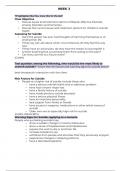
Week 1: Mental health 3524
What to expect:
• Classes (Mental Health) – 6 weeks
• Identify the complexities of care
• Examine the vulnerability, resilience and recovery of this patient
population
• Ethical issues
• Legal requirements of nurses
• Examine Therapeutic Relationships
• Explore current mental health issues
Topics to be covered:
• Therapeutic relationships and communication with individuals and
families
• Vulnerability; empowerment; strength; quality of life, and health
promotion
• Advocacy and consent to treatment
• Culturally sensitive care
• Chronic illness, loss, grief, recovery, resilience, hope and coping
• Health education; child/individual safety, family-centred/family
sensitive care
• Professional boundaries; stigma and social inclusion; violence and
child abuse; legal and ethical obligations
• Communicating with patients: body language, validation, verbal
communication, showing respect,
• Everyone has mental illness but people are afraid to talk about it due
to stigma
• Family members are ashamed by their patient because they may
seem it was a phase, or overreacting
• Study about STIGMA
• Culture and its impact of mental health: cultures may be religious
based and say to pray instead of dealing with it, they make think it is
a sign of weakness,
• How can we help with patients that have mental illness: connecting
them to resources
Therapeutic communication:
, -Body language
-Setting limits
-No crossed arms (pt will think you are closed off)
-Verbal communication
-Respect
Stigma:
Many will not seek help because there is stigma attached to it
Pt’s family at first visit all the time but after a year, they do not because they
feel ashamed
Culture also impacts mentally ill clients à in some cultures they accept
mental illness and others don’t
-Pain and suffering may be looked upon as a punishment
-Some cultures think that mental illness is taboo
-Some cultures think if the pt is seeing things, that it’ll go away with
time and that they wont need treatment
STIGMA WILL BE ON THE TEST **STUDY**
How to help someone:
-Connect them with resources
Key Course Information:
• 6 Lectures for Mental Health and 6 for Pediatrics
• Test #1 is based on mental health content, Test #2 is on Paeds
content, Final exam includes both
• Course includes a practicum – must pass both practicum and theory
in order to pass the course
Important Course Dates
• Test # 1 (Mental Health)– 20 % - Week 4 Sept. 28
• Test # 2 (Paediatrics)– 20 % - Week 4 Nov. 16h
• Tests are multiple choice and/or short answer. Held in the first hour
of class. There will be a class after each test.
• Exam – 60%- during YorkU exam period
Required Readings
• Readings are assigned from both the required text, recommended
text (at YorkU library) and from key documents accessible
electronically.
• Successful students in this course complete required readings prior
to class and ask questions and engage in discussions in class, and/or
participate in Moodle discussions.
, • Class is a opportunity for critical dialogue, discussion, and
exploration of key concepts/issues from readings.
• Not all required readings are covered in lectures and students are
responsible for the content of all required readings and class
discussions.
Mental Health
• What does that mean to you, to others?
• How is it culturally defined?
• What is one’s acceptable behaviour, coping ability and response to
stress?
• According to World Health Organization (WHO), why is mental
health an integral and essential component of health?
Mental Health Definitions:
“It is not just an absence of mental disorder or disability...It is defined as a
state of well-being in which every individual realizes his or her own potential,
can cope with the normal stresses of life, can work productively and fruitfully,
and is able to make a contribution to her or his community” (Mental Health
Commission of Canada, 2013).
Karen L. Fontaine (2009), defined mental health as a “life long process that
includes a sense of harmony and balance in the individual, family, friends, and
community”.
Features of mental health:
Emotional Intelligence: Salvoy & Mayer (1990) 4 components:
1. Perceiving emotions
2. Reasoning Emotions
3. Understanding Emotions
4. Managing Emotions
– Emotions are skills for living.
– Important to recognize our emotions-know ourselves.
– Have emotional self control.
– Recognize emotions in others.
– Handle relationships.
RESILIENCY: the ability to emerge and grow from negative life events
What comes to your mind when you hear mental illness?
- It comes to altercations to thinking
- Ex: I am not good enough, Upswings to mood, Hearing voices
- Hallucinations with the five senses:
o Taste
What to expect:
• Classes (Mental Health) – 6 weeks
• Identify the complexities of care
• Examine the vulnerability, resilience and recovery of this patient
population
• Ethical issues
• Legal requirements of nurses
• Examine Therapeutic Relationships
• Explore current mental health issues
Topics to be covered:
• Therapeutic relationships and communication with individuals and
families
• Vulnerability; empowerment; strength; quality of life, and health
promotion
• Advocacy and consent to treatment
• Culturally sensitive care
• Chronic illness, loss, grief, recovery, resilience, hope and coping
• Health education; child/individual safety, family-centred/family
sensitive care
• Professional boundaries; stigma and social inclusion; violence and
child abuse; legal and ethical obligations
• Communicating with patients: body language, validation, verbal
communication, showing respect,
• Everyone has mental illness but people are afraid to talk about it due
to stigma
• Family members are ashamed by their patient because they may
seem it was a phase, or overreacting
• Study about STIGMA
• Culture and its impact of mental health: cultures may be religious
based and say to pray instead of dealing with it, they make think it is
a sign of weakness,
• How can we help with patients that have mental illness: connecting
them to resources
Therapeutic communication:
, -Body language
-Setting limits
-No crossed arms (pt will think you are closed off)
-Verbal communication
-Respect
Stigma:
Many will not seek help because there is stigma attached to it
Pt’s family at first visit all the time but after a year, they do not because they
feel ashamed
Culture also impacts mentally ill clients à in some cultures they accept
mental illness and others don’t
-Pain and suffering may be looked upon as a punishment
-Some cultures think that mental illness is taboo
-Some cultures think if the pt is seeing things, that it’ll go away with
time and that they wont need treatment
STIGMA WILL BE ON THE TEST **STUDY**
How to help someone:
-Connect them with resources
Key Course Information:
• 6 Lectures for Mental Health and 6 for Pediatrics
• Test #1 is based on mental health content, Test #2 is on Paeds
content, Final exam includes both
• Course includes a practicum – must pass both practicum and theory
in order to pass the course
Important Course Dates
• Test # 1 (Mental Health)– 20 % - Week 4 Sept. 28
• Test # 2 (Paediatrics)– 20 % - Week 4 Nov. 16h
• Tests are multiple choice and/or short answer. Held in the first hour
of class. There will be a class after each test.
• Exam – 60%- during YorkU exam period
Required Readings
• Readings are assigned from both the required text, recommended
text (at YorkU library) and from key documents accessible
electronically.
• Successful students in this course complete required readings prior
to class and ask questions and engage in discussions in class, and/or
participate in Moodle discussions.
, • Class is a opportunity for critical dialogue, discussion, and
exploration of key concepts/issues from readings.
• Not all required readings are covered in lectures and students are
responsible for the content of all required readings and class
discussions.
Mental Health
• What does that mean to you, to others?
• How is it culturally defined?
• What is one’s acceptable behaviour, coping ability and response to
stress?
• According to World Health Organization (WHO), why is mental
health an integral and essential component of health?
Mental Health Definitions:
“It is not just an absence of mental disorder or disability...It is defined as a
state of well-being in which every individual realizes his or her own potential,
can cope with the normal stresses of life, can work productively and fruitfully,
and is able to make a contribution to her or his community” (Mental Health
Commission of Canada, 2013).
Karen L. Fontaine (2009), defined mental health as a “life long process that
includes a sense of harmony and balance in the individual, family, friends, and
community”.
Features of mental health:
Emotional Intelligence: Salvoy & Mayer (1990) 4 components:
1. Perceiving emotions
2. Reasoning Emotions
3. Understanding Emotions
4. Managing Emotions
– Emotions are skills for living.
– Important to recognize our emotions-know ourselves.
– Have emotional self control.
– Recognize emotions in others.
– Handle relationships.
RESILIENCY: the ability to emerge and grow from negative life events
What comes to your mind when you hear mental illness?
- It comes to altercations to thinking
- Ex: I am not good enough, Upswings to mood, Hearing voices
- Hallucinations with the five senses:
o Taste