Section 1: Nucleus and DNA packaging
The Nucleus:
➔ Functions:
◆ Protect cell’s DNA
● Double layered membrane (nuclear envelope)
● Very selective nuclear pores
● Unique fluid called the nucleoplasm
◆ Allows DNA to be replicated and transcribed to mRNA when needed
◆ Regulates which molecules can access the DNA and separates the DNA from
other cell components
◆ Keeps all DNA organized since DNA is fragile
,DNA packaging:
➔ Cells are only microns in size, it has to carefully package DNA
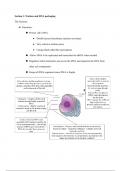
Level 2: DNA is wrapped twice around proteins called histones to create nucleosomes (shortens DNA 7 fold)
(200bp of DNA are wrapped around one octamer (core DNA))
Level 3: String of nucleosomes coiled in a spiralling chromatin fibre (shortens DNA by 42 fold)
Level 4: chromatin fibres formed into chromatin looped domains (shortens DNA by 750 fold)
Level 5: chromatin looped domain further compressed and folded into heterochromatin of 700nm - highly
condensed DNA - further condensed into chromosomes during cell division
Level 1-4 = Euchromatin - active DNA - replication of chromosomes, reading a strand of DNA to make
mRNA)
, Section 2: The endomembrane system
The linked machinery that processes transporting cargo throughout the cell
➔ The nucleus is connected to the ER cisternae by the outer layer nuclear envelope -
nuclear pores connect ER and nucleus so molecules can freely pass through
➔ Vesicle transport - vesicles used to shuttle material between organelles
◆ Small vesicles bud off of the lipid membrane of organelles or the cell, with the
purpose of transporting e.g soluble or membrane-bound proteins
◆ Once reaching their final destination, they fuse with other lipid membranes
➔ Golgi network
◆ Trans Golgi addition:
● Each cell has different requirements for their trans Golgi network
(different cell type, different proteins needed)
● Retrograde transport: Some proteins have an ER retention signal so the
trans Golgi network packs them with COPI coating proteins so they are
recycled back to the ER
The Nucleus:
➔ Functions:
◆ Protect cell’s DNA
● Double layered membrane (nuclear envelope)
● Very selective nuclear pores
● Unique fluid called the nucleoplasm
◆ Allows DNA to be replicated and transcribed to mRNA when needed
◆ Regulates which molecules can access the DNA and separates the DNA from
other cell components
◆ Keeps all DNA organized since DNA is fragile
,DNA packaging:
➔ Cells are only microns in size, it has to carefully package DNA
Level 2: DNA is wrapped twice around proteins called histones to create nucleosomes (shortens DNA 7 fold)
(200bp of DNA are wrapped around one octamer (core DNA))
Level 3: String of nucleosomes coiled in a spiralling chromatin fibre (shortens DNA by 42 fold)
Level 4: chromatin fibres formed into chromatin looped domains (shortens DNA by 750 fold)
Level 5: chromatin looped domain further compressed and folded into heterochromatin of 700nm - highly
condensed DNA - further condensed into chromosomes during cell division
Level 1-4 = Euchromatin - active DNA - replication of chromosomes, reading a strand of DNA to make
mRNA)
, Section 2: The endomembrane system
The linked machinery that processes transporting cargo throughout the cell
➔ The nucleus is connected to the ER cisternae by the outer layer nuclear envelope -
nuclear pores connect ER and nucleus so molecules can freely pass through
➔ Vesicle transport - vesicles used to shuttle material between organelles
◆ Small vesicles bud off of the lipid membrane of organelles or the cell, with the
purpose of transporting e.g soluble or membrane-bound proteins
◆ Once reaching their final destination, they fuse with other lipid membranes
➔ Golgi network
◆ Trans Golgi addition:
● Each cell has different requirements for their trans Golgi network
(different cell type, different proteins needed)
● Retrograde transport: Some proteins have an ER retention signal so the
trans Golgi network packs them with COPI coating proteins so they are
recycled back to the ER