NUMBER PATTERNS
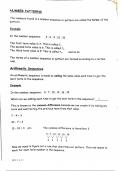
The numbers found in a number sequence or
pattern.
pattern are called the Ters o
Example
In the number sequence: 3:6:9:12: 15
The first term value is 3. This is called T,.
The second term value is 6. This is called T,.
The third term value is9. This is called Ta, and so on.
The terms of a number sequence or pattern are formed according to a
rule. cerfain
Arithmetic Sequences
An arithmetic sequence is made by adding the same value each time to get the
next term in the sequence.
Example
In the number sequence: 4:7:10: 13:16: 19
What are we adding each time to get the next term in the sequence?
This is known as the common difference because we can create it by taking any
term and subtracting the previous term from that value.
7-4 3
10 -7= 3
13 - 10 = 3 etc. The commondifference is therefore 3.
4;7;10;13: 16;19
3 3 3 3 3
Now we need to figure out arule that describes our pattern, This rule needs to
work for each term number in the sequence.
52 | P age
, Every arithmetic sequence follows the rule:
T,, =term number x common difference +a value
T = 4 4 = 1x 3+
T =7 7=2X 3+
T3 = 10 10 = 3 x3 +
TË =13 13 = 4x3+
This rule can be written as:
an expression:
T, =3n +1
T, =n x 3+ 1 or
" in words:
obtain the next term in the
Startingat 4 we add three to each term to of the
state the starting point
sequence. It is very important that we
pattern is following.
sequence so that we knowexactly what path our
" both words and numbers:
+1
the term value =3 x the term number
INPUT number (term
To create anumeric pattern, arule is applied to an
number.
number) and this results inan OUTPUT
This can be represented in a table as follows:
1 2 3 4 5 6
Input (x)
Output () 4 7 10 13 16 19
In this table,the constant difference between the output values is 3. The input
value is multiplied by3 and then one is added to obtain the output value.
This can be written as: y=3xx+1 or y= 3x +1
The numbers found in a number sequence or
pattern.
pattern are called the Ters o
Example
In the number sequence: 3:6:9:12: 15
The first term value is 3. This is called T,.
The second term value is 6. This is called T,.
The third term value is9. This is called Ta, and so on.
The terms of a number sequence or pattern are formed according to a
rule. cerfain
Arithmetic Sequences
An arithmetic sequence is made by adding the same value each time to get the
next term in the sequence.
Example
In the number sequence: 4:7:10: 13:16: 19
What are we adding each time to get the next term in the sequence?
This is known as the common difference because we can create it by taking any
term and subtracting the previous term from that value.
7-4 3
10 -7= 3
13 - 10 = 3 etc. The commondifference is therefore 3.
4;7;10;13: 16;19
3 3 3 3 3
Now we need to figure out arule that describes our pattern, This rule needs to
work for each term number in the sequence.
52 | P age
, Every arithmetic sequence follows the rule:
T,, =term number x common difference +a value
T = 4 4 = 1x 3+
T =7 7=2X 3+
T3 = 10 10 = 3 x3 +
TË =13 13 = 4x3+
This rule can be written as:
an expression:
T, =3n +1
T, =n x 3+ 1 or
" in words:
obtain the next term in the
Startingat 4 we add three to each term to of the
state the starting point
sequence. It is very important that we
pattern is following.
sequence so that we knowexactly what path our
" both words and numbers:
+1
the term value =3 x the term number
INPUT number (term
To create anumeric pattern, arule is applied to an
number.
number) and this results inan OUTPUT
This can be represented in a table as follows:
1 2 3 4 5 6
Input (x)
Output () 4 7 10 13 16 19
In this table,the constant difference between the output values is 3. The input
value is multiplied by3 and then one is added to obtain the output value.
This can be written as: y=3xx+1 or y= 3x +1