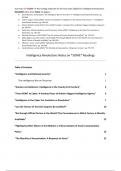
Summary of *SOME* of the reading materials for the final exam (2023) for Intelligence Revolutions.
INCLUDES notes from (Total: 16 pages):
● Daniel Byman’s article (2013) “The Intelligence War on Terrorism” in “Intelligence and National Security”, pp.
837-863.
● Charles Cogan’s article (2004) “Hunters not Gatherers: Intelligence in the Twenty-First Century” in “Intelligence
and National Security”, pp. 304-321.
● Richard Aldrich’s article (2021) “From SIGINT to Cyber: A Hundred Years of Britain’s Biggest Intelligence Agency”,
pp. 910-917.
● David Gioe, Michael Goodman and Tim Stevens’ article (2020) “Intelligence in the Cyber Era: Evolution or
Revolution”, pp. 191-224.
● Maureen Ramsay’s article (2006) “Can the Torture of Terrorist Suspects Be Justified?”, pp. 103-119.
● Mirko Bagaric and Julie Clarke’s article (2005) “Not Enough Official Torture in the World? The Circumstances in
Which Torture Is Morally Justifiable”, pp. 581-616.
● Michael L. Gross’ article (2003) “Fighting by Other Means in the Mideast: a Critical Analysis of Israel's
Assassination Policy”, pp. 350-368.
● Daniel Statman’s article (2003) “The Morality of Assassination: A Response to Gross”, pp. 775-779.
Intelligence Revolutions Notes on *SOME* Readings
Table of Contents
“Intelligence and National Security” 1
The Intelligence War on Terrorism 1
“Hunters not Gatherers: Intelligence in the Twenty-First Century” 4
“From SIGINT to Cyber: A Hundred Years of Britain’s Biggest Intelligence Agency” 6
“Intelligence in the Cyber Era: Evolution or Revolution” 7
“Can the Torture of Terrorist Suspects Be Justified?” 10
“Not Enough Official Torture in the World? The Circumstances in Which Torture Is Morally
Justifiable” 12
“Fighting by Other Means in the Mideast: a Critical Analysis of Israel's Assassination
Policy” 14
“The Morality of Assassination: A Response to Gross” 15
, 1
“Intelligence and National Security”
The Intelligence War on Terrorism
Common criticisms of intelligence agencies (e.g., CIA) misunderstand counterterrorism
intelligence’s realities for gaining information on terrorist groups.
➔ Need to recognise differences when evaluating counterterrorism.
➔ Calls for being cautious with intelligence reform (i.e., changing US detention policy, making
the public more aware of the inevitable gaps).
Intelligence’s neglect is attributed to its shadowy nature.
➔ Counterterrorism intelligence is distinct from traditional intelligence & much of the work
does NOT emphasise these crucial distinctions (e.g., criticisms of the US intelligence
community for failing to reform after 9/11).
◆ CIA criticisms:
● Unable to infiltrate Al Qaeda’s inner circle.
● Relies too heavily on technical means to gather information
◆ Lacks attention regarding the importance of signals intelligence, liaison
relationships, document exploitation & interrogation.
What is Counterterrorism Intelligence?
Intelligence cycle:
1. Planning intelligence gathering.
2. Collecting intelligence.
➔ Counterrosim varies, including supplementary steps.
3. Processing the intelligence into a report.
4. Analysing the information.
5. Disseminating the information.
Terrorists as an Intelligence Challenge
Counterterrorism intelligence analysis requires knowing the adversary.
➔ Intelligence’s targets are proven terrorists & anyone who might commit terrorism in the
future = difficult to identify.
◆ Already even more difficult regarding Al Qaeda:
1. Has a global presence.
2. Is aware of the contours of the US intelligence effort & adjusts accordingly.
3. Its structures involve networks/hierarchies, making senior-level penetration
difficult.
Collection, Analysis & Counterterrorism
Variety of methods used in intelligence collection (i.e. ‘INTs’):
● Human spies (HUMINT).
➔ Traditional focus on slowly developing sources whose value pays off over time.
➔ With terrorism:
◆ Information’s value is short-lived.
, 2
◆ Information comes from interrogation (with/without torture).
➔ ‘DocEx’: Document exploitation.
➔ Foreign Liaison Relationships: Unrealistic for a country to have strong unilateral
capabilities in every country where a terrorist group is present. HOWEVER, foreign
governments can fill this gap acting as a force multiplier.
◆ Local governments can be part of the:
● Problem = are often corrupt & undemocratic, creating grievances
that terrorists work to exploit.
● Solution = these grievances create terrorist hotbeds, with allies
having impressive capabilities available (e.g., local languages,
cultural awareness, jails). These states can simply arrest
questionable people, as being a member of a terrorist group or
otherwise supporting violence is almost uniformly illegal.
● Intercepting phone calls, emails, tracking financing & other signals (SIGINT).
➔ Despite being particularly important in counterterrorism, signals intelligence is often
neglected.
➔ Deciding whom to monitor/locate can be exceptionally difficult, HOWEVER, SIGINT
can be valuable when monitoring careless terrorist communications.
● Imagery on terrorist activities (IMINT).
Counterterrorism Analysis
Involves puzzling together name fragments, phone numbers & other small pieces = very difficult.
Different Relationships among Analysts, Collectors & Policymakers
Divide between intelligence & policy in counterterrorism, as the intelligence community is a
producer & consumer of intelligence.
➔ Analysts drive the collection of information.
➔ The consumer of the information is often the intelligence community itself.
Dilemmas & Problems
Counterterrorism poses many challenges:
● Intelligence policy = exacerbated tension in terrorism by working with operatives involved in
violence (ethical & legal challenge).
● Coordination = counterterrorism involves multiple intelligence services.
● Interrogation & lack of an institutionalised detention program = shift away from this
essential practice, with NO suitable alternative.
● Issues overseas = difficulties, corruption & repression in hostile areas (e.g., Afghanistan,
Iran) where governments tolerate terrorist activity for their purposes (e.g., Pakistan, Yemen),
or where there is NO functioning government (e.g., Sudan).
➔ For counterterrorism, allies are found in countries with order problems & poor
economies.
➔ Liaison services may be less skilled in some aspects of counterterrorism. Often
foreign intelligence agencies within an autocratic country do NOT communicate (to
prevent a coup by limiting the necessary flow of information).
➔ Cooperation requires different intelligence partners within a foreign country.
INCLUDES notes from (Total: 16 pages):
● Daniel Byman’s article (2013) “The Intelligence War on Terrorism” in “Intelligence and National Security”, pp.
837-863.
● Charles Cogan’s article (2004) “Hunters not Gatherers: Intelligence in the Twenty-First Century” in “Intelligence
and National Security”, pp. 304-321.
● Richard Aldrich’s article (2021) “From SIGINT to Cyber: A Hundred Years of Britain’s Biggest Intelligence Agency”,
pp. 910-917.
● David Gioe, Michael Goodman and Tim Stevens’ article (2020) “Intelligence in the Cyber Era: Evolution or
Revolution”, pp. 191-224.
● Maureen Ramsay’s article (2006) “Can the Torture of Terrorist Suspects Be Justified?”, pp. 103-119.
● Mirko Bagaric and Julie Clarke’s article (2005) “Not Enough Official Torture in the World? The Circumstances in
Which Torture Is Morally Justifiable”, pp. 581-616.
● Michael L. Gross’ article (2003) “Fighting by Other Means in the Mideast: a Critical Analysis of Israel's
Assassination Policy”, pp. 350-368.
● Daniel Statman’s article (2003) “The Morality of Assassination: A Response to Gross”, pp. 775-779.
Intelligence Revolutions Notes on *SOME* Readings
Table of Contents
“Intelligence and National Security” 1
The Intelligence War on Terrorism 1
“Hunters not Gatherers: Intelligence in the Twenty-First Century” 4
“From SIGINT to Cyber: A Hundred Years of Britain’s Biggest Intelligence Agency” 6
“Intelligence in the Cyber Era: Evolution or Revolution” 7
“Can the Torture of Terrorist Suspects Be Justified?” 10
“Not Enough Official Torture in the World? The Circumstances in Which Torture Is Morally
Justifiable” 12
“Fighting by Other Means in the Mideast: a Critical Analysis of Israel's Assassination
Policy” 14
“The Morality of Assassination: A Response to Gross” 15
, 1
“Intelligence and National Security”
The Intelligence War on Terrorism
Common criticisms of intelligence agencies (e.g., CIA) misunderstand counterterrorism
intelligence’s realities for gaining information on terrorist groups.
➔ Need to recognise differences when evaluating counterterrorism.
➔ Calls for being cautious with intelligence reform (i.e., changing US detention policy, making
the public more aware of the inevitable gaps).
Intelligence’s neglect is attributed to its shadowy nature.
➔ Counterterrorism intelligence is distinct from traditional intelligence & much of the work
does NOT emphasise these crucial distinctions (e.g., criticisms of the US intelligence
community for failing to reform after 9/11).
◆ CIA criticisms:
● Unable to infiltrate Al Qaeda’s inner circle.
● Relies too heavily on technical means to gather information
◆ Lacks attention regarding the importance of signals intelligence, liaison
relationships, document exploitation & interrogation.
What is Counterterrorism Intelligence?
Intelligence cycle:
1. Planning intelligence gathering.
2. Collecting intelligence.
➔ Counterrosim varies, including supplementary steps.
3. Processing the intelligence into a report.
4. Analysing the information.
5. Disseminating the information.
Terrorists as an Intelligence Challenge
Counterterrorism intelligence analysis requires knowing the adversary.
➔ Intelligence’s targets are proven terrorists & anyone who might commit terrorism in the
future = difficult to identify.
◆ Already even more difficult regarding Al Qaeda:
1. Has a global presence.
2. Is aware of the contours of the US intelligence effort & adjusts accordingly.
3. Its structures involve networks/hierarchies, making senior-level penetration
difficult.
Collection, Analysis & Counterterrorism
Variety of methods used in intelligence collection (i.e. ‘INTs’):
● Human spies (HUMINT).
➔ Traditional focus on slowly developing sources whose value pays off over time.
➔ With terrorism:
◆ Information’s value is short-lived.
, 2
◆ Information comes from interrogation (with/without torture).
➔ ‘DocEx’: Document exploitation.
➔ Foreign Liaison Relationships: Unrealistic for a country to have strong unilateral
capabilities in every country where a terrorist group is present. HOWEVER, foreign
governments can fill this gap acting as a force multiplier.
◆ Local governments can be part of the:
● Problem = are often corrupt & undemocratic, creating grievances
that terrorists work to exploit.
● Solution = these grievances create terrorist hotbeds, with allies
having impressive capabilities available (e.g., local languages,
cultural awareness, jails). These states can simply arrest
questionable people, as being a member of a terrorist group or
otherwise supporting violence is almost uniformly illegal.
● Intercepting phone calls, emails, tracking financing & other signals (SIGINT).
➔ Despite being particularly important in counterterrorism, signals intelligence is often
neglected.
➔ Deciding whom to monitor/locate can be exceptionally difficult, HOWEVER, SIGINT
can be valuable when monitoring careless terrorist communications.
● Imagery on terrorist activities (IMINT).
Counterterrorism Analysis
Involves puzzling together name fragments, phone numbers & other small pieces = very difficult.
Different Relationships among Analysts, Collectors & Policymakers
Divide between intelligence & policy in counterterrorism, as the intelligence community is a
producer & consumer of intelligence.
➔ Analysts drive the collection of information.
➔ The consumer of the information is often the intelligence community itself.
Dilemmas & Problems
Counterterrorism poses many challenges:
● Intelligence policy = exacerbated tension in terrorism by working with operatives involved in
violence (ethical & legal challenge).
● Coordination = counterterrorism involves multiple intelligence services.
● Interrogation & lack of an institutionalised detention program = shift away from this
essential practice, with NO suitable alternative.
● Issues overseas = difficulties, corruption & repression in hostile areas (e.g., Afghanistan,
Iran) where governments tolerate terrorist activity for their purposes (e.g., Pakistan, Yemen),
or where there is NO functioning government (e.g., Sudan).
➔ For counterterrorism, allies are found in countries with order problems & poor
economies.
➔ Liaison services may be less skilled in some aspects of counterterrorism. Often
foreign intelligence agencies within an autocratic country do NOT communicate (to
prevent a coup by limiting the necessary flow of information).
➔ Cooperation requires different intelligence partners within a foreign country.