EMT MOD 6 | Test Bank| With Complete Solutions (200 Q&A)
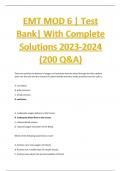
EMT MOD 6 | Test Bank| With Complete Solutions (200 Q&A) You are summoned to the aid of a 45-year-old male who was hunting and fell from a tree stand. When you arrive, he is experiencing severe pain in his lower right thigh. On examination, you find that an area about three inches above his right knee has an open wound about one inch in diameter that is bleeding minimally. There are no exposed bones, but you palpate crepitus and see swelling that makes you suspect bone fracture. You would you classify this as a(n): A. sprain. B. open extremity injury. C. closed extremity injury. D. dislocation. [Ans: - B. open extremity injury. A patient has been exercising too much, which has led to a muscle injury in his right shoulder due to too much strenuous activity involving that muscle. This is a: A. fracture. B. sprain. C. strain. D. dislocation. [Ans: - C. strain. You arrive on scene to the local park, where you are presented with a 20-year-old male complaining of severe left shoulder pain. The patient states he fell on the ground and immediately felt a sharp pain in the shoulder. As you evaluate the shoulder, you note that the left shoulder sits lower than the right. He has intact distal pulse, motor, and sensory function, but his shoulder is locked in place and he cannot move it without severe pain. Based on the assessment findings, the patient is most likely suffering from which of the following? A. Distal humerus fracture B. Dislocation C. Compartment syndrome D. Shoulder strain [Ans: - B. Dislocation You arrive on scene to a private residence, where you find a 56-year-old female patient sitting in her living room complaining of pain, paresthesia, and pressure in her lower right leg. She states that a few days ago, she slipped on her way downstairs, and has had pain in her leg ever since, but she has not been to the doctor. During your examination, you note that her right lower leg is pale and pulseless. You see swelling and palpate hardness compared with the uninjured left lower leg. Based on these findings, the patient is most likely experiencing which of the following conditions? A. Compartment syndrome B. Muscle strain of the gastrocnemius C. Deep vein thrombosis D. Possible sprain of her right ankle [Ans: - A. Compartment syndrome When performing a primary assessment of a patient with musculoskeletal injuries, you should: A. focus primarily on highly visible, external factors. B. consider multiple fractures to the femurs to be low-priority injuries. C. avoid your focus being distracted by the most dramatic extremity injuries. D. keep in mind that painful extremity injuries tend to be the most serious. [Ans: - C. avoid your focus being distracted by the most dramatic extremity injuries. Application of a cervical collar to a patient should happen: A. before addressing any life-threatening conditions. B. during the primary assessment. C. after loading the patient to initiate transport. D. during the secondary assessment. [Ans: - D. during the secondary assessment. A primary reason for splinting a bone or joint injury is: A. preventing movement to reduce the chance for further injury. B. preventing swelling, which might complicate the ED physician's examination. C. setting the bone ends back into their proper position. D. replacing exposed bone ends back into the extremity. [Ans: - A. preventing movement to reduce the chance for further injury. Guidelines for splinting long-bone injuries include: A. assessing the radial pulse for a lower extremity injury. B. splinting the injured extremity to the uninjured extremity. C. immobilizing the hand or foot in the position of function. D. having the patient bend the leg at the knee to check motor function. [Ans: - C. immobilizing the hand or foot in the position of function. Which of the following should be applied to provide stability for an upper arm injury? A. Straight arm splint B. Pressure bandage C. Sling and swathe D. Traction splint [Ans: - C. Sling and swathe Your patient has a nontraumatic fracture of the left wrist. Appropriate treatment would be to: A. splint with a padded rigid splint. B. apply a sling and swathe, followed by rigid splinting. C. transport the patient without a splint. D. splint the injured wrist to the uninjured wrist. [Ans: - A. splint with a padded rigid splint. Your patient fractured her right wrist in a motor vehicle collision. You notice swelling, redness, and tenderness distal to the site. The patient is wearing a ring and a bracelet. The ring slides off her finger easily but the bracelet is tight against the swelling. You should: A. cut off the bracelet but leave the ring in place. B. leave both the ring and bracelet in place. C. slide off the ring and cut off the bracelet. D. slide off the ring but leave the bracelet in place. [Ans: - C. slide off the ring and cut off the bracelet. Which of the following is one of the "six Ps" of assessing compromise to an extremity when a musculoskeletal injury is suspected? A. Probability B. Proximity C. Putrescence D. Pressure [Ans: - D. Pressure When treating a patient with musculoskeletal injuries, after addressing any life-threatening conditions, splint: A. injuries to the arms. B. any suspected extremity fracture. C. injuries to the legs. D. any fracture that has broken the skin. [Ans: - B. any suspected extremity fracture.
Written for
- Institution
- EMT
- Course
- EMT
Document information
- Uploaded on
- October 3, 2023
- Number of pages
- 76
- Written in
- 2023/2024
- Type
- Exam (elaborations)
- Contains
- Questions & answers
Subjects
-
emt mod 6
-
emt
-
emt mod 6 test bank

Also available in package deal