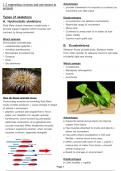
1.2 supporting systems and movement in Advantages
animals - provide framework for muscles to contract so
movement can take place
Types of skeletons Disadvantages
A. Hydrostatic skeletons - no protection (no defence mechanism)
Fluid lled closed chambers inside body = - Restricted range of movement
provide support against which muscles can - Move slow
contract to bring movement - Con ned to areas near or in water as lose
water readily
Which animals: - Cannot reach great size
Soft bodied invertebrates
- coelenterates (jelly sh ) B. Exoskeletons
- Annelids (earthworms) Skeleton found outside body. Skeleton made
- Nematodes (roundworms) from chitin (similar to cellulose found in cell walls
- Octopus of plants) light and strong
- Snail
- Sea anemone Which animals
- crustaceans
- Myriapods (shongololo)
- Insects
- Arachnids
How do these animals move
Contracting muscles surrounding uid lled
cavity creates pressure = cause change in shape
of animal = movement
- jelly sh: contract bell shaped form, force
water out. Skeleton for aquatic animals
- Earthworms: move forward by peristalsis Advantages
(alternate contraction of longitudinal and Supports animal and protects its internal
circular muscles) When lengthwise muscles organs from injury
contract, segments shorten, when circular Has muscles attached to knobs and plants =
muscles contract, segments elongate allows for movement
Has joints where exoskeleton is thin and
exible = animal move more easy
Often covered with layer of wax = cuticle =
reduce loss of water from body = prevent
animal drying out
Resist to changes in environment
Disadvantages
Limit mobility = rigidity
Page 1
fl fifi fi fi fl fi
, Limit growth • Bones can be broken
Have to molt (grow)
Heavy skeleton and vulnerable to predators What tissues make up
endoskeleton?
How can disadvantages be overcome
Arthropoda shed skeletons to enable to grow
1. Cartilage
= mounting or ecdysis. New skeleton
Cartilage occurs in isolated areas. Softer than
generated under epidermis
bone as less minerals and few blood cells and no
Mollusks have shells and as grow diameter to
nerves
shell added to enlarge shell without altering
shape
How is cartilage made up
Anthropoid skeleton divided into functional
Three types:
units for movement
I. Hyaline cartilage (jelly matrix) (sternum,
Anthropoid have jointed limbs where skeleton
breastbone)
is thin
II. Elastic cartilage ( bres in matrix)
III. Fibrous cartilage ( bres in matrix)
C. Endoskeletons
Found within body of animal.
All vertebraeʼs have endoskeleton. Vertebrates
skeletons made bone or cartilage
Sharks and rays have skeletons made of cartilage =
softer n lighter than bone
All three have the same basic compounds
- chondrocytes (mature cartilage cells) in
lacunae (cavities) surrounded by
- Matrix made up jelly like substance in which
both collagen bres (for exibility and
strength) and elastic bres (for elasticity) are
deposited
- Large amount tissue uid
Why is cartilage important
Advantages - lines many joints , preventing friction and
• Support body and give shape facilitating smooth movement
• Made up of living tissue grow as animal - Act as shock absorber between vertebrae
increases in size - Forms exible structures = epiglottis and
• Protect internal organs pinna of ear
• Provide anchors for muscles which work with
bones to allow movement 2. Bone
• Movement is quick Hardest tissue in body and needs to be as light
as possible. Blood vessels, nerves, lymph vessels
Disadvantages
Page 2
fl fi fifi fl
fi fl
animals - provide framework for muscles to contract so
movement can take place
Types of skeletons Disadvantages
A. Hydrostatic skeletons - no protection (no defence mechanism)
Fluid lled closed chambers inside body = - Restricted range of movement
provide support against which muscles can - Move slow
contract to bring movement - Con ned to areas near or in water as lose
water readily
Which animals: - Cannot reach great size
Soft bodied invertebrates
- coelenterates (jelly sh ) B. Exoskeletons
- Annelids (earthworms) Skeleton found outside body. Skeleton made
- Nematodes (roundworms) from chitin (similar to cellulose found in cell walls
- Octopus of plants) light and strong
- Snail
- Sea anemone Which animals
- crustaceans
- Myriapods (shongololo)
- Insects
- Arachnids
How do these animals move
Contracting muscles surrounding uid lled
cavity creates pressure = cause change in shape
of animal = movement
- jelly sh: contract bell shaped form, force
water out. Skeleton for aquatic animals
- Earthworms: move forward by peristalsis Advantages
(alternate contraction of longitudinal and Supports animal and protects its internal
circular muscles) When lengthwise muscles organs from injury
contract, segments shorten, when circular Has muscles attached to knobs and plants =
muscles contract, segments elongate allows for movement
Has joints where exoskeleton is thin and
exible = animal move more easy
Often covered with layer of wax = cuticle =
reduce loss of water from body = prevent
animal drying out
Resist to changes in environment
Disadvantages
Limit mobility = rigidity
Page 1
fl fifi fi fi fl fi
, Limit growth • Bones can be broken
Have to molt (grow)
Heavy skeleton and vulnerable to predators What tissues make up
endoskeleton?
How can disadvantages be overcome
Arthropoda shed skeletons to enable to grow
1. Cartilage
= mounting or ecdysis. New skeleton
Cartilage occurs in isolated areas. Softer than
generated under epidermis
bone as less minerals and few blood cells and no
Mollusks have shells and as grow diameter to
nerves
shell added to enlarge shell without altering
shape
How is cartilage made up
Anthropoid skeleton divided into functional
Three types:
units for movement
I. Hyaline cartilage (jelly matrix) (sternum,
Anthropoid have jointed limbs where skeleton
breastbone)
is thin
II. Elastic cartilage ( bres in matrix)
III. Fibrous cartilage ( bres in matrix)
C. Endoskeletons
Found within body of animal.
All vertebraeʼs have endoskeleton. Vertebrates
skeletons made bone or cartilage
Sharks and rays have skeletons made of cartilage =
softer n lighter than bone
All three have the same basic compounds
- chondrocytes (mature cartilage cells) in
lacunae (cavities) surrounded by
- Matrix made up jelly like substance in which
both collagen bres (for exibility and
strength) and elastic bres (for elasticity) are
deposited
- Large amount tissue uid
Why is cartilage important
Advantages - lines many joints , preventing friction and
• Support body and give shape facilitating smooth movement
• Made up of living tissue grow as animal - Act as shock absorber between vertebrae
increases in size - Forms exible structures = epiglottis and
• Protect internal organs pinna of ear
• Provide anchors for muscles which work with
bones to allow movement 2. Bone
• Movement is quick Hardest tissue in body and needs to be as light
as possible. Blood vessels, nerves, lymph vessels
Disadvantages
Page 2
fl fi fifi fl
fi fl