Jurisprudence Dworkin
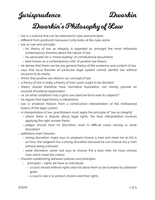
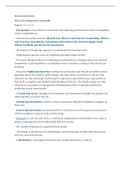
Dworkin’s Philosophy of Law
• law is a science that can be reduced to rules and principles
• different from positivism because it only looks at the rules alone
• law as rule and principle:
• his theory of law as integrity is regarded as amongst the most influential
contemporary theories about the nature of law
• he advocates for a “moral reading” of constitutional documents
• best known as a contemporary critic of positive law theory
• he denies that there can be any general theory of the existence and content of law
• says that local theories of particular legal system cannot identify law without
recourse to its merits
• thinks that positive law distorts our concept of law
• a theory of law is really a theory of how cases ought to be decided
• theory should therefore have normative foundation, not merely provide an
account of political organization
• i.e. on what conditions may a govt use coercive force over its subjects?
• he argues that legal theory is interpretive
• law is whatever follows from a constructive interpretation of the institutional
history of the legal system
• in interpretation of law, practitioners must apply the principle of “law as integrity”
• where there is dispute about legal rights, the best interpretation involves
applying the right answer thesis
• judges should have no discretion, even in difficult cases (strong vs weak
discretion)
• definitions from Dworkin:
• strong discretion: major says to sergeant choose 5 men and meet me at HQ in
an hour, the sergeant has a strong discretion because he can choose any 5 men
without being criticized
• weak discretion: same, but says to choose the 5 best men, he must choose
men which meet the criteria
• Dworkin establishing between policies and principles
• principles = rights we have as individuals
• a court should enforce rights and not allow them to be trumped by utilitarian
goals
• a court’s role is to protect citizens and their rights
KMB 1 of 5
Dworkin’s Philosophy of Law
• law is a science that can be reduced to rules and principles
• different from positivism because it only looks at the rules alone
• law as rule and principle:
• his theory of law as integrity is regarded as amongst the most influential
contemporary theories about the nature of law
• he advocates for a “moral reading” of constitutional documents
• best known as a contemporary critic of positive law theory
• he denies that there can be any general theory of the existence and content of law
• says that local theories of particular legal system cannot identify law without
recourse to its merits
• thinks that positive law distorts our concept of law
• a theory of law is really a theory of how cases ought to be decided
• theory should therefore have normative foundation, not merely provide an
account of political organization
• i.e. on what conditions may a govt use coercive force over its subjects?
• he argues that legal theory is interpretive
• law is whatever follows from a constructive interpretation of the institutional
history of the legal system
• in interpretation of law, practitioners must apply the principle of “law as integrity”
• where there is dispute about legal rights, the best interpretation involves
applying the right answer thesis
• judges should have no discretion, even in difficult cases (strong vs weak
discretion)
• definitions from Dworkin:
• strong discretion: major says to sergeant choose 5 men and meet me at HQ in
an hour, the sergeant has a strong discretion because he can choose any 5 men
without being criticized
• weak discretion: same, but says to choose the 5 best men, he must choose
men which meet the criteria
• Dworkin establishing between policies and principles
• principles = rights we have as individuals
• a court should enforce rights and not allow them to be trumped by utilitarian
goals
• a court’s role is to protect citizens and their rights
KMB 1 of 5