Psychology A Level Essay Plans/Notes – Gender
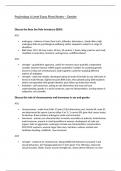
Discuss the Bem Sex Role Inventory (BSRI)
AO1
androgyny - balance of masc/fem traits, attitudes, behaviours ; Sandra Bem, high
androgyny links to psychological wellbeing, better equiped to adapt to a range of
situations
BSRI, Bem 1974, 20 masc traits, 20 fem, 20 neutral, 7 point rating scale for each trait,
classified as masculine, feminine, androgynous, undifferentiated
AO3
strength - quantitative approach, useful for research eg to quantify a dependent
variable, however Spence (1984) argues qualitative is better for analysing gender
(more to it than set of behaviours), both together useful for studying different
aspects of andogyny
strength - valid and reliable, developed asking 50 male 50 female to rate 200 traits in
terms of male/female, highest became BSRI traits, then piloted using 1000 students
which corresponded with gender identity, plus follow up study (test retest)
limitation - self awareness, asking to rate themselves but may not have
understanding, gender is a social construct, open to interpretation, scoring system is
subjective, not scientific
Discuss the role of chromosomes and hormones in sex and gender
AO1
chromosomes - made from DNA, 23 pairs (23rd determines sex), female XX, male XY,
sex determined by sperm (carries either X or Y), Y carries SRY gene that causes testes
to develop, these produce androgens (male sex hormones)
hormones - primary sex characteristics in womb, secondary at puberty; testosterone:
male hormone, present in small quantities in women, devlopment of male sex
organs, links to aggression; oestrogen: female sex characteristics, menstruation,
PMT/PMS; oxytocin: women larger than men, lactation, reduces cortisol and
facilitates bonding, childbirth, ‘love hormone’
AO3
strength - evidence for testosterone, Wang (2000) link between increased T and
sexual behaviour, 227 hypogonadal (low T) men given T for 180 days, improved
sexual function, libido, mood, muscle strength etc, shows direct influence on men
, limitation - social factors ignored, Hofstede (2010) gender roles more social norms
than biology, individualist cultures more masculine (capitalist eg US/UK), social more
important
limitation - reductionist, ignores other explanations, eg cognitive influence of
schema, psychodynamic influence of childhood and interaction with family, more
complex
Discuss atypical sex chromosome patterns
AO1
klinefelters syndrome - 1 in 600 biological males with additional X chromosome
(XXY), physical - reduced body hair, underdeveloped genitals, breast development
etc, psychological - poor language + reading, passive, no interest in sex, problems
with executive functions etc
turners syndrome - 1 in 5000 biological females with absence of X chromosome (XO),
physical - no menstrual cycle, ovaries dont develop (infertile), no breast
development, physically immature etc, psychological - high reading ability, socially
immature, poor spatial skills etc
AO3
strength - nature nurture debate, can see differences between typical/atypical,
differences have a biological basis, innate characteristics have effect on behaviour
strength - real world application, research leads to ealier/more accurate diagnosis,
Herlihy (2011), 87 klinefelters benefited from early diagnosis, increased awareness is
useful
limitation - sampling issue, only severe symptoms identified, picture may be
distorted, Boda (2009) reported following from birth is more accurate (many do not
experience significant issues), may be exaggerated
Outline and evaluate Kohlberg’s theory of gender development
AO1
Kohlberg (1966), cognitive, understading of gender matures with age due to brain
maturation, after stages there is tendency towards gender stereotyping (seeking
evidence)
stage 1 - gender identity, 2/3, identify as boy/girl, can identify others as boy/girl, only
labels, not fixed ; stage 2 - gender stability, 4, realise always stay same gender,
doesnt yet apply to others ; stage 3 - gender constancy, 6, gender is constant across
time/situations, seek gender appropriate role models to identify with and imitate
AO3
strength - research support, Damon (1977), story of a boy playing with dolls, 4 years
said it was ok vs 6 years said it was not, gender stereotyping and constancy
Discuss the Bem Sex Role Inventory (BSRI)
AO1
androgyny - balance of masc/fem traits, attitudes, behaviours ; Sandra Bem, high
androgyny links to psychological wellbeing, better equiped to adapt to a range of
situations
BSRI, Bem 1974, 20 masc traits, 20 fem, 20 neutral, 7 point rating scale for each trait,
classified as masculine, feminine, androgynous, undifferentiated
AO3
strength - quantitative approach, useful for research eg to quantify a dependent
variable, however Spence (1984) argues qualitative is better for analysing gender
(more to it than set of behaviours), both together useful for studying different
aspects of andogyny
strength - valid and reliable, developed asking 50 male 50 female to rate 200 traits in
terms of male/female, highest became BSRI traits, then piloted using 1000 students
which corresponded with gender identity, plus follow up study (test retest)
limitation - self awareness, asking to rate themselves but may not have
understanding, gender is a social construct, open to interpretation, scoring system is
subjective, not scientific
Discuss the role of chromosomes and hormones in sex and gender
AO1
chromosomes - made from DNA, 23 pairs (23rd determines sex), female XX, male XY,
sex determined by sperm (carries either X or Y), Y carries SRY gene that causes testes
to develop, these produce androgens (male sex hormones)
hormones - primary sex characteristics in womb, secondary at puberty; testosterone:
male hormone, present in small quantities in women, devlopment of male sex
organs, links to aggression; oestrogen: female sex characteristics, menstruation,
PMT/PMS; oxytocin: women larger than men, lactation, reduces cortisol and
facilitates bonding, childbirth, ‘love hormone’
AO3
strength - evidence for testosterone, Wang (2000) link between increased T and
sexual behaviour, 227 hypogonadal (low T) men given T for 180 days, improved
sexual function, libido, mood, muscle strength etc, shows direct influence on men
, limitation - social factors ignored, Hofstede (2010) gender roles more social norms
than biology, individualist cultures more masculine (capitalist eg US/UK), social more
important
limitation - reductionist, ignores other explanations, eg cognitive influence of
schema, psychodynamic influence of childhood and interaction with family, more
complex
Discuss atypical sex chromosome patterns
AO1
klinefelters syndrome - 1 in 600 biological males with additional X chromosome
(XXY), physical - reduced body hair, underdeveloped genitals, breast development
etc, psychological - poor language + reading, passive, no interest in sex, problems
with executive functions etc
turners syndrome - 1 in 5000 biological females with absence of X chromosome (XO),
physical - no menstrual cycle, ovaries dont develop (infertile), no breast
development, physically immature etc, psychological - high reading ability, socially
immature, poor spatial skills etc
AO3
strength - nature nurture debate, can see differences between typical/atypical,
differences have a biological basis, innate characteristics have effect on behaviour
strength - real world application, research leads to ealier/more accurate diagnosis,
Herlihy (2011), 87 klinefelters benefited from early diagnosis, increased awareness is
useful
limitation - sampling issue, only severe symptoms identified, picture may be
distorted, Boda (2009) reported following from birth is more accurate (many do not
experience significant issues), may be exaggerated
Outline and evaluate Kohlberg’s theory of gender development
AO1
Kohlberg (1966), cognitive, understading of gender matures with age due to brain
maturation, after stages there is tendency towards gender stereotyping (seeking
evidence)
stage 1 - gender identity, 2/3, identify as boy/girl, can identify others as boy/girl, only
labels, not fixed ; stage 2 - gender stability, 4, realise always stay same gender,
doesnt yet apply to others ; stage 3 - gender constancy, 6, gender is constant across
time/situations, seek gender appropriate role models to identify with and imitate
AO3
strength - research support, Damon (1977), story of a boy playing with dolls, 4 years
said it was ok vs 6 years said it was not, gender stereotyping and constancy