Lecture 15
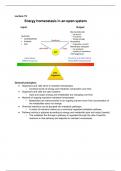
General principles:
● Organisms and cells strive to maintain homeostasis
○ Constant levels of energy and metabolic composition over time
● Organisms and cells are open systems
○ Input and output energy and metabolites are changing over time
● Network of ongoing reactions maintains homeostasis
○ Metabolites are interconverted in an ongoing manner even if the concentration of
the metabolites does not change
● Chemical reactions can be grouped into metabolic pathways
○ A series of reactions makes up a commonly regulated metabolic pathway
● Pathway activity is adjusted according to energy and metabolite input and output (needs)
○ The metabolic flux through a pathway is regulated through the rate of specific
reactions in that pathway and adjusted to maintain homeostasis
,Catabolism and Anabolism
Catabolism - Breakdown of large molecules to release energy and small
molecules
Anabolism - Synthesis of large molecules for storage or biomass using energy
Energy Stuff
Energy storage - Macromolecules such as glycogen (carbohydrate), triglycerides (fat)
and proteins
Energy transport - within the cell or between cells , mostly monomers such as glucose,
fatty acids or amino acids
Energy release - through breakdown of macromolecules = CATABOLISM
Energy storage - through synthesis of macromolecules = ANABOLISM
, The breakdown of larger molecules can release
energy = CATABOLISM (again)
Cellular metabolism generates ATP and
macromolecules
Metabolic pathways
, Metabolic pathways are series of sequential reactions
A metabolic pathway describes a series of reactions.
Each reaction is catalyzed by a specific enzyme.
For example glycolysis:
From Glucose to Pyruvate
The conversion of glucose to pyruvate requires 10 reactions with different
reaction mechanisms, kinetic and thermodynamic characteristics, regulatory
mechanisms, co-factor requirements, side products …
Common types of reactions that make up a metabolic pathway:
- Group transfer reactions: acylation, phosphorylation, glycosylation, catalyzed by
transferases, kinases,
- Oxidations and reductions: often involve NAD+/NADH, NADP+/NADPH as redox
partners. Oxidation and reduction are always coupled. Catalyzed e.g. by
dehydrogenases, oxidases
- Eliminations, isomerizations and rearrangements: Dehydration, formation of
double bonds: Isomerases,
- Reactions that make or break carbon-carbon bonds - The reactions listed are only
examples, there are of course more types of chemical reactions that fit into these
categories.
Metabolic pathways are interconnected in a large network
General principles:
● Organisms and cells strive to maintain homeostasis
○ Constant levels of energy and metabolic composition over time
● Organisms and cells are open systems
○ Input and output energy and metabolites are changing over time
● Network of ongoing reactions maintains homeostasis
○ Metabolites are interconverted in an ongoing manner even if the concentration of
the metabolites does not change
● Chemical reactions can be grouped into metabolic pathways
○ A series of reactions makes up a commonly regulated metabolic pathway
● Pathway activity is adjusted according to energy and metabolite input and output (needs)
○ The metabolic flux through a pathway is regulated through the rate of specific
reactions in that pathway and adjusted to maintain homeostasis
,Catabolism and Anabolism
Catabolism - Breakdown of large molecules to release energy and small
molecules
Anabolism - Synthesis of large molecules for storage or biomass using energy
Energy Stuff
Energy storage - Macromolecules such as glycogen (carbohydrate), triglycerides (fat)
and proteins
Energy transport - within the cell or between cells , mostly monomers such as glucose,
fatty acids or amino acids
Energy release - through breakdown of macromolecules = CATABOLISM
Energy storage - through synthesis of macromolecules = ANABOLISM
, The breakdown of larger molecules can release
energy = CATABOLISM (again)
Cellular metabolism generates ATP and
macromolecules
Metabolic pathways
, Metabolic pathways are series of sequential reactions
A metabolic pathway describes a series of reactions.
Each reaction is catalyzed by a specific enzyme.
For example glycolysis:
From Glucose to Pyruvate
The conversion of glucose to pyruvate requires 10 reactions with different
reaction mechanisms, kinetic and thermodynamic characteristics, regulatory
mechanisms, co-factor requirements, side products …
Common types of reactions that make up a metabolic pathway:
- Group transfer reactions: acylation, phosphorylation, glycosylation, catalyzed by
transferases, kinases,
- Oxidations and reductions: often involve NAD+/NADH, NADP+/NADPH as redox
partners. Oxidation and reduction are always coupled. Catalyzed e.g. by
dehydrogenases, oxidases
- Eliminations, isomerizations and rearrangements: Dehydration, formation of
double bonds: Isomerases,
- Reactions that make or break carbon-carbon bonds - The reactions listed are only
examples, there are of course more types of chemical reactions that fit into these
categories.
Metabolic pathways are interconnected in a large network