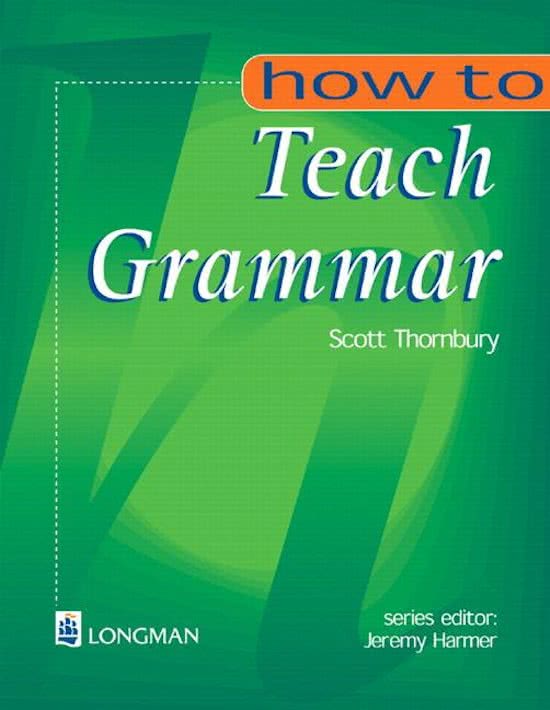
How to teach grammar
Chapter 1 What is grammar?
What is grammar?
* The form of the language > how you put words into structures
e.g. She baked a cake – NOT: baked a she cake.
* Feelings of correctness about a language > competence in that language
What is grammar? Not just structures
- it communicates meaning, as does vocabulary/lexicon
- ‘You?’ Vocabulary/lexically means the person(s) you are talking to, but in grammar it
may mean: ‘What would you like to drink?’
- So what is vocabulary/lexicon and what is grammar?
Different kinds of grammar rules:
1. Prescriptive e.g. use the continuous for actions in progress.
2. Descriptive e.g. the continuous is also used for actions in progress.
Grammar rules can be:
1. Complete rules: true, but complex, complicated, hard to understand.
2. Simple rules: easy to understand, but may lack in information, or even be not
completely true.
3. Pedagogic rules: make sense to learners and helps them when forming sentences, but
are not complete, nor too simplistic.
Pedagogic rules can be two types:
1. rules of form
2. rules of use
e.g. rule of form: the perfect tense is formed with to have.
rule of use: the perfect tense is used to express what started in the past and
continues until now, or the result is still visible.
- rules of use are harder to formulate in easy language.
- giving lots of examples and lots of context helps.
Chapter 2 Why teach grammar?
Through the years grammar teaching has moved from one extreme to the other:
- Heavy emphasis on grammar: Grammar-Translation
- Medium grammar: Audiolingual/direct > Shallow-end CLT
- Zero grammar: Deep-end CLT/Natural approach
What is the state of grammar teaching now?
- Covert (dealing with grammar items that arise) vs overt (explicit) grammar teaching.
- Somewhat more grammar than when CLT started
- Less emphasis on accuracy, more on intelligibility > grammar still needed
Grammar revival:
1. focus on form
2. consciousness-raising
Conclusion: paying attention to form is important as a help to communicate better!
Chapter 1 What is grammar?
What is grammar?
* The form of the language > how you put words into structures
e.g. She baked a cake – NOT: baked a she cake.
* Feelings of correctness about a language > competence in that language
What is grammar? Not just structures
- it communicates meaning, as does vocabulary/lexicon
- ‘You?’ Vocabulary/lexically means the person(s) you are talking to, but in grammar it
may mean: ‘What would you like to drink?’
- So what is vocabulary/lexicon and what is grammar?
Different kinds of grammar rules:
1. Prescriptive e.g. use the continuous for actions in progress.
2. Descriptive e.g. the continuous is also used for actions in progress.
Grammar rules can be:
1. Complete rules: true, but complex, complicated, hard to understand.
2. Simple rules: easy to understand, but may lack in information, or even be not
completely true.
3. Pedagogic rules: make sense to learners and helps them when forming sentences, but
are not complete, nor too simplistic.
Pedagogic rules can be two types:
1. rules of form
2. rules of use
e.g. rule of form: the perfect tense is formed with to have.
rule of use: the perfect tense is used to express what started in the past and
continues until now, or the result is still visible.
- rules of use are harder to formulate in easy language.
- giving lots of examples and lots of context helps.
Chapter 2 Why teach grammar?
Through the years grammar teaching has moved from one extreme to the other:
- Heavy emphasis on grammar: Grammar-Translation
- Medium grammar: Audiolingual/direct > Shallow-end CLT
- Zero grammar: Deep-end CLT/Natural approach
What is the state of grammar teaching now?
- Covert (dealing with grammar items that arise) vs overt (explicit) grammar teaching.
- Somewhat more grammar than when CLT started
- Less emphasis on accuracy, more on intelligibility > grammar still needed
Grammar revival:
1. focus on form
2. consciousness-raising
Conclusion: paying attention to form is important as a help to communicate better!