Biology Unit Test- Study Notes
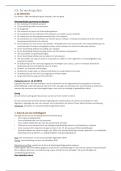
2,1 Plant and Animal Cells
The Cell Theory:
1. All living things are made up of one or more cells and their products
2. The cell is the simplest unit that can carry out all life processes
Organism
No nucleus Nucleus
Prokaryote Eukaryote
E Coli One Cell Many Cells
Single-celled Multicellular
organism organism
Amoeba
animal plant
3. All cells come from other cells; they do not come from non-living matter
2.3 Cell Division
Reasons for Cell Division:
1. Reproduction: amoeba can reproduce by mitosis-cloning themselves
2. Repair: if skin is cut, cells will undergo cell division to fill in the gap
3. Replace: RBC are constantly being regenerated to replace old RBCs
4. Growth: a single fertilized egg undergoes mitosis to lead to a multicelled organism
Diffusion: a transport mechanism for moving chemicals into and out of the cell, from an area of
higher concentration to an area of lower concentration
Osmosis: the movement of fluid, usually water, across a membrane toward an area of high
solute concentration; hypotonic to hypertonic flow
Concentration: the amount of a substance (solute) in a given volume of solution
2.5 Cell Cycle
2,1 Plant and Animal Cells
The Cell Theory:
1. All living things are made up of one or more cells and their products
2. The cell is the simplest unit that can carry out all life processes
Organism
No nucleus Nucleus
Prokaryote Eukaryote
E Coli One Cell Many Cells
Single-celled Multicellular
organism organism
Amoeba
animal plant
3. All cells come from other cells; they do not come from non-living matter
2.3 Cell Division
Reasons for Cell Division:
1. Reproduction: amoeba can reproduce by mitosis-cloning themselves
2. Repair: if skin is cut, cells will undergo cell division to fill in the gap
3. Replace: RBC are constantly being regenerated to replace old RBCs
4. Growth: a single fertilized egg undergoes mitosis to lead to a multicelled organism
Diffusion: a transport mechanism for moving chemicals into and out of the cell, from an area of
higher concentration to an area of lower concentration
Osmosis: the movement of fluid, usually water, across a membrane toward an area of high
solute concentration; hypotonic to hypertonic flow
Concentration: the amount of a substance (solute) in a given volume of solution
2.5 Cell Cycle